


What PTPs and Treating Physicians Must Know to Get Paid
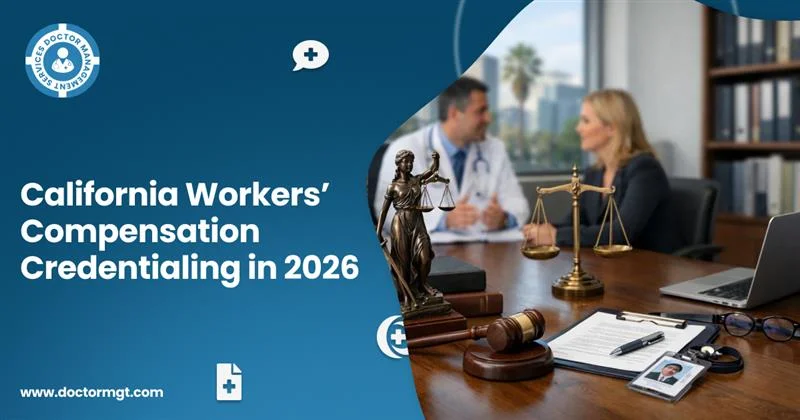
As California Workers’ Compensation (WC) regulations continue to evolve, 2026 brings increased scrutiny on provider credentialing, Medical Provider Network (MPN) participation, and billing compliance.
In the case of Primary Treating Physicians (PTPs) and WC-based practices, effective credentialing is now not only an administrative issue but also directly affects payment, defensibility, and long-term revenue. Many denials and lien disputes that we see in 2026 are not caused by medical necessity issues, but as a result of credentialing and compliance gaps.
Let’s take a look at the latest updates on California workers’ compensation credentialing and see what’s changing for 2026.
Why WC Credentialing Is a Bigger Issue in 2026?
In 2026, workers’ compensation credentialing is becoming a bigger challenge than ever.
Claims administrators and payers are looking over the shoulders of provider eligibility, verifying MPN participation before the payment, and making sure that NPIs, taxonomies, and services billed all fit exactly. They’re also starting to question med-legal and treatment bills much earlier in the process.
For California PTPs, it implies that minor mistakes in credentialing may appear sooner and become more expensive than previously.
How California Workers’ Compensation Credentialing Differs from PPO/HMO (Still a Major 2026 Mistake)
California WC credentialing does not follow CAQH or traditional payer enrollment models.
There is:
- No standardized WC entry portal.
- No automatic acceptance on commercial credentialing.
Rather, WC reimbursement depends on:
- Proper provider setup
- MPN compliance
- Accurate billing structure
- Recognition of claims administrator.
Many physicians who are credentialed with all PPOs continue to be denied WC because of a misinterpretation of this difference.
2026 Core Requirements for California WC Provider Credentialing
-
License, NPI & Taxonomy Accuracy (Now Actively Audited)
In 2026, payers are increasingly validating:
- Active California professional license
- Appropriate NPI usage of Individuals vs Group.
- • Proper taxonomy codes that correspond to WC services.
Note: Even those minor taxonomy mismatches can now trigger:
- Payment holds
- Requests for additional documentation
- Downstream lien disputes
-
Medical Provider Network (MPN) Enrollment – A 2026 Priority
In California, a majority of WC claims fall under Medical Provider Networks (MPNs).
In 2026:
- Claims administrators are verifying MPN participation before releasing the payment
- Treatment outside the MPN without written permission is progressively refused.
- Retroactive MPN corrections are hardly getting accepted
During the case of PTPs, MPN verification should occur at or before the initial visit and not at the time of billing.
-
Claims Administrator & TPA Provider Recognition
WC payments come from:
- Insurance carriers
- Third-Party Administrators (TPAs)
- Self-insured employers
In 2026, the accurate provider setup across these systems is critical. Some of the common red flags include:
- Mismatching of the name or address
- Incorrect tax ID linkage
- Inconsistent NPI usage across bills
These problems postpone payment despite fully justified treatment.
-
EAMS Registration & Med-Legal Compliance (Heightened in 2026)
For physicians involved in:
- Med-legal reporting
- QME-related documentation
- Liens and disputes
It is necessary to identify EAMS accurately and comply with DWC med-legal standards. Providers who were improperly identified will be facing:
- Delayed lien resolution
- Reduced report defensibility
- Increased objections from defense attorneys
-
Workers’ Compensation Billing & OMFS Compliance
Credentialing alone does not guarantee payment.
In 2026, WC billing should be fully consistent with:
- California Official Medical Fee Schedule (OMFS)
- Correct CPT/HCPCS coding
- Proper modifiers and documentation
- WC-specific billing timelines
The submission of billing WC claims, such as commercial insurance, is among the highest causes of lost revenues by PTPs.
Most Common WC Credentialing Mistakes We See in 2026
Many denials, underpayments, and forced lien filings in California Workers’ Compensation cases happen because of simple credentialing and billing mistakes. Common errors include:
- Treating WC patients without confirming MPN status
- Using the wrong NPI structure (individual vs. group)
- Assuming PPO credentialing automatically applies to WC
- Submitting outdated provider demographics on WC bills
- Missing EAMS or med-legal identification
These minor details may lead to severe payment delays and disputes, and it is important to note that proper credentialing and compliance have never been as crucial as it is now.
Why WC Credentialing Is Mission-Critical for PTPs in 2026
Without proper California Workers’ Compensation credentialing, claims can also be denied even when the treatment is medically most important. Payments may be delayed for months, and physicians often have to rely on lien-based recovery.
This can make a practice’s cash flow unpredictable and create unnecessary stress for both providers and staff. For PTPs, credentialing is the foundation of WC billing, collections, and legal defensibility.
Our 2026 California WC Credentialing & Compliance Support
We assist California doctors and Workers Compensation practices with keeping up to date on medical credentialing and billing issues. With our services, your practice is ready to go, legal, and operating efficiently, which allows you to take care of the patient. Specifically, we help you:
- Pre-judge WC credentialing preparation.
- Check and control MPN participation.
- Optimize NPI and taxonomy configuration.
- Match billing to OMFS and WC.
- Reduce denials and reliance on lien-based recovery
We work closely with Primary Treatment Physicians(PTPs), chiropractors, physical therapists, psychologists, pain management physicians, and specialty providers throughout California.
Final Thought for PTPs in 2026
Workers’ Compensation is becoming more regulated, more audited, and less forgiving.
However, the practices that succeed in 2026 are the ones that treat WC credentialing as a strategic priority, not an afterthought.
Ready to Review Your WC Credentialing?
If you treat Workers’ Compensation patients in California, now is the time to ensure your credentialing is 2026-ready.
Contact us today to protect your revenue and reduce WC payment risk.