




Radiology claims get denied more often than almost any other service line in medical billing, and MRI brain scans are a frequent culprit. Saying otherwise, you have no choice but to understand CPT 70553, unless you want to deal with weeks, even months, worth of appeals piling up on your desk, or you want to avoid clean reimbursement.
In this guide, you’ll learn the CPT 70553 description, documentation guidelines, common denials, and how to avoid the back-and-forth and get paid quicker.
What Is CPT 70553?
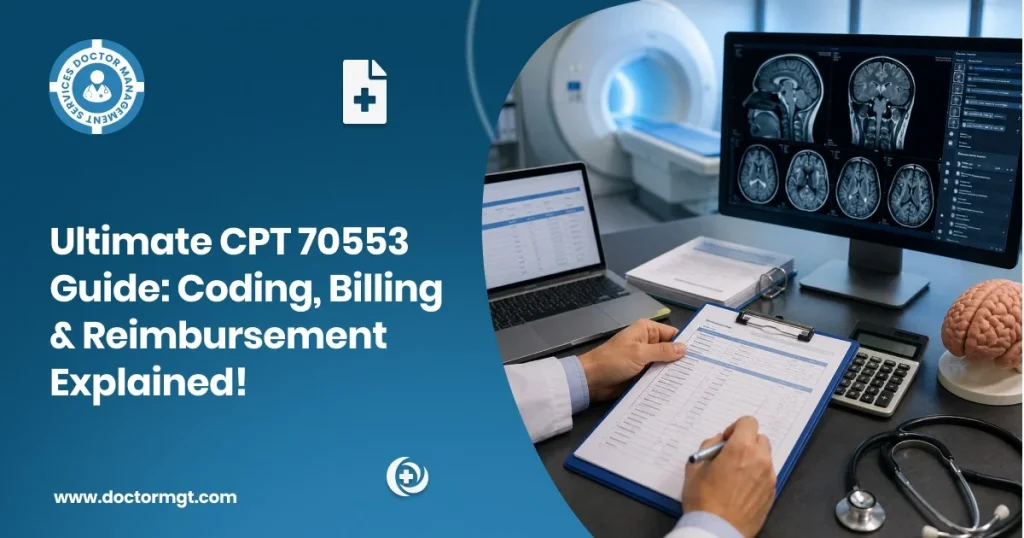
CPT 70553 covers a Magnetic Resonance Imaging (MRI) scan of the brain, including the brain stem, performed without contrast material first, followed by contrast material and additional imaging sequences. In plain terms, the 70553 CPT code description refers to a single combined study that captures both a non-contrast and a contrast-enhanced view of the brain during the same visit.
This distinguishes it from two related codes that billing teams frequently confuse:
- CPT 70551 — MRI brain without contrast only
- CPT 70552 — MRI brain with contrast only
- CPT 70553 — MRI brain without contrast, followed by contrast (the combined study)
Because 70553 bundles two imaging phases into one CPT code 70553, it typically reimburses at a higher rate than either standalone code, but it also comes with stricter documentation expectations from payers, since they want proof that both phases were medically necessary and actually performed.
When Is CPT 70553 Used?
Ordering physicians typically request this scan when a single-phase MRI won’t give a complete clinical picture. Common indications consist of suspected brain tumor, multiple sclerosis investigations, any unexplained neurological disorder, seizure disorders, and assessing and imaging prior surgical sites when it is important to distinguish scar tissue from a recurrence of the disease.
A common ICD-10 code that accompanies this study is R51.9 – headache, unspecified. A contrast-enhanced brain MRI is appropriate if headache is associated with the following symptoms by most payer policies: red-flag symptoms, sudden onset, neurological symptoms, vision change, or significant change in headache pattern; but not if the headache is just a complaint. Claims with no other diagnosis than r51.9 are a cause for concern for billing teams, as payers are becoming more diligent in checking the medical necessity of these claims before reimbursing them.
Other diagnosis codes frequently associated with CPT 70553 are those for brain neoplasms, demyelinating disease, and post-craniotomy follow-up. One of the easiest ways to avoid a denial before a claim is made is to include a diagnosis that adequately covers the need for contrast with the CPT code.
Reimbursement and Medical Necessity Requirements
Reimbursement for CPT 70553 is very dependent on the clear medical necessity of the contrast phase in particular, as seen by the payer. The ordering provider is not just asking for “a complete picture” – the documentation should make it clear why the ordering provider thinks a non-contrast study alone is not enough.
Strong documentation typically includes:
- The specific clinical question the scan is meant to answer (rule out tumor, evaluate demyelination, assess post-op changes, etc.)
- Relevant history, prior imaging results, or lab findings that support escalation to a contrast study
- Any neurological exam findings tied to the presenting symptom
Both Medicare Administrative Contractors (MACs) and commercial payers typically will require prior authorization for CPT 70553, especially for outpatient imaging centers. This is one of the most frequent and easiest-to-avoid excuses for outright claim denial. Reimbursement rates also differ by place of service (POS), and the modifier for the place of service on the claim is just as important as the actual CPT code.
Common Billing Errors and Denial Triggers
A few recurring mistakes account for the majority of denials tied to this code:
First, mismatched or vague diagnosis coding is the biggest offender. Billing 70553 against a nonspecific code like r51.9 without supporting neurological documentation almost guarantees a request for records or an outright denial.
Second, the codes 70553 and 70551 or 70552 are bundled together with NCCI (National Correct Coding Initiative) edits. As 70553 is the combined study. The three codes can be submitted together and will be marked redundant.
Third, prior authorization is a major source of clean claim rejection, particularly for brain MRI studies. As commercial payers have been more rigorous about their utilization management (UM) policies in recent years.
Last but not least, incomplete radiology reports – where the non-contrast portion is not reported with the contrast portion – can cause the payer to believe that the complete combined study was not performed. Which can lead to a downcode to 70551 or 70552.
Best Practices for Clean Claims
The key to getting CPT 70553 paid the first time, correctly, is a few straightforward habits. Confirm prior authorization prior to scan, NOT after the scan. Ensure that the ordering diagnosis is well supported by both phases of imaging. Particularly for a working diagnosis as general as r51.9. Review the radiology report to confirm that the entire two-phase study was captured. And to be sure that coders are not accidentally breaking it out into individual line items when filing a claim.
Practices that build these checks into their front-end workflow. Rather than catching problems after a denial arrives. Consistently see faster turnaround and fewer appeals on radiology medical billing claims overall.
Why Accurate Radiology Coding Matters Beyond Reimbursement
Getting CPT 70553 right isn’t just about revenue. Diagnosis-to-CPT alignment also protects practices during payer audits, supports medical necessity if a claim is ever reviewed. And keeps a clean compliance record for both the ordering physician and the imaging facility. In a specialty as scrutinized as radiology, accuracy at the coding level is really a form of risk management.
This is where experienced medical billing and coding support makes a measurable difference. After a denial letter arrives.
Final Thoughts
When used correctly, CPT 70553 is a valuable code; however, it requires precision. It’s a process that starts with diagnosis pairing, moves to prior authorization, and ends. With the proper documentation of the reports. Each step is critical to full and timely reimbursement. Denials and underpayments of claims for brain MRI may be recurring if your practice is experiencing them. So it’s worth considering a billing team audit of your current workflow to help you save some of that revenue.