


Let’s start with a simple question: did you know that healthcare practitioners in the United States send billions of insurance claims every year? Any single inaccuracy, even a small mistake on a claim form, can trigger a delay in payment and cost a practice a significant amount of money to rectify and re-file.
That is where the knowledge of payer IDs becomes crucial to all the providers. But when you operate a medical practice, a surgery center or clinic, or an outpatient care facility, you have already come across claims that were refused, either immediately or later, because of inaccurate payer information.
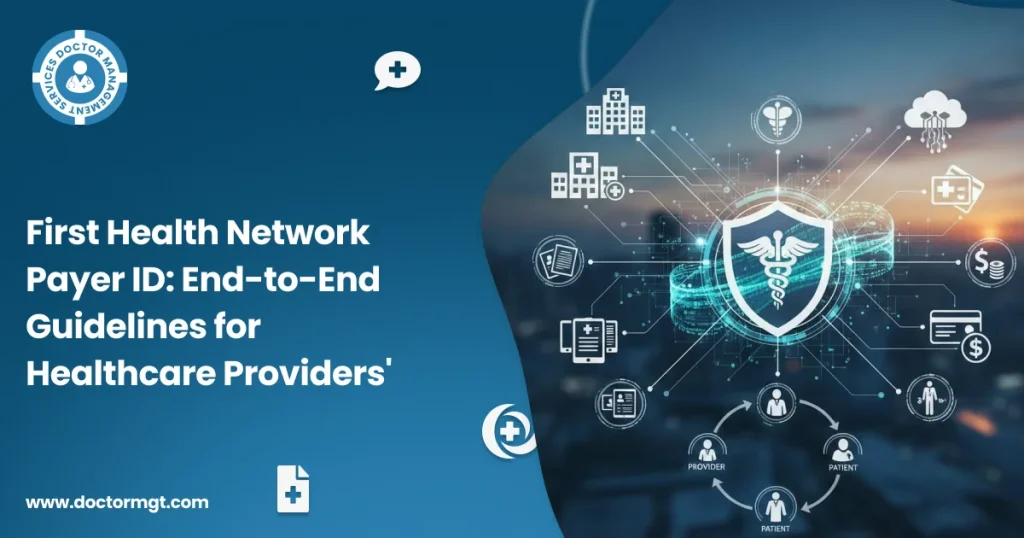
The first health network payer ID is one of the most frequent causes of confusion, a coded identifier applied during electronic transactions to make sure that the claims are sent to the right insurance company.
However, one common source of confusion is the First Health Network Payer ID, a coded identifier used in electronic transactions to ensure claims reach the correct insurer.
This blog is a complete guide for providers and billing teams who want to make sure their claims hit the right target the first time. We’ll also cover related billing rules and best practices that keep your cash flow running.
What Is a Payer ID and Why Does It Matter?
The electronic claims (both professional/1500 and institutional/UB) are covered by the primary Payer ID of First Health Network, which is 95019.
This ID includes providers of First Health, First Choice of the Midwest, and Confinity. Essentially, all health insurers or plans in the U.S that are subject to electronic claims are classified using a Payer Identification Number.
You may consider it as an address label which indicates the clearing house to which the company should present you with the claim in order to process the claim.
If this payer ID is wrong, even by one digit, the claim can be:
- Rejected
- Sent to the wrong processing queue
- Delayed for manual intervention
Claimed electronically passes through the clearinghouses that relay information on doctors and insurance companies with the help of codes. The right payer ID helps in making the process quicker and reducing additional office work.
First Health Network: A Brief Overview
First Health Network has been an established Preferred Provider Organization (PPO) network that links providers to covered populations in most parts of the United States.
Providers in its network are engaged to serve under certain agreements which specify:
- Reimbursement rates
- Claims filing requirements
- Eligibility checks
The First Health Network Payer ID directs the electronic claims to go through your practice management system or clearinghouse to the processing center at the insurer.
This ID also determines how remittance advice and explanation of benefits (EOB) data are returned to you.
Common First Health Network Payer IDs and Variants
It is not only one ID with all plans and networks involved. According to the sources, the payer ID you utilize can be different depending on the plan administrator or third-party administrator (TPA) relationship.
For example:
Some of the payer ID numbers of First Health Network claims are mentioned as numerical numbers like 38233 or any other numbers that are associated with the clearinghouse routing procedure.
The older or alternative payer IDs, such as 73159, can be seen in older clearinghouse lists, particularly where smaller third-party plans utilize First Health as a network partner.
Important Tip: It is important to check the payer ID on the insurance card of a patient. Insurance schemes are not constant, and misplaced IDs are among the major reasons for claims being rejected.
Where to Find First Health Network Payer IDs
Here are reliable places to look up accurate payer ID numbers:
1. Patient insurance card
This must be the first place to check before making a claim.
2. Provider portals
Claims submission and payer data online portals are available on most insurance companies.
3. Clearinghouse lists
Clearinghouses such as Change Healthcare or Availity maintain searchable payer directories, so you can verify from there also.
Verifying the payer ID before submitting a claim is not a luxury; it’s a necessity if you want to avoid wasted staff time and lost revenue.
Basic Criteria of Electronic Claims Submission!
Electronic filing is the common procedure in the industry. Electronic claims are quicker, more dependable, and have little chance of misplacement as opposed to paper.
To submit electronic claims correctly:
- Enter the correct First Health Network Payer ID from the insurance card.
- Use standard claim forms like CMS-1500 (for professional providers) or UB-04 (for institutions and hospitals).
- Include required identifiers such as the NPI (National Provider Identifier), accurate patient details, and service dates.
The HIPAA regulations require all standardized formats of electronic transactions, such as X12 837, that are used in claims. Such standards must be embraced by practices in the submission of electronically submitted practices.
Eligibility Verification Before Claim Submission
- Please verify your patient coverage and that the service is in network under the First Health contract before you bill
- Use the payer’s toll-free number when available.
- Log in to the provider portal for eligibility and benefit details.
- Some clearinghouses also offer real-time eligibility checks that integrate with practice management systems.
This step can prevent denials due to out-of-date enrollment or services that require prior authorization. Electronic eligibility tools simplify the Medicare verification process for providers, reducing claim rejections and administrative burden.
How does the First Health Network Payer ID Affect Claim Types?
Claims of different kinds need to pay special attention to the payer ID:
Professional Claims (CMS-1500)
For office visits and provider services:
- Write the appropriate payer ID in the appropriate section on the claim form.
- Make sure that the provider has the right NPI, taxonomy code, and service codes (CPT/HCPCS).
Institutional Claims (UB-04)
For facility charges such as surgery centers or hospitals:
- Make the same payer ID on the revenue and diagnosis policy.
- Add the correct bill type and discharge status where necessary.
Getting these details right ensures your claims don’t bounce back with edits.
Common Claims Issues and How to Avoid Them
Mistakes in claims often lead to denials, appeals, or extra work. The typical pitfalls include:
- Incorrect payer ID. This alone can cause rejection.
- Mismatched NPI or Tax ID numbers. Ensure your identifiers match your contract.
- Missing service details. Diagnosis codes (ICD-10) and procedure codes must reflect actual service.
Consistency matters; review claims before submission to catch simple errors early.
Key Laws and Compliance Requirements
U.S. healthcare billing is highly regulated. The major compliance requirements are:
HIPAA Transaction Standards:
All electronic health transactions should be of standard form of claims and remittance advice.
National Provider Identifier (NPI):
It is a mandatory law that providers must use NPIs in standard claim transactions.
Coding Standards:
It requires CPT, HCPCS, and ICD-10 code sets to specify services and diagnoses. Knowledge of these laws not only helps you stay within the law but also avoids legal and financial traps.
Reduce Your Billing Stress with Expert Claim Support
The workflow of billing and turnaround of claims can be hectic. Organizations, such as Doctors Management Services, take all of your headaches away to enable you to concentrate on treating patients. Their services include:
- Claims submission support, ensuring correct payer IDs are used
- Automated eligibility verification
- Tracking remittances and correcting denials
- Reporting on revenue cycle health
With external expertise, the practices will in turn be in a position to minimize overhead, rejections, and concentrate more on patient care than paperwork.
Getting Payment Status and Follow-Up
After you have provided a claim with the right First Health Network payer ID, you can view the status of your claim by:
- Provider portals
- Clearinghouse dashboards
- Dedicated payer support lines
Follow-up is most important. Missing documentation claims are sometimes pending or need further follow-up. Sealing this loop in a short period of time makes a great difference in cash flow.
Handling Denials and Appeals
A denied claim doesn’t have to mean loss of revenue. Here’s what to do:
- Read the Explanation of Benefits (EOB). Understanding the reason for denial helps you fix the issue.
- Correct and resubmit. Fix errors and attach supporting documents if needed.
- File an appeal. In case you think that a claim has been unfairly rejected, refer to the process of appeal of a payer in accordance with your contract with the insurer or on the site of the insurer.
Denial management is good to enhance your general revenue cycle performance.
Real-World Tips from the Provider Community
Providers often share practical advice:
- Double-check payer IDs on every claim.
- Train staff to verify eligibility before service.
- Track remittance advice daily.
- Document communications with payers for audit trails.
A proactive approach reduces stress during insurance billing cycles.
Final Thoughts: Get It Right the First Time!
A correct payer ID is more than a number, but it is your access point to payment. Insurance networks and codes may be a little technical, but a little knowledge of these basics will yield benefits in the form of fewer delays, resubmissions, and healthier practice finances.
Remember:
- Verify payer IDs from the insurance card.
- Use standardized claims formats.
- Track eligibility and denials closely.
- Consider supplemental billing support if needed.
With the right systems and attention to detail, you can make sure that First Health Network Payer ID works for you, not against you.
FREQUENTLY ASKED QUESTIONS
-
What is the payer ID for First Health Network?
The most searched and commonly used payer ID for First Health Network is 95019 for electronic claims. However, some plans may use different IDs, so providers should always confirm from the patient’s insurance card or clearinghouse.
-
How do I find the correct First Health Network payer ID?
The easiest way is to check the patient’s insurance card. You can also verify through provider portals or clearinghouse payer lists like Availity or Change Healthcare to make sure the ID is current.
-
What happens if I use the wrong payer ID on a claim?
Using the wrong payer ID can cause claim rejection, payment delays, or routing to the wrong insurer. This often leads to resubmissions and slower reimbursements.
-
Does First Health Network have multiple payer IDs?
Yes. First Health works with different third-party administrators and health plans, so payer IDs can vary. Always verify for each patient instead of relying on old records.
-
Is First Health Network an insurance company or a PPO network?
First Health Network is a PPO network, not a direct insurance company. It connects providers to various insurance plans, and claims are usually processed by the insurer or plan administrator.