


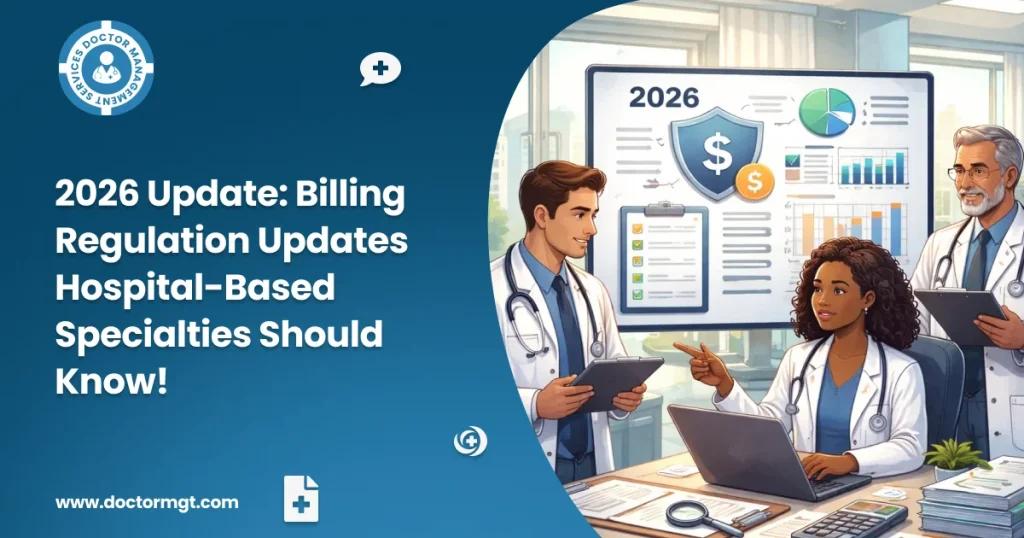
For hospital-based specialty services, it is no longer a choice to be ahead of the changes of the regulations imposed by CMS but rather a mission-level decision. The changes provided by the CY-2026 regulatory cycle of CMS introduce modifications in payment math, site-of-service regulations, quality reporting, and documentation demands, all of which affect the payment of hospital-based specialists and the preservation of claims.
In this article, we’ll unpack:
- Adjustment of payment rate and conversion factor.
- Policy changes in site-neutral settings and in outpatient settings.
- The updates are quality and reporting measures of hospital related specialties.
- Documentation, coding, billing implications.
- Next steps to be taken now.
1. Payment Rate & Conversion Factor Changes
Among the initial items that the hospital-based specialties need to revise is the expected reimbursement in 2026, regardless of the Physician Fee Schedule (PFS) and the Outpatient/ASC payment systems.
Physician Fee Schedule (PFS) Highlights
- CMS-1832-P, a proposed rule (CY 2026 PFS) on July 14, 2025, is a change in payment of services of physicians and other healthcare practitioners; it becomes effective on January 1, 2026.
- Starting from calendar year 2026, CMS proposes two separate conversion factors beginning CY 2026: one for qualifying Advanced Payment Model (APM) participants (QPs) and another for physicians/practitioners who are not QPs.
- According to CMS analysis, the proposed conversion factor is ~$33.5875 for QPs (≈ 3.83% increase from CY 2025) and ~$33.4209 for non-QPs (≈ 3.62% increase).
- However, and critically for hospital‐based specialties, these increases may be offset by efficiency adjustments, practice expense changes, and budget-neutrality constraints, meaning net reimbursement for many procedural services could be flat or even slightly downward.
Hospital Outpatient / ASC Payment System Highlights
- For CY 2026, CMS proposes to increase the OPPS and ASC rates by 2.4% (based on a 3.2% market basket update minus a 0.8% productivity adjustment) for hospitals meeting quality reporting requirements.
- It implies that in the case of hospital outpatient departments (HOPDs) and ASCs, the reimbursement of various services will rise slightly, but the conditions (quality requirements, site-neutral adjustments) are significant.
Why This Matters for Hospital-Based Specialties
- Hospital-based specialties (including hospital-employed cardiology, neurosurgery, interventional radiology and hospitalist medicine) should assess the correspondence between the new PFS conversion factor, and OPPS/ASC rate updates and their service mix.
- An increment of 2.4 per cent on OPPS/ASC would be small when weighed against the possible reductions on site-neutral payment or drug administration policy changes and net margins become susceptible.
- The dual-track reimbursement setting highlights the importance of being clear in billing strategy in the case of specialties that bill under practitioner services in the hospital environment (i.e. employed specialists billing under PFS versus hospital billing under OPPS).
2. Site-of-Service, Site-Neutral & Outpatient Setting Policy Reforms
Coupled with rate adjustments, CY 2026 introduces significant policy changes in point of service delivery and CMS compensation for them compared to the location.
Expansion of Site-Neutral Payments
- The proposed CY 2026 OPPS/ASC rule by CMS is an indicator of increased use of site-neutral payment of some services in hospital outpatient departments (HOPDs), particularly off-campus provider-based departments. As an illustration, the drug administration provided under excepted off-campus provider-based departments can be billed at the relevant PFS rate (not the entire OPPS rate) of estimated savings of approximately 280 million in CY 2026.
- The rule also seeks feedback on the extension of site-neutral payment to the visit of a clinic in on-campus HOPDs.
Removal / Phase-out of the Inpatient-Only (IPO) List
- CMS suggests that 285 procedures will be dropped off the IPO list starting in CY 2026. Most of them are musculoskeletal surgeries that were traditionally in inpatient hospital care; their removal enables such services to be offering in outpatient care or in ASCs.
- In the case of specialty hospital departments (orthopedics, spine, vascular surgery, etc.), it is a major change: the place of care is different, the reimbursement process is different, and internal workflow effects appear.
Outpatient / ASC Covered Procedures List (CPL) Expansion
- CMS suggests amending the ASC Covered Procedures List to add more procedures: 276 procedures under the revised criteria and 271 more codes should be proposed to be removed off the IPO list in CY 2026.
Why This Matters
- In the case of hospital-based specialties, such changes imply reconsidering. The capabilities and/or necessity of services to migrate to outpatient/ASC facilities or vice versa.
- Since the differences in reimbursement rates can be significant between HOPD vs ASC vs physician office, the expansion of the site-neutral payment can undermine the old-fashioned hospital outpatient margins.
- Procedural, finance/RCM, and strategic plan departments need to align internally so that, under the new variable-based environment of more flexibility and greater reimbursement scrutiny, service lines are optimize.
3. Quality Reporting, Health Equity & Documentation-Driven Compliance
Documentation, quality measurements, health equity, and reporting are still highlighting in regulation. Specialties within hospitals should remain on their guard.
Quality Reporting & Health Equity Measures
- Within the CY 2025 OPPS/ASC final rule (that will impact future payment years), CMS adopted the so-called Hospitals Commitment to Health Equity measure starting the CY 2025 reporting period (to be used in payment determination in CY 2027).
- Within the Hospital outpatient Quality Reporting (OQR) Program, all hospitals become required to report on the following categories starting CY 2026 (to be used to calculate payment made in CY 2028): Screening for Social Drivers of Health (SDOH) and the Screen Positive Rate of SDOH.
- In the quality star rating process of the HOPDs in CY 2026, CMS suggests the introduction of 4-star limit on hospitals in the lowest quartile of the safety of care performance and possibly, 1-star decrease by CY 2027.
Documentation / Coding and Billing Workflow Emphasis
- The focus on making documentation accurate is now increased: CMS still underlines that the services that are billed should be based on medical necessity, clearly documented diagnoses, appropriate settings, and a justification of the site-of-service in case of necessity.
- As an illustration, the Quality Payment Program (QPP) and Shared Savings Program (SSP) changes to be implemented in the PFS proposed rule are focused on better documentation, assignment of beneficiaries, and quality standards.
Why This Matters
- Specialty practices that operate in a hospital should make sure that the coding and billing departments are in tandem with the upgraded documentation processes that facilitate the new quality and equity initiatives, as opposed to conventional service-based billing.
- The departments need to liaise with hospital compliance teams to confirm. That outpatient services (HOPD/ASC) are compliant with star-rating quality standards, health-equity standards and site-neutral policy conditions.
- Failing to meet quality reporting or health equity mandates can affect payment update factors. Hospital reimbursement, and risk increased audits or denials.
4. Key Implications for Hospital-Based Specialty Departments
Summing up the abovementioned changes, below are practical implications of the changes in the hospital-based specialties. Including orthopedics-spine, cardiology, interventional radiology, neurosurgery, hospitalist services, and other procedural departments.
ImplicationA: Service Line Review & Site-Migration Strategy
- As the IPO listing items were eliminating and ASC CPL expanded, the specialty departments need to consider. Whether they need to continue doing it at HOPD, switch to ASC, or do it in the physician. Office setting, depending on reimbursement, operating cost, staffing, compliance risk, and patient demand.
- Example: A spine or total joint surgery that was an inpatient before can now be an outpatient/ASC. The cost/reimbursement impact under OPPS vs ASC vs office should be modelles by departments.
ImplicationB: Revenue Cycle Management (RCM) Adaptation
- Under the PFS, coding and billing processes should include adjustments (such as payment neutrality of drug administration in an off-campus environment). And physician/practitioner billing alterations.
- Finance teams should keep track of the way conversion factors and efficiency changes can impact the net payment. Although a headline reimbursement may look greater.
- Billing departments ought to indicate claims. Where the site of service is different, modifiers and place of service codes are proper (e.g., HOPD vs ASC vs physician office), and track payer contracts. On changes owing to these federal regulations.
ImplicationC: Compliance & Documentation Risk Mitigation
- With more focus on documentation, specialty providers and coders based in hospitals should make sure that the records clearly. Underpin site of service, the appropriateness of the procedure, medical necessity, and bundling/unbundling provisions.
- Examples include: Billing a procedure in a HOPD. When it was realizing to now fall under the ASC category will result in review. And documentation needs to be in justification of the reason. The hospital outpatient setting was decides to be using (complexity, comorbidity, hospital resources).
- The specialty departments need to audit their adherence to documentation workflow to align with the quality and health equity requirements. Mandated by CMS that drive payment.
ImplicationD: Strategic Planning and Budgeting
- The medium shifts in payment (2.4% in OPPS/ASC, approximately 3.6-3.8% conversion factor in PFS) might be falling. Behind the inflation rates, staffing expenses, or the cost of technology adoption in the specialty units. In conjunction with site-neutral and quality readjustments, it is necessary to manage the margins effectively.
- Scenario modelling must be part of the strategic planning: What if service migration to ASC is more? What would happen if the payer policies embrace the CMS suggested site-neutral changes? What is the impact of the deficiency of quality reporting on revenue?
- To form dashboards that monitor these variables, departments. Must be in line with the hospital leadership. The RCM partners (such as Doctor Management Services).
Actionable next steps to implement now
In case you are also overwhelming with the current billing updates, and you cannot handle all of them. Never mind, you need not worry anymore. This heavy load of administration can be relieved through the outsourcing of specialized Medical Billing and Coding Services in USA. In this way, you will be able to employ a team of professionals. Capable of dealing with all these requirements on your behalf. And instead focus on what is of the essence, patient care.
Conclusion
The CY 2026 CMS rule-making cycle is a turning point of hospital-based specialties. Although the headline news of an increase in reimbursement (2.4% increase in OPPS/ASC. And approximately 3.6-3.8% in PFS conversion factor) is a relief. The actual change was in the policy changes: site-of-service reclassification, expansion of ASC procedures. This site-neutral payment erosion, and increased documentation/quality compliance.
The hospital-based specialty leaders must see the mandate to be adapt to it proactively. The services should be evaluating regarding their optimal placement. The billing processes and documentation have to be adjusting to the new regime. The risk of compression of the margin should be introduces into the financial planning. In the process, your specialty department is protecting reimbursement and is also positioning to succeed. In a more value-driven, documentation-driven environment.