


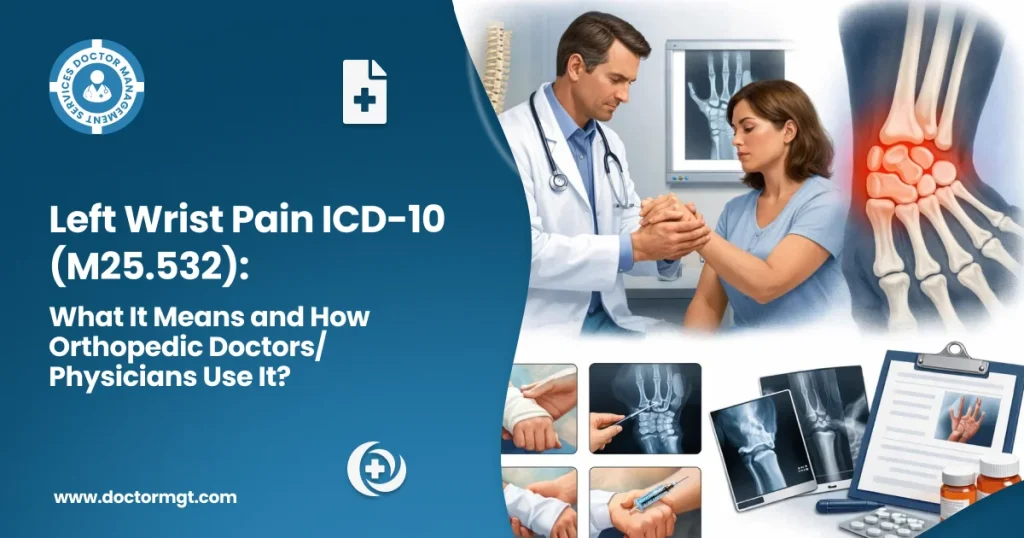
Does it ever occur to you why wrist pain is one of the most common joint complaints that is seen in orthopedic clinics? Our wrist is involved in almost every daily activity, from typing, lifting, cooking, and driving to sports activities; that is why even a small injury can cause serious discomfort.
When patients visit an orthopedic clinic for left wrist pain, doctors do more than just treat symptoms. They assign a specific medical code specify for your pain called Left Wrist Pain ICD-10 (M25.532), which plays a major role in diagnosis and insurance billing.
This code might look like a small technical detail, but it helps healthcare providers organize patient care and receive proper payment for services. Understanding what ICD-10 code M25.532 means can help patients and providers avoid confusion during treatment and billing.
What ICD-10 Code M25.532 Actually Tells Orthopedic Doctors
ICD-10 codes are not just any random numbers that are assigned for billing; instead, each character communicates clinical information. Basically, the M25 category refers to joint disorders that are not linked to a confirmed disease yet.
However, the digits .532 narrow the description specifically to pain in the left wrist joint.
During initial conversation, Orthopedic physicians use this code, especially when symptoms exist but the underlying condition has not been specifically verified through imaging or testing.
As you know, there are 2 types of codes
- Definitive diagnosis codes
- Symptoms-based codes
M25.532 falls into a symptom-based code, which means it reflects what the patient experiences rather than what has been proven medically. This distinction is important because insurance companies allow symptom codes only when a final diagnosis is still under investigation.
Orthopedic providers prefer using M25.532 early in treatment because it allows:
- Immediate documentation of patient complaints
- Faster approval for imaging tests
- Justification for conservative treatment
- A starting point for long-term records
When imaging confirms a fracture, ligament injury, or arthritis, the physician updates the diagnosis code to something that’s more specific.
Why Left Wrist Pain Is Diagnosed Differently Than Right Wrist Pain
Many patients wonder why the ICD-10 system separates left wrist pain from right wrist pain. The difference exists because laterality, i.e., the distinction between left and right sides of the body, matters in orthopedic medicine. Doctors need to know exactly which joint is affected so that they can start working on the injury and avoid treatment mistakes.
Insurance carriers also use laterality to prevent duplicate claims. For example, If the same patient later develops pain in the opposite wrist, for that purpose separate documentation will be required.
Because of this, orthopedic physicians rely heavily on the precise identification that is provided by M25.532.
How Orthopedic Physicians Evaluate Left Wrist Pain Beyond the Basic Exam
Left wrist pain normally seems easy on the surface yet the structure of the wrist makes it hard to diagnose.
The joint consists of eight carpal bones, several tendons as well as ligaments and nerve channels.
Symptoms can be similar to other conditions due to small structural problems. Orthopedic doctors do not rely on physical exams only. They merge several assessment techniques to determine the cause.
- A comprehensive analysis typically involves:
- Functional movement examination
- Comparison of the grip strength of both hands
- Tendon stress testing
- Joint stability checks
- Neurological screening
- Imaging review
Minor traumas like tears in the ligaments may not be detected in ordinary X-rays. Now, for these types of cases, MRI imaging helps the physician find out the real problem. Doctors often continue using M25.532 until a structural abnormality is confirmed.
This protects the accuracy of the patient record.
What are the Hidden Causes of Persistent Left Wrist Pain?
Wrist pain can be experienced longer than patients expect. Most people think that it can be a mere sprain, but the orthopedic doctors often find out that there is more to the problem. Other causes of left wrist pain, which are not well-known, are micro-instability between carpal bones, small cartilage tears, and inflammation of tendon sheaths. These conditions do not necessarily cause swelling, but they can restrict the movement of the wrist.
Other causes that are not evident are:
- Degenerative changes of the joints at the initial stage.
- Strain due to repeated use of mobile devices.
- Minor fall post-traumatic stiffness.
- Tendon friction syndromes
- Occupational vibration exposure.
Wrist strain has become quite an issue in the modern lifestyle. Long hours of keyboard work and handheld devices place continuous pressure on small wrist structures.
Orthopedic physicians often see patients whose symptoms developed gradually rather than from a single injury.
How ICD-10 M25.532 Supports Imaging and Testing Approval
Insurance companies rarely approve advanced imaging without documenting all the medical necessity. But when it comes to the ICD-10 code, M25.532 serves as the official record where symptoms exist, and the investigation is required.
Without a diagnosis code, imaging orders may be rejected automatically.
Orthopedic doctors typically use M25.532 to justify:
- Diagnostic X-rays
- MRI scans
- Ultrasound studies
- Nerve conduction testing
The diagnosis code becomes part of the claim submission and connects medical necessity to the procedure performed.
If documentation is incomplete, imaging approvals may be delayed for weeks.
How Billing Systems Connect to Wrist Pain Treatment
Once treatment begins, every service must match the diagnosis code used during the visit. If a physician documents wrist pain but bills for unrelated procedures, insurance companies may reject the claim.
This is why orthopedic practices rely on professional work rather than wrongly coded documentation.
Many clinics use Doctor Management Services to coordinate scheduling, documentation, and coding accuracy. These services help maintain consistent patient records across multiple visits.
Imaging procedures require special attention. Diagnostic billing services help ensure that MRI scans, X-rays, and other tests are properly linked to ICD-10 code M25.532 so claims meet insurance requirements.
Orthopedic treatment often involves therapy sessions, follow-ups, and specialist consultations. Because of this complexity, many clinics depend on orthopedic medical billing services to manage long treatment cycles without documentation errors.
Without structured billing support, clinics often accumulate Pending medical bills, especially when claims require corrections or additional documentation. These delays can affect both patient accounts and clinic revenue.
Why Early Coding Accuracy Improves Recovery Outcomes
Accurate coding is often seen as a financial issue, but it also affects medical outcomes. When orthopedic physicians document symptoms clearly, treatment decisions become easier to track.
Detailed records help doctors evaluate whether therapy is working or if adjustments are needed.
Accurate documentation supports:
- Faster imaging approvals
- Earlier therapy referrals
- Consistent follow-up care
- Better communication between providers
- Reduced treatment interruptions
It actually gives benefit to the patient when documentation remains consistent throughout the treatment period.
The Long-Term Role of ICD-10 M25.532 in Patient Records
Some patients recover within weeks, while others experience recurring wrist pain. In long-term cases, ICD-10 records become a timeline of the condition.
Doctors can review earlier visits to identify patterns such as recurring inflammation or repeated injuries.
If surgery becomes necessary later, previous records help surgeons understand how the symptoms developed.
Accurate coding also supports occupational injury claims and disability documentation when required.
Final Thoughts
So, what did we learn from this guide?
Left Wrist Pain ICD-10 (M25.532) represents far more than a simple description of discomfort. It serves as the clinical entry point for orthopedic evaluation, diagnostic testing, and treatment planning.
Orthopedic physicians rely on this code to document symptoms accurately while investigating the underlying cause. When documentation and billing processes work together, patients receive faster approvals and fewer delays.
Understanding how M25.532 functions behind the scenes explains why accurate coding remains essential to both orthopedic care and medical billing workflows.
FREQUENTLY ASKED QUESTIONS
-
What is the use of ICD-10 M25.532 in orthopedic practice?
M25532 or ICD-10 is mostly used in order to record the pain in the joint of the left wrist when the cause remains unknown. Orthopedic doctors use this code to substantiate the application of diagnostic imaging tests, to direct the treatment planning stage, and to ensure the proper keeping of patient records at the initial evaluation stage.
-
What is the clinical meaning of distinguishing between pain on the left and the right wrist?
The orthopedic documentation implies laterality. Left and right wrist pain classification will help in the precise planning of treatment, prevent errors during the procedure, and facilitate correct billing. It also helps in ensuring that insurance companies do not receive duplicate claims and also helps physical therapists to target rehabilitation appropriately.
-
Under what situations would M25.532 be substituted with a more specific diagnosis code?
After diagnosing, imaging, or lab tests reveal a conclusive diagnosis, e.g. ligament tear, fracture, tendonitis, or arthritis, orthopedic physicians update the ICD-10 code to indicate the positive diagnosis. This will guarantee the clinical accuracy and adherence to insurance billing policies.
-
What is the effect of proper coding of wrist pain on the insurance approvals and reimbursement?
The proper documentation of left wrist pain using M25.532 is what defines the medical necessity of the procedure, imaging tests, and treatment. This coding is used to handle claims by insurance carriers. Inaccurate coding or ambiguous coding can result in rejected claims, delayed payments, and extra administrative efforts.
-
What is the relationship between the ICD-10 codes, such as M25.532 and orthopedic medical billing services?
The code of ICD-10 is the foundation of orthopedic medical billing services. It monitors that all treatments, imaging, and follow-up visits are duly recorded and billed. Examples of professional billing services that make use of this coding to avoid pending medical bills and work through the reimbursement process include Doctor Management Services and diagnostic billing services.