


Health insurance isn’t just a personal expense; it’s a safety net that protects individuals and families from the unpredictability of illness, hospitalization, and long-term care.
In the United States, the marketplace for private health insurance companies is vast and constantly evolving, remaining one of the world’s biggest hubs for healthcare and medical insurance.
In 2025, the industry is valued at around $1.59 trillion, and it continues to grow by more than 6% annually. If this momentum holds, the market is projected to cross $2.13 trillion by 2030.
Therefore, Medical insurance means that millions of Americans rely on a handful of insurers for critical coverage, making it essential to understand which health insurance company is the best, and who the top health insurance providers are in 2025-2026.
In this blog, we take a close look at the top 10 health insurance companies in the USA, exploring the services that put them in the leadership positions.
Key Metrics for Ranking Health Insurance Companies
Before diving into the list, it’s worth noting that rankings of the largest health insurance companies are generally based on a mix of:
- Market share and enrollment
- Size of provider networks
- Product breadth (individual, group, Medicare/Medicaid)
- Geographic scale
American Medical Association (updated 2026) data shows that the U.S. insurance market is still highly concentrated, and a limited number of insurers dominate a large share of the available coverage options that can be offered to consumers and employers.
What are the important players, and why are you asked? The answer is simple. These health insurers do not merely influence patient access to care; they directly affect reimbursement and the reality of the most critical medical billing and coding. This is why it is important to enroll in the appropriate networks. Cooperation with major payers will be a better way to enhance the rate of claims, increase the money stream, and open the gateway to a wider customer base.
Let’s take a closer look at the major health insurance companies shaping the U.S. market today.
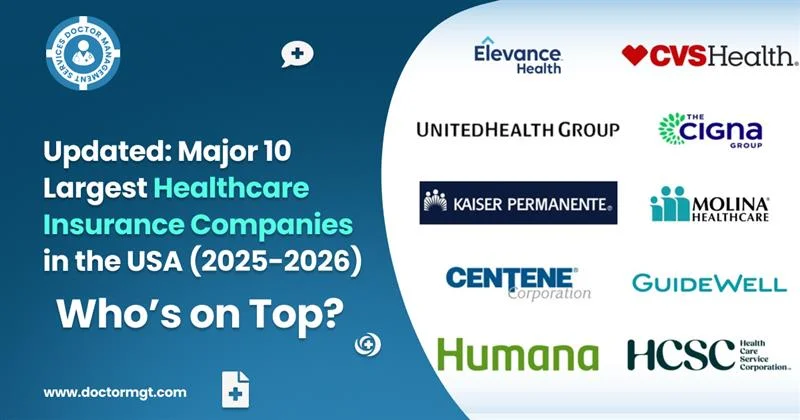
The Top 10 Health Insurance Companies in the USA (2025-2026)
Here is a detailed look at the top 10 health insurance companies in the United States. The companies are often regarded as the biggest health insurance companies based on multiple functions like market presence, financial activity, and policy enrollments.
1. UnitedHealth Group

UnitedHealth Group stands at the forefront as the largest health insurance company in the U.S. Its insurance division, UnitedHealthcare, combines with Optum’s service and healthcare delivery arms to form a broad healthcare ecosystem that goes far beyond traditional insurance coverage.
Why does it lead?
- Largest market share of all U.S. insurers
- Massive provider network and coverage options
- Offers employer plans, individual plans, Medicare Advantage, and Medicaid products
- Optum intelligence and pharmacy services enhance value
UnitedHealth is consistently ranking as one of the top health insurance providers, as it controls over 16% of the market and has approximately $269.45 billion in direct written premiums. For many consumers, its scale and reach make it an appealing choice whether seeking family coverage, group plans, or retiree protection.
2. Elevance Health (Formerly Anthem)
Formerly known as Anthem, Elevance Health is one of the major health insurance companies in the United States, with deep roots in the Blue Cross Blue Shield Association and a nationwide footprint that serves millions of members.
The company operates a wide range of BCBS-branded plans across multiple states and offers commercial health insurance, Medicare, Medicaid, and specialty programs.
Backed by extensive provider networks in many regions, Elevance consistently ranks near the top in both revenue and enrollment, making it one of the top health insurance companies in the USA and an important name to consider when comparing coverage options.
3. Kaiser Permanente

Kaiser Permanente holds 6.01% of the U.S. health insurance market, making it one of the largest insurance payers in the country, according to the latest NAIC data.
What truly separates Kaiser from other health insurance companies is its long-standing integrated managed care structure. With more than 70 years in operation, the organization delivers coordinated care and coverage to over 12.5 million members across eight states.
Rather than contracting with wide, open networks, Kaiser follows a more unified approach. It works closely with a carefully selected group of providers, creating a more focused and tightly coordinated network than most insurance payers.
This system currently includes over 25,000 physicians, more than 73,000 nurses, 40 hospitals, and 600+ medical offices. For healthcare professionals, becoming a Kaiser provider can open access to this integrated care model, though it’s important to note that Kaiser’s credentialing process is largely handled internally.
4. Centene Corporation

Founded in 1984, Centene Corporation holds a 6.74% market share and received nearly $113.19 billion by issuing policies in 2024, called as one of the big health insurance companies. This St. Louis-based private healthcare company manages both government and commercial insurance plans. It also sells marketplace insurance products through Ambetter. Its footprint expanded rapidly through strategic acquisitions and partnerships.
One interesting fact about Centene? It started as a nonprofit Medicaid plan in Milwaukee. However, it now offers healthcare products and solutions to more than 1 individual among 15 people
Centene’s scale in Medicaid and Marketplace programs gives it a unique place among the top health insurance providers in the U.S.
5. Humana

You should also consider enrolling in Humana’s network, as they maintain a powerful position among the largest health insurance companies in the United States by building much of their business around Medicare Advantage and senior-focused healthcare.
A significant portion of Humana’s membership base is based on Americans aged 65 and older, and the company has invested heavily in preventive services, home-based care programs, and chronic condition management.
With the wide range of Medicare and Medicaid plans for over 14.8 million medical members. Humana has collected over $110.55 billion in premium income in 2024, making it one of the biggest health insurance companies.
6. CVS Health / Aetna

CVS Health’s aquired Aetna in 2018, is a major player in the top health insurance companies list.
It offers advanced care solutions, such as pharmacy services and health plans. Moreover, it serves over 36 million people through Aetna. In short, CVS Health is now the sixth-largest health insurance payer with $121.24 billion worth of policies written in 2024.
Even though CVS announced plans to restructure some parts of its insurance footprint, Aetna remains one of the major health insurance companies with a broad market presence.
7. The Cigna Group (Cigna Healthcare)

Cigna brings a strong international background into
the U.S. insurance market, serving both domestic members and multinational employers with healthcare needs that extend across borders. In the United States,
Cigna is widely used by large employers and mid-sized businesses for its expansive provider network on chronic disease management, behavioral health, and pharmacy integration.
It is also one of the largest health insurance companies with a global network of over 2 million healthcare providers, clinics, and facilities. In the U.S., the company serves over 15 million medical and more than 16 million dental customers via public and private employer relationships.
8. HCSC Group

Health Care Service Corporation (HCSC) reported $64.07 billion in policy revenue in 2024, for roughly 3.82% of the U.S. health insurance market.
What truly distinguishes HCSC from other major insurers is its structure. It is the largest customer-owned health insurance company in the United States, giving it a different operational model than most for-profit carriers.
HCSC’s greatest competitive advantage lies in its regional market dominance. As an independent licensee of the Blue Cross Blue Shield Association, it operates leading BCBS health plans across Illinois, Montana, New Mexico, Oklahoma, and Texas.
For healthcare providers in these states, participation often means access to a substantial portion of the insured population and stronger in-network visibility.
9. Molina Healthcare Inc.

Molina Healthcare ranks as the ninth-largest health insurance payer in the United States, holding an estimated 2.14% share of the national market.
Founded in 1980, the company was built specifically to serve government-sponsored healthcare programs, with a strong focus on Medicaid, Medicare, and subsidized health plans. Unlike many commercial insurers, Molina’s core mission centers on improving access to medical insurance in the USA for underserved and economically vulnerable populations.
Today, Molina provides coverage to more than 5.8 million members nationwide, securing its place among the top 10 health insurance companies by enrollment.
In 2024, the company generated approximately $35.84 billion in direct written premiums, reflecting steady expansion across multiple states. For healthcare organizations and independent practices that primarily treat Medicaid and Medicare patients, Molina’s growing network offers direct access to a large and consistent patient base.
Participation in the Molina provider network can be particularly valuable for practices focused on community healthcare delivery.
10. Guidewell (Florida Blue)

Guidewell, formerly known as GuideWell Mutual Holding Corporation, completes the list of the largest health insurance companies in the country.
According to the latest NAIC data, the organization reported $30.71 billion in direct written premiums, representing roughly 1.83% of the U.S. health insurance market. Operating as a nonprofit mutual insurance holding company.
Founded in 2013, Guidewell functions primarily as a regional health insurance organization, with its strongest footprint in Florida and nearby markets. It is the parent company of Florida Blue, one of the most recognized Blue Cross Blue Shield brands in the Southeast. Through its portfolio of health and wellness businesses,
They offer a wide range of insurance products covering individuals, families, employers, and government-linked programs.
Conclusion — Landscape of the U.S.A Health Insurance in 2025-2026
The health insurance market in the United States is clearly defined by a small group of powerful payers. Companies like UnitedHealth Group, Elevance, Kaiser Permanente, and Centene don’t just lead in size; they shape how care is financed, how networks are built, and how reimbursement systems function. For patients, understanding the top health insurance companies in the USA helps narrow choices and compare coverage. For providers, it goes even deeper. These insurers influence the daily realities of medical billing and coding.
But network participation alone isn’t enough to build a stable practice. DoctorMGT thoroughly points out that choosing the right company is not enough, but long-term success also depends on having the essential insurance coverages for medical practices. Professional liability insurance, cyber protection, workers’ compensation, and business interruption coverage are not optional safeguards; they are operational necessities. These protections defend practices against lawsuits, data breaches, workplace injuries, and unexpected shutdowns that can otherwise derail patient care and financial stability.
In a healthcare environment where medical insurance in the USA continues to evolve, informed payer relationships and proper risk protection remain two of the most important foundations for sustainable, patient-centered care.
FREQUENTLY ASKED QUESTIONS
-
What is the best health insurance plan in the USA?
There is no single best health insurance plan for everyone. The best plan depends on your age, health needs, budget, and location. Some people prefer low-cost plans with higher deductibles, while others choose higher monthly premiums for better coverage and lower out-of-pocket costs. The right plan covers your doctors, medicines, and expected medical needs.
-
How much does health insurance cost per month in the U.S.?
The average monthly cost can range from under $100 to more than $600. Prices depend on your age, state, plan type, and whether you qualify for government subsidies. Many people lower their costs through the Health Insurance Marketplace or employer-sponsored plans.
-
What does health insurance usually cover?
Most health insurance plans cover doctor visits, hospital care, emergency services, prescription drugs, mental health care, maternity services, and preventive care like vaccines and annual checkups. Coverage details vary by plan, so it’s important to review what is included before enrolling.
-
What is the difference between HMO and PPO health insurance plans?
An HMO plan usually requires you to choose a primary care doctor and get referrals to see specialists. It often costs less but limits you to a smaller network. A PPO plan gives more freedom to visit specialists and out-of-network doctors, but monthly premiums are usually higher.
-
Can I get health insurance if I’m unemployed or self-employed?
Yes. You can buy health insurance through the Health Insurance Marketplace even if you don’t have a job. Depending on your income, you may qualify for discounts or Medicaid. Self-employed individuals often use marketplace plans for affordable coverage.
-
When can I enroll in a health insurance plan?
Most people enroll during the Open Enrollment period, which happens once a year. You can also sign up during a Special Enrollment Period if you experience a major life change such as losing a job, getting married, having a baby, or moving to a new state.
-
What happens if I don’t have health insurance in the USA?
Without health insurance, you are responsible for paying full medical costs out of pocket. Even a short hospital stay can result in very high bills. While there is no longer a federal fine, some states still have penalties, and being uninsured carries serious financial risk.
-
How do I choose the right health insurance company?
Start by checking which companies cover doctors and hospitals near you. Compare monthly costs, deductibles, prescription benefits, and customer service reviews. The best insurance company is one that fits your medical needs, financial situation, and location.
-
Which health insurance companies are best for people living in California?
In California, many people choose plans from major insurers like Anthem Blue Cross (Elevance Health), Kaiser Permanente, Health Net, Blue Shield of California, and Oscar Health. Kaiser Permanente is especially popular because it offers integrated care with its own doctors and facilities. Blue Cross and Blue Shield plans tend to have wider networks of doctors and hospitals. The best company for you will depend on your budget, where you live in California, and which doctors you want to keep.
-
How do I compare health insurance companies before buying a plan?
To compare companies, start by checking:
• Network size: Do they include your preferred doctors and hospitals?
• Costs: Look at monthly premiums, deductibles, copays, and out-of-pocket limits.
• Plan types: HMO, PPO, EPO, and others have different rules for seeing specialists.
• Member reviews: Customer satisfaction and claim handling ratings can help you avoid frustration.
• Special programs: Some companies offer extra benefits like wellness programs, telehealth, or gym discounts.
You can compare plans online through Covered California if you live in California, or through the Health Insurance Marketplace for other states.