

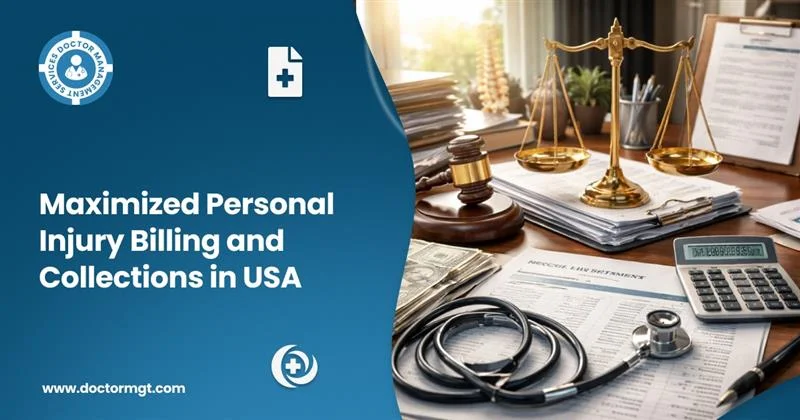
When you hear the term personal injury billing, all the hectic work administration tasks come to mind. But what if someone is there for you to do all the frustrating tasks? One can easily maximize their personal injury billing through outsourcing. It may seem a lot to hear, but once you start outsourcing, there is no going back.
According to the National Library of Medicine, about 36% of U.S. households carry medical debt, and 14.6% have been contacted by collection agencies over unpaid medical bills.
It’s a lot for a provider to take care of a patient and the bills, both at the same time. Staff can help, but what if a patient needs extra help? The staff’s priority will always be the patient.
What Is Personal Injury Billing?
Basically, PI billing is the process of charging and collection payment that are used in medical services provided to patients who are injured in accidents.
Instead of billing insurance right away, healthcare providers treat the patient first and bill against a personal injury case (like a car accident or workplace injury). Payment usually comes after the case settles, which mostly involves attorneys, insurance companies, and lien agreements.
And what about personal injury claims? They can arise from many situations, including car accidents, medical errors, workplace incidents, defective products, slips and falls, and assaults. And all the situations will have different types of billing, even a right-hand minor knuckle crack will have a different code than other hands’ knuckle cracks.
From Intake to Payment: Optimizing the PI Billing Lifecycle
Billing procedure is not an easy task to manage; it involves a long-lasting process that could take years to complete. That’s not it, billing procedure involves all different types of coding, and one has to make sure of the compliance; every detail must be confidential, HIPAA (Health Insurance Portability and Accountability Act) does make sure of that.
Furthermore, the process involves multiple steps. Let’s discuss it below:
1. Patient Intake & Information Collection
During the initial check-up, practitioners will gather patient demographics, accident details, insurance, and attorney details. This is an important step since providers must collect correct billing and payer information prior to services.
2. Insurance & Liability Verification
The provider checks the payer (liability insurance, workers’ comp, or other payer). In personal injury litigation, it is necessary to determine who is the primary payer to prevent wrongful billing.
3. Medical Treatment & Documentation
Throughout the treatment, injuries, services, and medical necessity must be documented by the provider. These are the legal and billing basis of the claim, which are later utilized to justify reimbursement.
4. Medical Coding & Charge Entry
The registered services are coded into standard codes (ICD-10, CPT), and the charges are recorded into the system to generate a billable claim.
5. Claim Creation & Submission
Claims are made based on patient information, codes, and billing information and sent to the relevant payer (insurance or liability entity) to process the claims.
6. Claim Review & Adjudication
The payer examines the claim, checks the accuracy, and makes a decision of approval, denial, or payment modification. This involves validation and internal claim validation.
7. Follow-Ups & Collections
Providers have to follow up, rectify mistakes, or re-file claims in order to get reimbursed in case of late or denied payment. This step is key to maintaining cash flow.
8. Payment Posting & Reconciliation
After receiving a payment (which is usually settled in PI cases), it is posted, balances are reconciled, and any remaining amounts are collected or closed.
Staying Compliant with U.S. Healthcare Billing Regulations
One of the many important things is to stay updated on the billing regulations. SO many questions are solved on their own when you have knowledge of the latest update.
Billing compliance is guided by the Centers for Medicare & Medicaid Services (CMS), along with federal laws like the Health Insurance Portability and Accountability Act and False Claims Act. These regulations require providers to follow strict standards when documenting.
Another key area is patient data protection as its discuss above. Under HIPAA, providers must ensure that all patient information is securely handled and shared only when necessary. This is especially important in personal injury collection cases, where medical records are sometimes shared with attorneys and third parties.
Every bill must be handled carefully, using a standardized coding system like ICD-10 and CPT Errors in these coding will have consequences like claim denials or others.
Strategies to Improve PI Billing and Collections
To improve PI billing or make it less hectic, there are so many options, like having knowledge of every minor and major latest update, having software that helps in coding, or the staff that works 24/7 to help you in billing.
All the above-mentioned solutions are good, but to have everything proper and according to the law, one can always choose to outsource, which automatically makes your personal injury billing less hectic and solves almost all of your billing tasks.
Final Thoughts: Building a Profitable PI Billing System
Building a profitable personal injury (PI) billing system isn’t about doing something extraordinary; it’s about getting every step right, consistently.
The reality is, PI billing is complex. It consists of late payments, legal alignment, strict regulations, and continuous monitoring.
Outsourcing is the most effective option for many providers who want to be sure that all the billing and collections are in the hands of professionals, and your staff have their focus on patients.
In the end, a profitable PI billing system is one that is organized and supported by the right expertise, and outsourcing can help with that. Providers can witness reduced delays, an improvement in the cash flow, and a stressful process becoming a scalable revenue stream.