




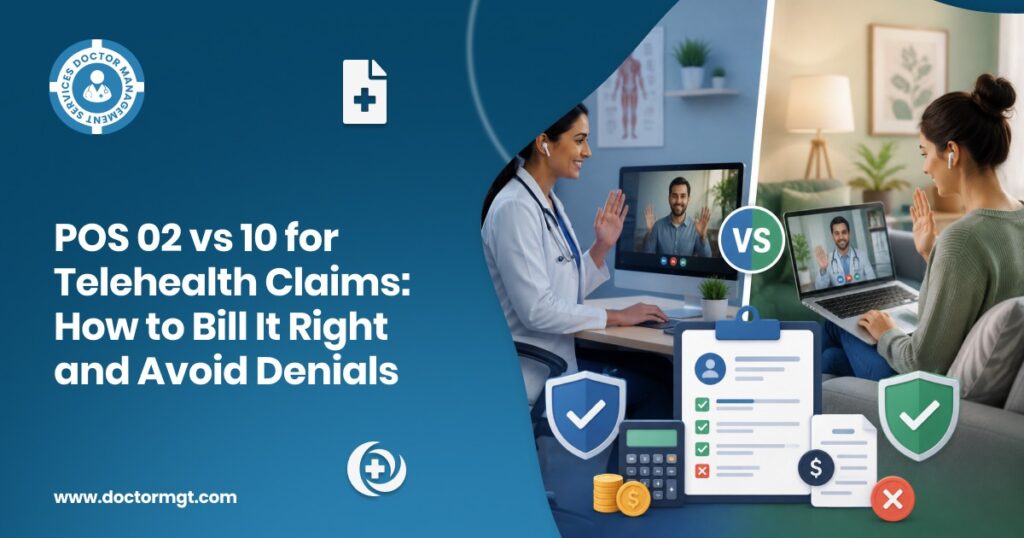
Telehealth billing looks simple until a claim bounces back for the wrong place of service code, and that one detail is often the difference between getting paid and getting denied. For virtual visits, both POS 02 and POS 10 are used, and they mean two different things about the patient’s location at the time of the visit. Even if a clinical note is clean, getting that detail wrong, and pairing it up with the wrong modifier will not make the claim.
The guide to Place of Service (POS) breaks down POS 02 vs 10 in plain terms, explains where modifier 95 fits into the picture, and walks through the denial patterns billing teams run into most often with telehealth claims.
What Is Place of Service Code 02?
Place of service 02 instructs the payer that the patient was seen via telehealth in an offsite location. This may be a hotel room while traveling, a workplace, shelter, or any other environment that the patient selected for the visit other than a home. Before home-based virtual visits were designated as a separate category by payers, there was a code originally used for telehealth (POS 02).
Providers continue to use POS 02 regularly, but it is the one that needs the setting detail. When a patient logs into the video visit from a hotel while traveling on business, it is POS 02. If the patient is at home, POS 10 applies instead.
What Is Place of Service Code 10?
Place of service 10 was designed to specifically record telehealth visits at the patient’s home. It was not in existence prior to 2022 and is added by CMS so it can make it easier for payers to distinguish home-based virtual care from all other types of telehealth visits. With most telehealth visits conducted at home, POS 10 has increasingly replaced POS 02 as the default code billers reach for, POS 02 remains correct, but only when the patient isn’t at home.
The difference isn’t purely cosmetic. A few payers rely on POS 10 as a criterion to identify payments for telehealth services as either facility or non-facility, and a growing number classify the type of telehealth service (facility or non-facility) directly by the patient’s location (at home or not). Even if the claim is processed correctly, a biller can cause a rate difference through billing the wrong one.
POS 02 vs 10: What Actually Changed and Why It Matters
Prior to the development of POS 10, POS 02 was used for all of the patient’s telehealth visits, regardless of where the patient was sitting. That was fine until payers began requesting specific information, especially regarding liability of home health parity rules. Questions on whether a code is covered by a practice expense, questions on location, and questions on payment differentials. Related to the practice expense components of a code.
Now, the only question is where did the patient go during the visit, for POS 02 vs 10? Home means POS 10. Any other place workplace, family, hotel, or community location – is POS 02. Billing teams that don’t see the difference between these will see denial rates rise as this is a common mismatch flagged by the clearinghouses and payer systems and increasingly documented in the medical record as the location of the visit.
Where Modifier 95 Fits into Telehealth Billing
Place of service: shows the location of the patient. Modifier 95 provides information to the payer regarding the mode of delivery of the service, which is a synchronous telehealth service, where the audio and video are real-time. Most payers will require the modifier 95 to go with the correct CPT code and not in lieu of it and correct POS.
Here’s where many arguments break down. A practice could appropriately choose POS 10 for a home visit and not add modifier 95 or add modifier 95 but default to 11 in an in-office template. A POS and modifier 95 match are a confirmation that the visit was truly telehealth and if there is a mismatch, it can be the quickest path to a manual review or even a denial.
Not all payers’ mandate modifier 95 on all of the telehealth codes, and some CPT codes are inherently telehealth only and do not require modifier 95. It’s always best to review each payer’s latest telehealth billing guide before submitting. As these guidelines are updated more frequently than many billing teams anticipate.
POS 02 vs 10 at a Glance
| Detail | POS 02 | POS 10 |
| Patient location | Anywhere other than home (hotel, workplace, shelter, relative’s home, etc.) | Patient’s home |
| Introduced | Original telehealth POS code | Added in 2022 to separate out home-based visits |
| Typical modifier | Modifier 95 for synchronous audio-video visits | Modifier 95 for synchronous audio-video visits |
| Reimbursement impact | Often tied to facility-rate logic depending on payer | Some payers apply non-facility or home-specific rates |
| Common denial trigger | Used by default even when patient was actually home | Payer system not yet updated to recognize the code |
Common Denial Triggers with POS 02 vs 10
The vast majority of POS 02 vs 10 denials are the result of a small number of repeat offenders. The largest one is templates, ehr and billing software default to what the last claim used for pos and it ends up being pos 02 by default and not by design. The second most common problem is missing or incorrect modifier 95, especially when the front desk had just filled out the type of visit and the coder failed to compare that with the type of visit (POS) in the claim.
A third wave of denials arises from payer-specific telehealth policies. A third round of denials stems from payer-specific telehealth policies. Some commercial payers still honor POS 02 and POS 10 at the same rate, others pay differently based upon utilization of POS 02 vs. POS 10, and a few have not yet fully updated their systems to honor POS 10 at all, requiring patients to go back to using POS 02, regardless of where they were. This is an area in which Medicaid programs differ by state, and a policy which might be accepted by one program could be automatically rejected by another.
Documentation gaps complete the list. If the clinical note fails to indicate the patient’s location during the visit. The claim may be audited or questioned for medical necessity and there is nothing in the chart to support the POS being billed. This can be eliminated in most cases by the front end staff asking only one question (where are you today) and recording the answer. Thereby preventing the problem from becoming a billing (after-the-fact) issue.
Payer-Specific Considerations for POS 02 and POS 10
In addition, Medicare accepts both POS 02 and POS 10 and pays for the practice expense portion of each code. Which may sometimes be reimbursed at a different rate (or a lower rate) at home than at the office, depending on the current fee schedule. Medicare Advantage plans may not have exactly the same policy as fee-for-service Medicare, so a claim that is accepted. By fee-for-service Medicare may be rejected by Medicare Advantage with the same POS.
Telehealth policy is even more variable when considering the additional variation caused by Medicaid, as policy is determined at the state level.Texas Medicaid adopted POS 10 for home-based telehealth back in 2022, aligning with CMS.
California’s Medi-Cal fee-for-service program took a different path, it still directs providers to bill POS 02 for all telehealth regardless of patient location, pairing it with separate originating-site and transmission fee codes instead of splitting by home vs. not-home. Teams running medical billing services California providers rely on can’t apply Texas logic to a Medi-Cal claim, or vice versa, the two states solved this differently, not just on different timelines.
The most unpredictable of the three is commercial payers. Some follow CMS guidance very strictly, some have developed claims processing logic that supersedes the approach, and a few still have not implemented claims logic for POS 10.
Documentation That Supports POS 02 vs 10
Always the POS code on a claim should match some specific information in the clinical documentation. The claim is vulnerable if it is ever pulled for review if it is merely seen via telehealth without identifying where the patient is. Best practice is to have the visit note text or the intake record that links to the visit note, indicate where the patient was physically when the visit was made, or home or not.
This is particularly relevant to payers conducting audits specifically for telehealth. Since the number of these has risen with the volume of virtual care. A documented location is more than simply selecting the appropriate point of sale when you bill; it’s a record that proves the point if a payer requests it months later.
How to Choose the Right POS for Each Telehealth Visit?
The decision is simpler than the denial rates suggest.
- Confirm the patient’s physical location at the time of the visit, not their home address on file.
- Match that location to POS 10 if they are home, or POS 02 if they are anywhere else.
- Attach modifier 95 for synchronous audio-video visits unless the specific CPT code is exempt.
- Then check the payer’s current telehealth policy, because a small number of payers still want
- POS 02 across the board or layer their own modifier requirements on top of the CMS standard.
Practices that build this into an intake script, rather than leaving it to the coder to guess after the fact, see fewer telehealth denials meaningfully. It is a two-second question that prevents a rebill weeks later.
Getting Telehealth Claims Paid the First Time
With the ever-changing telehealth billing rules, POS 02 vs 10 is just one of a variety of payers. That have tightened up on the past few years. Outsourcing this piece is typically done because the practice wants to keep clinical staff. From getting involved in billing corrections, and to stay ahead of policy changes. Outsourcing companies, including those offering mental health billing services. Collaborate with providers across specialties to ensure telehealth claims remain compliant. With ongoing payer requirements to reduce claims being reworked due to something as easily correctable as a coding discrepancy.
The Bottom Line
The omission of POS 02 / 10 might seem minor on a claim form, but as telehealth billing moves forward. It will be a detail that payers are keeping a close eye on. A few of the habits that reduce denials and help keep the revenue flowing include. Verifying the patient’s location, matching correct Modifier 95 usage with the appropriate use, and reviewing payer-specific rules prior to submission.
Frequently Asked Questions
1. What is the difference between POS 02 and POS 10?
POS 02 is used when a telehealth patient is located somewhere other than home during the visit. POS 10 is used specifically when the patient is at home. Both codes indicate a telehealth encounter; they differ only in the patient’s physical location.
2. Do I still need modifier 95 if I use POS 10?
Yes, in most cases. POS 10 identifies the patient’s location, and modifier 95 confirms the service was delivered through real-time audio and video. Payers generally expect to see both on the claim for synchronous telehealth visits.
3. Does POS 10 pay differently than POS 02?
It depends on the payer. Some reimburse both codes identically, while others apply different rates or coverage rules based on whether the patient was at home. Checking each payer’s telehealth policy is the only reliable way to confirm this.
4. Why do telehealth claims get denied even with modifier 95 attached?
A mismatch between the POS code, the modifier, and the documented visit location is one of the most common causes. If the clinical note does not confirm where the patient was, or the POS defaults to an in-office code, the modifier alone will not prevent a denial.
5. Is POS 02 outdated now that POS 10 exists?
No. POS 02 is still active and required whenever the patient is not at home during a telehealth visit. POS 10 did not replace it; it simply added more precision for home-based visits.
6. Can POS 02 or POS 10 be used for audio-only telehealth visits?
Sometimes, but the modifier changes. Audio-only visits generally use modifier 93 instead of modifier 95, since modifier 95 specifically indicates synchronous audio and video. The POS code still follows the patient’s location either way, but pairing it with the wrong modifier for an audio-only encounter is a common source of denials.
7. What should a practice do if a telehealth claim was already billed with the wrong POS?
Most payers allow a corrected claim rather than a brand-new submission. The fix involves resubmitting with the accurate POS, verifying the modifier still matches, and referencing the original claim number so it processes as a correction instead of a duplicate.
8. Does POS 10 apply differently for behavioral or mental health telehealth visits?
The POS logic stays the same home means POS 10, elsewhere means POS 02 but behavioral health payers tend to enforce it more strictly because virtual visits make up a larger share of that specialty’s total claims.