

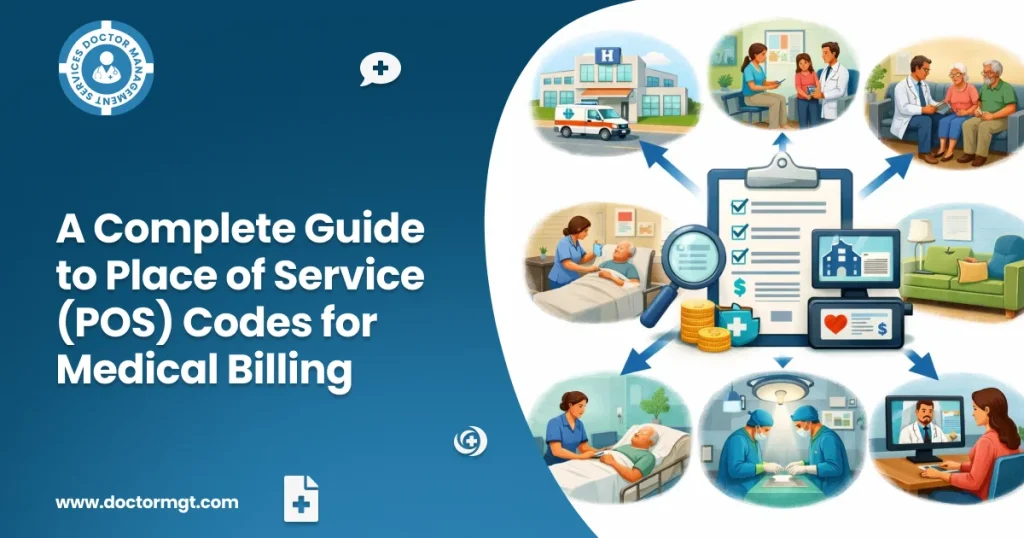
Did you know one small two-digit code on a claim form can actually decide how much a doctor will get paid or if they are going to get paid at all? These small codes are referred to as Place of Service (POS) codes, and many are not aware of the bigger role they play in the medical billing process.
However, when you are dealing with healthcare claims, operating a clinic, or handling the money of a practice, knowledge of POS codes can save time, money, and a considerable amount of stress.
Let’s break everything down in detail.
What Is Place of Service (POS) Codes in Medical Billing?
Basically, Place of Service (POS) codes are two-digit numbers that are used on healthcare claims to show where the medical service occurred. Insurance companies use them to determine:
- How much to reimburse
- Which billing rules apply
- Whether the service fits coverage policies
For example, a checkup done in a hospital is billed differently than the same checkup done in a private clinic. The POS code tells the payer which type of setting was used.
These codes appear on CMS-1500 claim forms and electronic claims. Also, they are standardized by the Centers for Medicare & Medicaid Services (CMS).
Why POS Codes Matter More Than You Think
As we discussed in previous blogs, so many claim denials happen, and one reason for those missing codes is also wrong or missing POS codes. Even sometimes when the treatment and diagnosis are correct, a mismatched location code can become the reason for rejection.
Here’s why these codes are so important:
1. They Affect Payment Rates
Insurance plans often pay different rates, and that depends on location. A hospital visit usually costs more than an office visit, so that’s gonna effects reimbursement too.
2. They Prevent Compliance Issues
Using the wrong POS code can be seen as billing inaccuracy. Repeated mistakes can raise audit risks.
3. They Speed Up Claim Processing
Properly coded POS claims take less time. Fewer delays mean more stable cash flow.
The Most Common POS Code Errors
Even those small POS code slip-ups can turn your clean claim into a denied one.
Many rejections happen not because of treatment errors, but because the service location was entered incorrectly or didn’t match the documentation. These mistakes can quietly slow payments.
Let’s take a look at the mistakes that often lead to denied claims:
1. Using Office Code for Hospital Work
In case a physician treats a patient at a hospital and submits a bill of POS 11 (office), it can be denied by the payer.
2. Mixing Up Telehealth Codes
Now telemedicine has particular POS codes. The payment may be slowed down by the use of old ones.
3. Guessing Instead of Verifying
Other employees consider the place rather than the records. That guess can be costly.
4. Not Updating Code Changes
CMS occasionally changes the definitions of POS. New problems can arise because of the old ones.
Major Guide to Place of Service (POS) Codes
The following is a brief and simplified list of the most frequent POS codes in medical billing. These codes indicate to insurers where a service was performed, and this has a direct impact on payment and approval of claims. Use this guide as a handy reference to avoid coding mistakes and speed up reimbursements.
Office & Clinic Settings
These are the codes used most by private practices and outpatient providers.
|
POS |
Place |
When It’s Used |
|
11 |
Office |
Regular doctor visits |
|
17 |
Walk-in Retail Clinic |
Pharmacy or store clinics |
|
49 |
Independent Clinic |
Stand-alone clinics |
|
50 |
FQHC |
Community-based health centers |
|
71 |
Public Health Clinic |
Government-run clinics |
|
72 |
Rural Health Clinic |
Rural provider locations |
Home & Living Facilities
Used when patients receive care where they live.
| POS | Place |
When It’s Used |
|
12 |
Home | Care at the patient’s house |
|
13 |
Assisted Living |
Assisted living communities |
|
14 |
Group Home | Group housing care |
|
31 |
Skilled Nursing Facility |
Medical nursing care |
| 32 | Nursing Facility |
Long-term nursing homes |
|
33 |
Custodial Care |
Non-medical living care |
| 34 | Hospice |
End-of-life care settings |
Hospital & Emergency Care
For services tied to hospital systems.
| POS | Place |
When It’s Used |
|
19 |
Off-Campus Outpatient | Hospital-owned, off-site |
|
21 |
Inpatient Hospital | Admitted patients |
| 22 | On-Campus Outpatient |
Hospital outpatient dept |
|
23 |
Emergency Room | ER visits |
| 24 | Ambulatory Surgical Center |
Same-day surgery |
| 25 | Birthing Center |
Labor & delivery care |
Telehealth & Virtual Care
Telemedicine has its own rules now.
|
POS |
Place | When It’s Used |
| 02 | Telehealth (Not Home) |
Patient outside the home |
| 10 | Telehealth (Home) |
Patient at home |
Transport & Mobile Services
Used when care is on the move.
|
POS |
Place |
When It’s Used |
|
15 |
Mobile Unit | Mobile clinics |
| 41 | Land Ambulance |
Ground transport |
| 42 | Air/Water Ambulance |
Helicopter or boat |
Behavioral & Specialty Care
For mental health and rehab services.
|
POS |
Place | When It’s Used |
|
51 |
Inpatient Psych | Psychiatric hospital |
|
52 |
Psych Partial | Day programs |
|
53 |
Community Mental Health | Local mental centers |
| 55 | Substance Abuse Residential |
Rehab housing |
| 57 | Substance Abuse Non-residential |
Outpatient rehab |
| 61 | Inpatient Rehab |
Intensive rehab |
| 62 | Outpatient Rehab |
Therapy visits |
Legal and Regulatory Facts About POS Codes
Did you know that POS codes aren’t optional? Federal billing rules actually require them.
Basically, CMS requires accurate POS reporting under Medicare claims guidelines. Submitting incorrect information can be considered improper billing.
In the False Claims Act, it is possible to face penalties when wrong claim data are knowingly submitted. Even though there will be honest mistakes, the chances of repeated ones are subject to scrutiny.
That is why checks and training are necessary.
How to Choose the Correct POS Code
Picking the right code becomes quite easy when you follow a simple method:
Step 1: Confirm Location
Find out where the patient was physically attended to.
Step 2: Review Documentation
Provider notes usually mention the setting.
Step 3: Match CMS Definitions
Compare the location with CMS descriptions.
Step 4: Double-Check Telehealth
There are special rules of virtual care. Determine whether the patient was at home or elsewhere.
How Outsourcing POS Coding and Billing Can Reduce Costly Errors?
Managing POS codes in-house sounds quite simple, but when it comes to reality, it only adds pressure to the busy teams already handling scheduling, eligibility checks, and patient support. One small location mistake can delay or reduce payment.
Outsourcing to experienced billing specialists adds a safety net. They stay updated on CMS rule changes, verify service locations carefully, and scrub claims before submission. This extra layer of review lowers denial rates and keeps cash flow steady.
Instead of constantly fixing rejected claims, your team can focus on patient care while experts handle the billing accuracy behind the scenes.
How Medical Billing Teams Keep POS Codes Accurate?
Strong billing teams don’t leave POS coding to guesswork. They use:
- Regular staff training
- Claim audits
- Updated CMS references
- Internal audit of practice management software
- Clear provider documentation
This is where skilled professionals in medical billing and coding become valuable. They actually understand payer rules, keep track of updates, and reduce costly mistakes.
Simple Tips to Avoid POS Code Denials
- Never copy old claims blindly
- Train front desk to record service locations
- Review telehealth policies often
- Run monthly claim audits
- Keep a POS cheat sheet handy
Small habits make a big difference.
Final Thoughts: POS Codes Are Small but Powerful!
Let’s take a look at what we actually learn from this blog. Now you may have a vague idea that Place of Service codes may look like tiny numbers, but they carry weight. They affect payment, compliance, and claim speed.
When used correctly, they help practices get paid faster and avoid headaches. When ignored, they can slow revenue and invite trouble.
If you handle healthcare claims, learning POS codes is not just helpful; it’s necessary.
Master them, keep updated, and your billing process will run more smoothly.
FREQUENTLY ASKED QUESTIONS
1. How do POS codes affect Medicare and commercial payer reimbursement?
Pos codes determine the amount of fee to charge a claim. Various rates are provided by Medicare and most commercial payers based on whether a service is done at a facility or a non-facility environment. Wrong POS may cause underpayment, recoupment of overpayment, or denial.
2. Are POS codes required on every CMS-1500 claim?
Yes. POS codes are quite mandatory, especially when it comes to professional claims submitted on the CMS-1500 form and electronic equivalents. Missing or invalid POS entries can be the reason for the claim rejections at the clearinghouse or payer level.
3. How do auditors verify POS code accuracy?
Auditors examine POS code on the claim against clinical documentation, scheduling records, and addresses of the facility. When the location of service billed is different than the location where the service was actually provided, that may be identified as a billing discrepancy.
4. When should POS 11 be used instead of outpatient hospital POS codes?
The POS 11 is applicable only when the services are rendered in a non-provider-based physician-owned office. In the case that the clinic is a hospital-owned or provider-based, outpatient hospital, POS codes such as 19 or 22 are usually needed.
5. Where can I get help with POS coding and billing accuracy?
Many practices work with specialized revenue cycle partners to avoid POS errors. Doctor Management Services is one recognized option that helps with POS verification, claim scrubbing, and compliance support, which allows doctors to pay more attention to patients and less to the billing problems.