


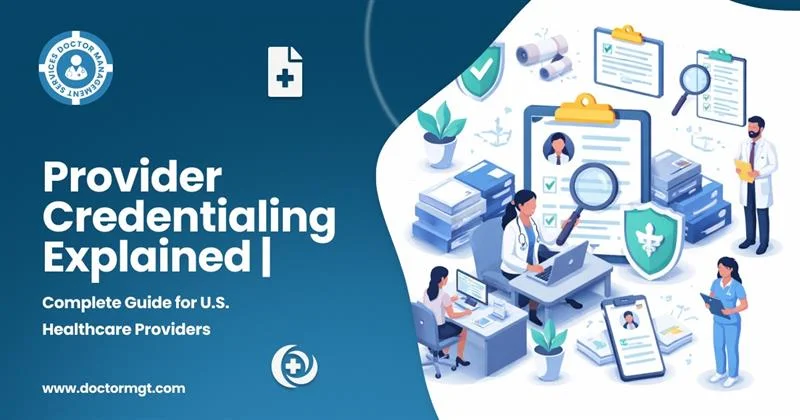
If you’re a healthcare provider in the U.S., you’ve already heard the term provider credentialing more times than you can actually count. But let’s be honest, between patient care, billing, and compliance, it feels like just another complicated process that you have to fulfill.
Credentialing is not only a good practice, but it’s also a requirement set by major regulatory bodies in the U.S. The Centers for Medicare & Medicaid Services (CMS) requires providers to undergo credentialing before they are allowed to bill or get payment under either Medicare or Medicaid. Without it, there could be no reimbursement.
So, let’s break it down in a simple, real-world way.
What Is Provider Credentialing in USA?
Basically, it is the act of ensuring that a medical practitioner is qualified before they can treat patients and receive reimbursement through insurance companies.
This includes checking:
- Education and training
- Licenses and certifications
- Work history
- Malpractice claims
- Board certifications
You can take it as a background check, but much more detailed and strictly regulated.
Why Provider Credentialing Matters More Than You Think?
Credentialing is viewed by many providers as merely paperwork. As a matter of fact, it has a direct influence on your revenue.
Without proper insurance credentialing, you cannot:
- Join insurance networks
- Bill payers like Medicare or private insurers
- Receive reimbursements for services
Any minor credentialing delay can cost the company months of lost income.
- On average, the credentialing process requires 60 to 120 days, depending on the payer.
- Application errors may add 30- 60 days to the approval process.
So yes, getting it right the first time matters.
Healthcare Credentialing: The Bigger Picture
By healthcare credentialing, we are not necessarily referring to individual providers. It’s a system that ensures:
- Patient safety
- Adherence to federal and state regulations.
- Provider, payer, and patient trust.
Credentialing is an essential part of hospitals, clinics, and even telehealth platforms, as without it, they cannot act in accordance with the law and remain efficient.
Now, just think, would you put your life into the hands of a healthcare system that has not checked the providers? Precisely, that is why credentialing is non-negotiable.
Types of Medical Credentialing
Not all credentialing is the same. Let’s simplify the main types of medical credentialing you’ll come across:
1. Provider Credentialing
It is the very first verification of individual healthcare professionals.
2. Insurance Credentialing
This allows providers to join payer networks and bill insurance companies.
3. Hospital Privileging
Hospitals authorize the providers to undertake certain procedures according to their qualifications.
All types have different purposes, yet they all co-exist to ensure the system is running smoothly.
Step-by-Step: How Provider Credentialing Works
Let’s take a look at the actual process of provider credentialing so you know what happens behind the scenes.
Step 1: Collecting Provider Information
This includes:
- NPI number
- State licenses
- DEA registration
- Education and training details
Step 2: Primary Source Verification (PSV)
All details are verified directly at the source, such as the medical schools or licensing boards.
Step 3: Submitting Applications
Applications are sent to:
- Insurance companies
- Medicare/Medicaid
- Credentialing databases like CAQH
Step 4: Review and Approval
The application is reviewed by payers, and this may take weeks or months.
Step 5: Enrollment and Contracting
Upon approval, the provider becomes in-network and is able to begin billing.
Common Challenges in Provider Credentialing
Let’s be real, credentialing isn’t always smooth.
Here are some common issues providers face:
1. Missing or Incorrect Information
A minor mistake is enough to delay the whole procedure.
2. Expired Licenses
Documents that are out of date may result in instant rejection.
3. Slow Response Times
The payers also need more time to process the applications.
4. Lack of Follow-Up
When no one monitors the application, it may remain in the shadows for weeks.
How Outsourcing Medical Credentialing Services Makes Life Easier
When work becomes quite hectic, and you are managing everything yourself, this is exactly where outsourcing medical credentialing services makes a difference.
Instead of handling everything yourself, these services:
- Manage documentation
- Ensure error-free submissions
- Follow up with payers
- Track application status
The result? Faster approvals and fewer headaches.
Practices that outsource credentialing mostly see approval times reduced by 20–30%.
And in healthcare, time literally equals money.
The Role of Physician Management Services
Credentialing does not exist on its own. It is a component of a larger system of operation.
That’s where physician management services step in.
They help with:
- Credentialing and re-credentialing
- Revenue cycle management
- Compliance monitoring
- Practice growth strategies
Think of them as the backbone of your administrative operations.
Providers do not need to multitask, but they can concentrate on their areas of expertise, which is patient care.
Where Virtual Medical Assistant Support Fits In
Now let’s talk about something that’s becoming increasingly popular: the virtual medical assistant.
Credentialing requires a great deal of repetition, such as:
- Data entry
- Document tracking
- Appointment follow-ups
- Communication with payers
A virtual assistant can handle these efficiently, saving time and reducing errors.
Why does this matter?
Because even a small delay in credentialing can affect your cash flow.
A virtual assistant will be able to do these effectively and save time and minimize mistakes.
Insurance Credentialing: Getting Paid Starts Here
Let’s zoom in on insurance credentialing, because this is where revenue actually begins.
Without it:
- Claims get denied
- Payments are delayed
- Patients may have to pay out-of-pocket
And that creates frustration for both providers and patients.
It is always better to begin the process at least 90 days prior to opening a practice or adding a new provider.
Whenever you plan ahead, you can save months of stress.
Re-Credentialing: The Part Many Providers Forget
Credentialing isn’t a one-time process.
Providers have to undergo re-credentialing on a 2-to 3-year basis.
This ensures:
- Licenses are still valid
- No new malpractice issues exist
- Providers remain compliant
Failure to meet a re-credentialing deadline may result in a temporary exclusion from insurance networks.
And yes, that means no payments during that period.
Technology and Credentialing: What’s Changing?
The process of credentialing is changing. Providers are assisted today with the help of digital platforms and automation tools:
- Submit applications faster
- Track progress in real time
- Reduce manual errors
A significant portion of the process has already been made easier by databases such as CAQH.
But here’s the reality:
Even with technology, human oversight is still critical.
How to Avoid Credentialing Delays?
If you want to stay ahead, here are some practical tips:
- Ensure all documents are kept and in order.
- Proofread all applications prior to submission.
- Monitor deadlines of re-credentialing.
- Maintain frequent contact with payers.
- Consider outsourcing to professionals
It is not about doing a lot, it is about doing it right.
Final Thoughts: Why Provider Credentialing Deserves Your Attention
So, where does all this leave you?
Credentialing of the provider is not solely an administrative responsibility, but rather the basis of the financial well-being of your practice.
Without it:
- You can’t bill insurance
- You can’t get paid
- You risk compliance issues
Through the right outsourcing, be it medical credentialing services, physician management services, or the help of a virtual medical assistant, you can make a complicated process a streamlined and predictable system.
And that’s the goal, right?
Less stress. Faster approvals. Better cash flow.