

Did you know that by the end of 2025, more than 90% of medical practices in major healthcare companies fully shifted to digital patient records, completely phasing out the paper chart? Healthcare centers globally have begun using intelligent software to maintain the flow of care without the headaches of paperwork. If you take a look its quite an enormous change in a short span of one decade.
Today, the 2026 Electronic Medical Records (EMR) world is overwhelmed with powerful platforms, and each one possesses its strengths, its history, and its specialty. Regardless of whether you are interested in billing, patient engagement, data analytics, or seamless daily workflow, a system is available to you.
In this guide, we take you through the Top 10 EMR systems of 2026, share what makes them unique, and help you understand which one might fit your practice best.
Why EMR Systems Are a Must for Modern Healthcare?
In today’s healthcare world, paper charts are no longer enough. Electronic Medical Records help:
- Doctors access patient histories instantly
- Clinics reduce errors
- Staff manage schedules and billing with fewer headaches
- Practices comply with privacy and medical laws like HIPAA
Patients remain more active in self-care. The selection of the appropriate EMR has the potential of enhancing efficiency, patient satisfaction, and financial well-being significantly.
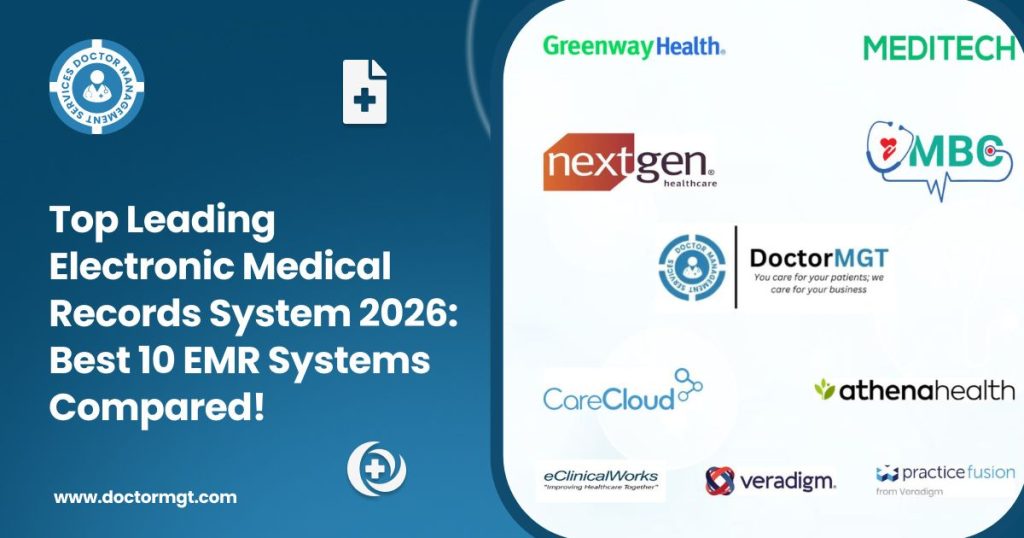
Top 10 US-Based EMR Systems in 2026
Here’s our carefully curated list of the leading EMR platforms based and developed in the United States, both old and new, cloud-first based.
1. Doctor Management Services
Founded in 2011. Doctor Management Services deals with medical billing and coding. It was built by a team of healthcare administrators, who observed how hectic such clinic operations could become.
They simply wanted to develop an EMR that would assist them in creating both clinical records and Doctor Management Services, which are rather hectic to be done by a single individual.
From helping practices manage schedules, staff coordination, patient flow, and documentation that every step requires, they do it all. Not only that, but they also have expertise in Personal Injury, Workers Comp, you said it, they’ve done it!!
What makes DoctorMGT stand out is how it blends medical records with real-world clinic management.
Doctors don’t just chart here; they run their entire practice from it.
2. MedBill Collections

The minds behind MedBill Collections are revenue cycle experts who realized that one major issue in healthcare is unpaid claims.
Unresolved or pending medical bills are the reason why many clinics lose money. It links EMR data to billing processes by displaying the real-time claim status, identifying each denial, and reminding employees of follow-ups.
Practices with a weak cash flow usually resort to MedBill because it clarifies their financial situation.
3. Athenahealth

Athenahealth builds cloud-based EMR and practice management solutions used by doctors and clinicians across the U.S. Its flagship platform,
athenaOne is a combination of billing, claims management, practice analytics, and patient engagement tools. Since it is cloud-native, it does not require significant IT overhead to roll out updates and new functions to clinics.
It is a popular platform among ambulatory practices that desire a hybrid EMR, billing, and patient-engagement system, without the need to heavily configure the server.
4. NextGen Healthcare

NextGen Healthcare produces EMR and practice management software in a broad range of medical and dental specialties.
Their personalized offerings consist of appointment booking, patient records, billing processes, revenue cycle applications, and mobile apps. NextGen also makes an investment in analytics and interoperability to allow practices to connect data between systems.
NextGen is a solid option when small and medium practices need customization and support in a range of different specialties.
5. eClinicalWorks

eClinicalWorks provides a feature-based EMR, which focuses on cloud integration, patient portals, telehealth, and population health solutions.
It’s used by hundreds of thousands of clinicians nationwide. The platform consists of documentation, billing support, automated workflows, and patient engagement modules, and is popular as both a solo practice and larger groups of practices.
6. Practice Fusion

Practice Fusion became a popular web-based EMR solution for small practices.
Following its swift growth in usage in the 2010s, it was purchased by Allscripts and still provides primary care and specialist clinics with charting, e-prescribing, patient portals, and basic medical billing assistance.
Practice Fusion remains an easy-to-use and cloud-based solution that is still the simple EMR preferred by small clinics that do not need complexity.
7. CareCloud

CareCloud (previously known as Medical Transcription Billing Corporation) offers electronic health records and practice management, medical billing, telehealth, and patient engagement solutions.
It positions itself as a full-fledged practice platform, with powerful support of revenue cycle management and cloud access.
CareCloud suits well with practices seeking EMR as well as more comprehensive financial solutions (such as billing and patient communications) in the same location.
8. Veradigm (Allscripts)

The EMR and health IT products of Allscripts are marketed as a business brand, named Veradigm.
As it’s written, Allscripts officially changed its name to Veradigm Inc. in January 2023, a transition that had been underway since 2022 to reflect the company’s broader focus on data, analytics, and its network, while integrating former Allscripts products under the new brand.
The platform provides hospitals, clinics, and extended care organizations with EMRs, patient engagement portals, analytics, and clinical coordination.
Medium practices that require scalable workflows and powerful patient engagement features tend to choose this system.
9. Meditech

Meditech is a relatively old player in the healthcare IT industry; however, it keeps innovating.
However, its Expanse platform supports clinical documentation, medical billing, patient portals, and interoperability across care settings. Meditech systems are commonly found in community hospitals and health systems.
Meditech is a hybrid of hospital-level strength and outpatient assistance, which is why it can be a great solution for mid-sized health systems.
10. Greenway Health

Greenway Health is a provider of EMR, practice management, and revenue cycle services.
It incorporates patient records, appointments, payments, and telehealth in its systems. Greenway specializes in the practices of ambulatory care, particularly in the areas of family medicine, internal medicine, and specialty outpatient care.
Their combined nature assists practices in handling clinical work processes and financial processes simultaneously.
The 2026 EMR Shortlist: Select the System that Will Clicks Less, Not your Revenue!
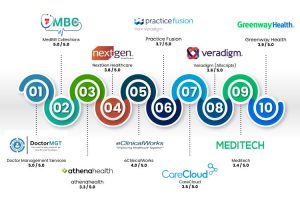
The comparison shows the top EMR software platforms according to user-review scores and is rated in the areas of usability, customer support, feature depth, and value.
Helping healthcare practices quickly evaluate systems and make informed, data-driven technology decisions.
|
Sno. |
EMR Software | Capterra Reviews | Ease of Use | Customer Service | Features | Value for Money |
| 1 | Doctor Management Services | 5.0 / 5 | 4.8 / 5 | 5.0 / 5 | 4.7 / 5 |
5.0 / 5 |
|
2 |
MedBill | 5.0 / 5 | 4.9 / 5 | 5.0 / 5 | 4.9 / 5 | 5.0 / 5 |
| 3 | athenahealth | 3.3 / 5 | 3.3 / 5 | 2.8 / 5 | 3.3 / 5 |
3.0 / 5 |
|
4 |
NextGen Healthcare | 3.8 / 5 | 3.8 / 5 | 3.6 / 5 | 3.8 / 5 | 3.5 / 5 |
| 5 | eClinicalWorks | 4.0 / 5 | 3.9 / 5 | 4.0 / 5 | 3.9 / 5 |
3.8 / 5 |
|
6 |
Practice Fusion | 3.7 / 5 | 4.0 / 5 | 3.5 / 5 | 3.6 / 5 | 4.0 / 5 |
|
7 |
CareCloud | 3.5 / 5 | 3.7 / 5 | 3.4 / 5 | 3.5 / 5 | 3.2 / 5 |
| 8 | Veradigm (Allscripts) | 3.6 / 5 | 3.4 / 5 | 3.3 / 5 | 3.7 / 5 |
3.4 / 5 |
| 9 | Meditech | 3.4 / 5 | 3.2 / 5 | 3.3 / 5 | 3.6 / 5 |
3.3 / 5 |
| 10 | Greenway Health | 3.9 / 5 | 3.8 / 5 | 3.6 / 5 | 3.7 / 5 |
3.8 / 5 |
Stop! These Top 6 Major Things to Read Before Selecting an EMR for Your Practice
When selecting an EMR, a number of factors must always be remembered so that the system can be able to reach your clinical, operational, and financial objectives. Below are the main considerations that need to be made before deciding.
1. Understand Your Practice Needs
Start out by defining your clinical process, administrative process, and billing needs. Having a clear vision of what is actually required within your practice will enable you to choose an EMR that will help you move toward efficiency and not complexity.
2. Establish a Clear Budget
Establish an affordable budget that includes not only the cost of licensing but implementation, customization, training, upgrades as well as the maintenance costs to prevent some unforeseen expenditures in the future.
3. Request Vendor Demonstrations
Ask for live demos from multiple EMR vendors to compare system usability, workflow alignment, and real-world performance in scenarios similar to your daily operations.
4. Evaluate Support and Training
The quality of customer support, response rates, and the presence of onboarding, training materials, and additional support should be revisited to help you easily integrate them into your workforce.
5. Check Interoperability Capabilities
Make sure the EMR is linked with the laboratory, pharmacies, payers, and other healthcare systems so that data can be exchanged correctly and coordinated care.
6. Confirm Legal and Regulatory Compliance
Verify that the EMR does not violate the laws and regulations of the region in healthcare, privacy, and data security to maintain patient information and minimize compliance risks.
Why EMRs Matter Financially, Beyond Patient Records?
EMRs simplify clinical records, yet the systems mentioned above also affect the financial well-being of a clinic. A major challenge in many practices is handling Doctor Management Services and pending medical bills without losing visibility into revenue cycles. Today’s EMRs integrate:
- Insurance claims tracking
- Denial management
- Automated billing alerts
- Patient balance summaries
Such tools simplify the process of reducing unpaid accounts and boosting revenue without forcing clinicians to spend time on them, instead of taking care of patients.
Investment vs. Expense: Final Thoughts on the Right EMR Choice!
In 2026, EMR systems are smarter, more connected, and more essential than ever. Choosing the right one depends on:
- Your practice size
- Specialty requirements
- Budget and IT resources
- Billing complexity
- Patient engagement needs
Whether you’re running a single-doctor practice or a multi-site health system, U.S.-based EMR solutions offer depth, compliance with U.S. laws like HIPAA, strong clinical tools, and financial workflows that help modern practices thrive.
Frequently Asked Questions
-
What is the best EMR system for small medical practices in 2026?
The highest value EMR for small practices is based on simplicity, cost, and support. The popularity of systems such as Doctor Management Services, MedBill, Practice Fusion, and CareCloud is due to their simplicity in workflows, billing integration, and the lack of IT complexity required when working with a team of fewer people.
-
How much does an EMR system cost per month?
EMR costs typically range from $200 to $800 per provider per month, depending on features, billing tools, support, and customization. Additional costs may include setup, training, integrations, and ongoing support, so practices should budget beyond just licensing fees.
-
Which EMR systems include medical billing and revenue cycle management?
Many modern EMRs integrate billing tools directly into the system. Platforms like Doctor Management Services, MedBill, CareCloud, and Greenway Health offer strong billing, claims tracking, denial management, and revenue cycle features to help practices improve cash flow.
-
How long does it take to implement an EMR system?
EMR implementation usually takes 4 to 12 weeks, depending on practice size, data migration needs, staff training, and system complexity. Cloud-based EMRs often deploy faster than on-premise systems with fewer technical requirements.
-
What should I look for when switching from one EMR to another?
When switching EMRs, focus on data migration support, downtime planning, staff training, interoperability, and customer support quality. Choosing a vendor with proven onboarding experience can reduce workflow disruption and ensure a smoother transition.