


Each year, hundreds of healthcare providers are unable to receive reimbursements or face claim denials just because they didn’t confirm patient Medicare eligibility accurately. This may cost practices thousands of dollars in lost revenue and wastage of administration.
The process of verifying Medicare coverage is not just a best practice, but it is also rather critical to the financial well-being and adherence to federal regulations.
Medicare refers to the federal healthcare insurance in the United States that covers individuals who are age 65 years or above, as well as younger adults who are diagnosed with disabilities. Before arranging services, making a claim, or providing treatment, a provider should ensure that the patient has active Medicare coverage.
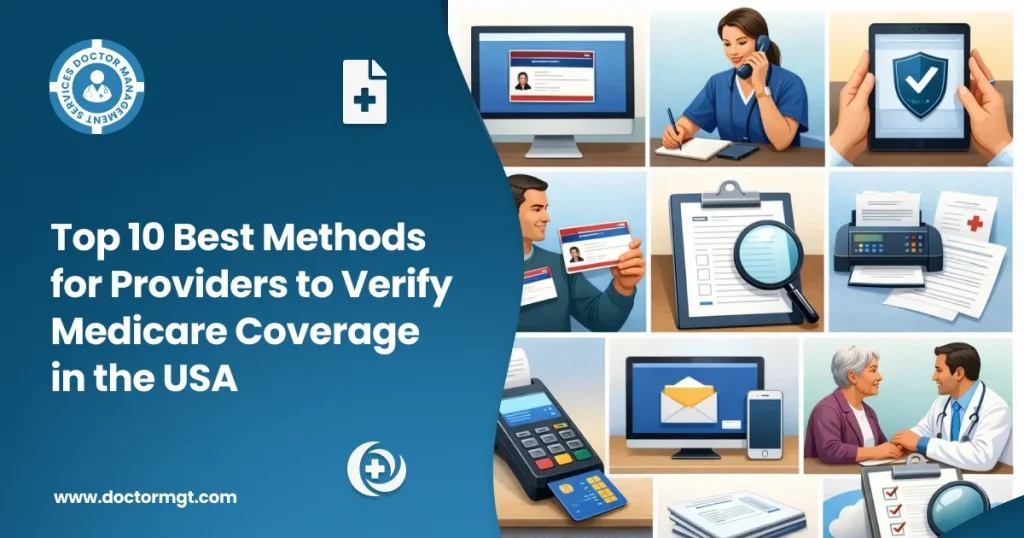
In this article, we explain the top 10 methods that providers can use to verify Medicare coverage. These methods are not only practical but also aligned with the latest guidelines from Medicare and CMS.
Understanding Medicare Coverage
Let’s understand what medical coverage actually is. Afterwards, we will discuss the verification methods.
Basically, Medicare is a federal health insurance program designed primarily for people 65 and older, as well as certain younger adults with disabilities.
Its actual purpose is not to pay all medical bills but assist in reducing the healthcare financial burden. Things such as copayments, deductibles, and services not covered by Medicare but they still the responsibility of beneficiaries.
Medicare is structured into four parts:
Part A (Hospital Insurance)
Inpatient stays in the hospital, as well as some skilled nursing, and they are a part of home health care and hospice care.
Part B (Medical Insurance)
Assists in the payment of doctor visits, doctor care as an outpatient, medical supplies, and preventive services that are not covered by Part A.
Part C (Medicare Advantage Plans)
This class includes the plans provided by private insurance companies that are certified by Medicare, including the benefits of Part A and Part B (and sometimes even more) in one plan.
Part D (Prescription Drug Coverage)
Assists in meeting the cost of prescription medicine, which is imperative to many acute and chronic conditions.
Understanding these parts helps providers know what services are already covered, and it highlights the importance of verifying eligibility before treatment. Using Medicare Administrative Contractors (MACs) and their portals ensures that your billing aligns with the patient’s active coverage.
Top Methods for Providers to Verify Medicare Coverage in the USA
Not all patients have the same levels of Medicare coverage; plans are modified, limits are exhausted, and minor data misstatements can lead to enormous billing issues.
Taking a few minutes to confirm coverage can save hours of rework and protect your revenue. It also gives patients peace of mind about their costs.
To make your day easier and your billing cleaner, explore the practical verification methods below.
1. Use the Secure Provider Online Tool (SPOT)
One of the best and most popular methods through which a provider can check the Medicare eligibility of a patient is the Secure Provider Online Tool (SPOT). With SPOT, a provider can:
- Check Part A and Part B coverage
- Check the deductibles and benefit limits
- Locate the Medicare Beneficiary Identifier (MBI)
- View claim status in forward and backward for up to 12 months
The SPOT can be accessed 24/7 and draws data directly out of Medicare databases, so the information will be up-to-date and precise.
2. Check via the HIPAA Eligibility Transaction System (HETS)
To verify the eligibility in real-time, lots of practices are linked to the HIPAA Eligibility Transaction System (HETS).
HETS supports electronic eligibility queries with X12 270 requests and provides the responses with comprehensive coverage information (a 271 response). This includes:
- Part A/B entitlements;
- Medicare Part D details;
- Remaining benefit days for skilled nursing or hospital care.
This approach is particularly applicable to a big health facility with billing software that is capable of automating the process.
3. Verify Using Medicare Administrative Contractor (MAC) Portals
Medicare Administrative Contractors are responsible for the process of Medicare claims and checking the eligibility with regard to various regions of the United States.
Every MAC provides a secure online portal in which providers can:
- Submit eligibility queries
- Check status of patient coverage
- Access claim histories.
Since this data is retrieved in the Common Working File, which is the live database at Medicare, the results are usually highly accurate and current.
4. Direct PECOS Lookup for Provider Enrollment Status
Before eligibility verification of patients, providers themselves must be enrolled and active in the Medicare system.
CMS uses the Provider Enrollment, Chain, and Ownership System (PECOS) as its portal to enroll Medicare providers. Providers must be able to confirm on a regular basis:
- They are actively enrolled in Medicare.
- The location and qualifications of their practice are up to date.
- Confirming this helps avoid billing errors and claim rejections based on provider status.
5. Call the Medicare Hotline
Even though the older systems are being phased out of use by the use of online tools, some providers insist on using the phone verification as a quick check.
Providers can confirm the coverage by calling 1 800 MEDICARE (800 633 4227) and providing the name of the beneficiary, date of birth, and Medicare ID to Medicare personnel.
However, be aware that CMS is phasing out some Interactive Voice Response (IVR) eligibility tools by March 2025, which means phone methods may soon be limited or require alternate approaches.
6. Use Third-Party Eligibility Software
Most practices have specific eligibility verification software that is linked to Medicare and other payer systems on demand. These tools:
- Retrieve coverage status within a few seconds automatically
- Integrate with practice management systems
- Eliminate manual data entry and errors
The current system of eligibility can verify Medicare Part A/B/C/D coverage, deductibles, copays, and patient financial responsibility.
Used properly, this method can save a lot of time during verification and eliminate claim denial.
7. Electronic Health Records (EHR) Integration
A large number of EHR systems have built eligibility checks into their workflow. The front desk personnel and billers are able to input patient information and access Medicare coverage information immediately. This method:
- Eliminates the necessity of changing systems
- Improves office efficiency
- Maintains records of the patient and ensures they are always updated with current insurance information
By incorporating the process of checking the eligibility into the EHR or practice management software, repetitive procedures will be eradicated, and the possibility of errors related to manual ones will be reduced to a minimum.
8. Batch Processing for Larger Practices
Batch eligibility verification is quite an effective solution for those larger providers who have enormous volumes of patients. This involves placing a batch of eligibility requests together as opposed to individually. Some systems allow:
- Checking hundreds of patient eligibility statuses with one upload;
- Faster verification for recurring treatments;
- Better workload management for administrative teams.
This especially happens in billing hubs, accountable care organizations, and large outpatient centers.
9. Verify Medicare Advantage (MA) Coverage Separately
Medicare Advantage plans (Part C) are administered by private insurers that are under contract with Medicare.
Because sometimes these plans have separate networks and coverage rules, providers should:
- Confirm if a beneficiary is enrolled in a traditional Medicare or Medicare Advantage plan.
- Check with the specific MA plan’s eligibility system.
- Document the accurate plan, contract, and ID numbers.
Some HETS responses may include these details, but contacting the private insurer directly gives you accurate knowledge.
10. Patient-Provided Documentation
Finally, don’t underestimate the value of the patient’s own Medicare card and documentation.
Before every visit, ask patients to:
- Present their current Medicare card.
- Confirm their MBI and name spelling.
- Provide any supplemental plan information.
This simple step gives your team the primary details needed to initiate eligibility verification and catch errors before claims are submitted.
Why Accurate Verification Matters
Medicare coverage verification is not something providers can afford to skip.
It directly affects whether your service gets paid, how a patient’s benefits are used, and how likely you are to face claim delays or denials. Sending a claim without checking coverage first can easily turn into lost money or even compliance trouble.
On the other hand, making verification a regular habit keeps your revenue cycle steady and your practice protected. Clinics that use digital tools and include eligibility checks in their daily workflow often save valuable time, reduce billing stress, and create a smoother experience for patients who want clear answers about their coverage.
Medical Billing and Coding Services in the USA: A Vital Piece of the Puzzle!
When your practice uses medical billing and coding services in USA, efficient Medicare eligibility verification becomes even more powerful. Skilled billers and coders ensure:
- Proper use of diagnosis and procedure codes;
- Claims are filed in accordance with Medicare.
- Verification data matches coding detail to avoid denials.
Such services are also used in maintaining records of eligibility checks, patient benefits, and claim histories, which are vital in compliance and audit preparedness. Well-trained billing personnel are aware of the best practices in Medicare verification and how to mitigate the administrative overheads and optimize the reimbursements.
Final Words
Healthcare providers in the United States have a central duty of verifying Medicare coverage. Having the appropriate combination of the SPOT and HETS tools in modern software, and EHR integration practices can safeguard the revenue, lower claims denials, and enhance patient trust.
If you haven’t already implemented a reliable verification process, today is the time to start. The more accurate and real-time your practices are, the more accurate your team choices and the more smoothly your revenue cycle will operate.
Well-developed systems allow your practice to concentrate on what is most important to them, delivering excellent care and ensuring claims are paid correctly and promptly.
FREQUENTLY ASKED QUESTIONS
-
How do healthcare providers check if a patient has active Medicare coverage?
Providers usually check Medicare coverage through secure online portals like MAC websites, SPOT, or eligibility tools built into their billing or EHR software. They enter the patient’s Medicare number, name, and date of birth to confirm if coverage is active and what benefits are available.
-
Why do providers need to verify Medicare eligibility before every visit?
Medicare coverage can change due to plan switches, benefit limits, or policy updates. Verifying before each visit helps avoid denied claims, billing errors, and surprise costs for patients.
-
What details are required to verify Medicare coverage?
Most of the time, providers need the patient’s Medicare Beneficiary Identifier (MBI), full legal name, and date of birth. Having the correct information ensures accurate results.
-
What happens if Medicare eligibility is not verified?
If coverage is not checked, a claim might be rejected or delayed. This can lead to lost revenue, extra paperwork, and patient dissatisfaction when bills are corrected later.
-
Can Medicare Advantage plans be verified the same way as Original Medicare?
Not always. Medicare Advantage plans are handled by private insurance companies, so providers often need to verify coverage directly with that insurer to confirm network status and benefits.