



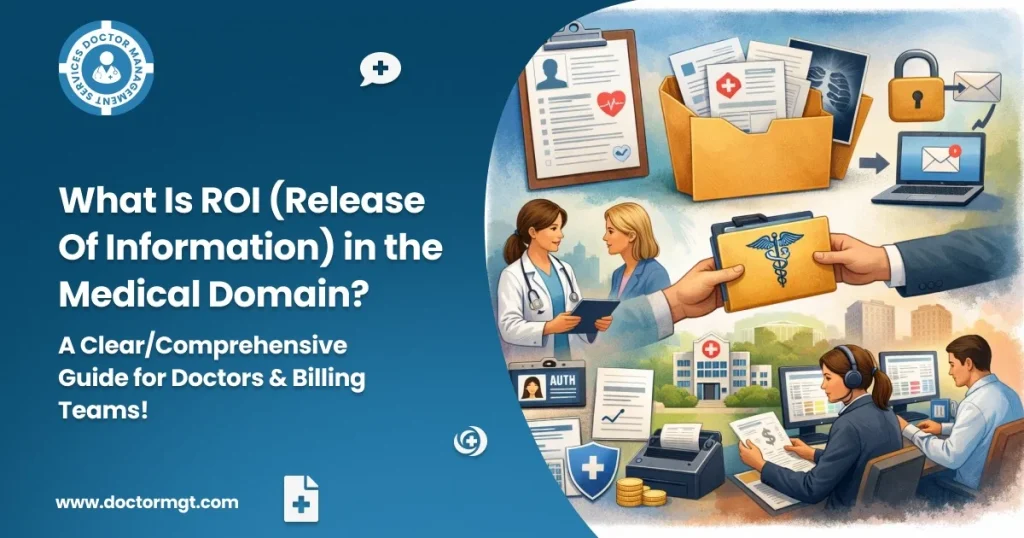
A single medical record can tell the complete story of someone’s life, illnesses, recoveries, personal struggles, and private details that they may not share with anyone else. Now imagine that record being sent to the wrong person, or shared without proper permission.
Situations like this are exactly the reason why Release of Information, or ROI, exists in healthcare.
In medical terms, ROI does not mean return on investment. It means Release of Information, which is the formal process of sharing patient health information with authorized individuals or organizations in a legal and controlled way. Now you may think it sounds administrative, but in actuality, ROI sits at the intersection of privacy, patient rights, clinical care, and billing operations. It affects multiple things, some of which are:
- How does information move?
- How quickly do payments happen?
- How much trust patients place in a practice?
Many clinics only think about ROI when a request arrives. In reality, it should be treated as a continuous system that protects both the patient and the provider.
Let’s explore this blog to gain a deeper understanding of ROI, its phases, complexities, and everything you need to know about how it works in healthcare.
What is ROI (Release of Information) in Healthcare?
Basically, ROI (Release of Information) is the structured method that is used to disclose medical records safely. It ensures that only the right people can see the right information only for the right reasons. This process exists because any kind of medical information is quite sensitive compared to any other organization.
Medical records include identifiers, treatment histories, medications, mental health notes, and sometimes deeply personal life details. Patients trust providers to protect their data. ROI is the operational system that turns that promise into action.
It is not just about sending records. It is about verifying identity, confirming permission, limiting scope, choosing secure delivery methods, and documenting every step. Each of these layers exists for a reason.
Why ROI Has Become More Important in Modern Healthcare
Healthcare today is more connected than ever. Patients visit multiple specialists, use telehealth, and change their health systems and insurers more often. Every transition often requires records to follow it. That provides even more volume of ROI requests.
At the same time, privacy awareness has grown amongst patients, and they are quite informed about their rights. Regulators are more focused on data handling. Medical documentation cases are increasingly becoming frequent in courts.
This makes ROI no longer a back-office activity that occurs periodically. It belongs to everyday activities. The process of ROI can be slow or hasty, leading to delays in care, frustration among patients, and billing.
Key Components of a Valid ROI
According to HIPAA standards, a valid Authorization for Release of Information must include:
Specific Description
Specific data that is to be utilized or revealed(e.g., “lab results from March 2025,” “entire medical record”).
Recipient Name
Name or category of the individual/organization to which they are supposed to provide the data.
Purpose
The reason why the information is being shared (e.g., at the request of the individual, to make a legal claim).
Expiration Date/Event
An explicit time limit or requirement, e.g., 90 days after signing.
Signature
The document should be signed and dated by the patient or his or her authorized personal representative.
Right to Revoke
A statement that informs the patient that they can cancel the authorization at any time.
The Legal Foundation Behind ROI
Privacy laws require healthcare providers to protect patient information and share it only under proper conditions.
In the majority of cases, records are not released without the written consent of the patient. A valid authorization typically contains the name of the patient, personal information of the recipient, the nature of information requested, the reason for disclosure, a signature, and a date. Some forms also include expiration terms.
In case of the absence of any of these, the release might be invalid. That puts the clinic at risk. Most errors in ROI occur due to the assumption by staff that a form is close enough. Close enough is not safe enough in privacy issues.
How ROI Works in Daily Practice
An effective ROI process takes a smooth and consistent journey. Upon request, it is registered immediately. Logging brings about accountability and a schedule.
Next comes verification. Employees validate that the individual demanding documents has the right to request the records. This process includes checking IDs, comparing signatures, or ensuring legal representation.
Then records are gathered carefully. It is necessary to share only the relevant sections. As an example, unrelated visits may not fit the request in case a surgery is concerned.
There is a person who checks the packet before delivery. The quality check helps to avoid unintentional disclosures. Lastly, the records are transmitted via secure channels, and the release is documented to be audited.
That documentation can protect a practice for months or even years later.
ROI Tiers: Levels of Release Requests in Healthcare
To assist healthcare teams in operating the ROI effectively, separating release requests according to purpose, complexity, and risk can be useful.
Prioritizing requests into levels will enable the staff to prioritize work, implement appropriate review levels, and follow privacy laws like HIPAA.
The chart below can be used as a reference for the overview of tiers of ROI, purposes, complexity, and crucial considerations:
|
Tier |
Type of Request | Purpose / Use | Complexity Level |
|
Tier 1 |
Patient-Directed Requests | Patients requesting their own records | Low |
| Tier 2 | Provider-to-Provider Transfers | Constant care between healthcare providers |
Moderate |
|
Tier 3 |
Billing & Insurance Requests | Claims processing, payment verification, and audits | Moderate to High |
| Tier 4 | Legal & Subpoena Requests | Legal cases, injury claims, court matters |
High |
| Tier 5 | Government & Regulatory Requests | Public health reporting, investigations, and compliance audits |
Very High |
This structured approach not only protects patient information but also reduces errors and supports timely clinical and billing processes.
How the ROI Workflow Really Works?
The process of releasing information isn’t random. It follows structured steps that help maintain accuracy, compliance, and traceability. Based on industry examples, ROI workflows commonly include these phases:
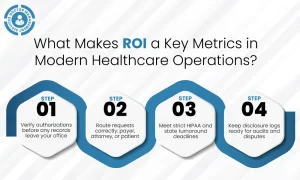
Phase 1: Intake, Verification & Tracking
- Receive request in writing
- Confirm valid authorization form
- Check patient identity and authorization details
- Assign a tracking ID or case number
This stage initiates the formal record-keeping process that is essential for audits.
Phase 2: Record Retrieval and Compilation
After the verification of the authorization, the staff requests the Designated Record Set (DRS), which is defined in the HIPAA Privacy Rule.
This includes:
- EHR encounters
- Results repositories
- Imaging PACS
- External interfaces (HIE/labs)
- Legacy archive systems
- Paper chart scans
Only relevant records are gathered that are based on the authorization scope.
Phase 3: Review & Redaction
Before sharing, staff must:
- Confirm the accuracy of content
- Remove or block protected items should not authorized for disclosure
- Ensure the minimum necessary principles are applied
Any errors here can result in a breach!
Phase 4: Secure Delivery
Records are delivered through secure channels, such as:
- Encrypted email
- Provider portals
- Secure fax
- Locked physical pickup
- HIPAA-compliant file sharing
Security is non-negotiable. It will not be send further unless the patient knowingly accepts the risk in writing.
Phase 5: Documentation & Audit Trail
Every action taken, from request receipt to delivery confirmation, must be logged.
Good ROI systems maintain:
- Date/time records
- Who requested the data
- What was released
- How it was transmitted
- Retention of authorization forms
This record supports compliance reviews and internal audits.
Legal Bases and Compliance: What Practices Must Know
Healthcare data is among the most tightly regulated in the world for obvious reasons, so there are some rules that they set, according to the law.
HIPAA Privacy Rule
In the U.S., HIPAA sets the framework for how and when PHI can be released. It covers:
- Valid authorization requirements
- Permitted disclosures
- Patient access rights
- Accounting of disclosures
Violation of HIPAA can lead to significant fines or corrective action.
State Privacy Laws
Many states have additional protections for special categories, such as:
- Mental health records
- Substance use treatment records
- Genetic information
These often require specific language on authorization forms.
Timeliness Requirements
Regulations often impose deadlines, for example, 30 days to process a patient request. Late delivery can trigger complaints or penalties.
Legal compliance isn’t optional; it directly affects workflow design and ROI performance.
ROI as Part of Operational Health
The release of Information does not only impact on privacy. It affects workflow, employee workload, and efficiency. Stress levels rise when the ROI systems are not organized. Staff rush, which makes mistakes become more likely.
Structured practices provide a specific accountability of ROI. They treat record handling as a professional function, not a side task.
At this point, most doctors managements realizes that ROI is not merely compliance, but it is an operational pillar. Once information is directed appropriately, all the information, including referrals and claims processing, is streamlined. When this does not happen, little problems accumulate silently.
The Risk of Ignoring ROI Efficiency
When ROI is slow or inconsistent, billing suffers. Reimbursements can be delayed due to delayed documentation.
This will eventually lead to unpaid medical bills that pressure the patients and the providers. Most of the practices attempt to address the issue of billing without considering their ROI workflow.
The missing component is the documentation flow at times, rather than coding or eligibility. Efficient ROI helps close that gap.
Looking Ahead: The Future of ROI
Release of Information is evolving.
There is an increase in automated portals, identity check systems, and intelligent tracking systems. Sensitive records are now automatically flagged by some systems. Complete automation is not probable.
In many instances, privacy decisions are contextual. The role of human oversight will continue to play a role in ROI in the predictable future. Patient expectations will change.
Strong ROI systems will be characterizing by faster accessibility, better communication, and transparency.
Final Thoughts
ROI (Release of Information) is where patient privacy meets healthcare operations. ROI ensures the safety of both the patients and the providers when managed correctly.
It promotes continuity of treatments, assists billing teams in receiving payments, and demonstrates respect towards personal information.
Moreover, the recent changes in the reimbursement systems of physicians are transforming the value of care services.
In California, the Division of Workers’ Compensation has published adjustments to the Official Medical Fee Schedule for Physician and Non-Physician Practitioner Services, effective March 1, 2026, aligning reimbursement values and coding standards with the latest Medicare payment system changes, such as updated relative value units and procedure edits.
Such adjustments are uses to ensure physician services are in line with realities in current practice and payment.
A clinic that manages to master ROI not only does not get into trouble, but it also operates more efficiently, patients trust it, and its financial stability is preserved. Responsible sharing has never been more important than in the era of fast information.