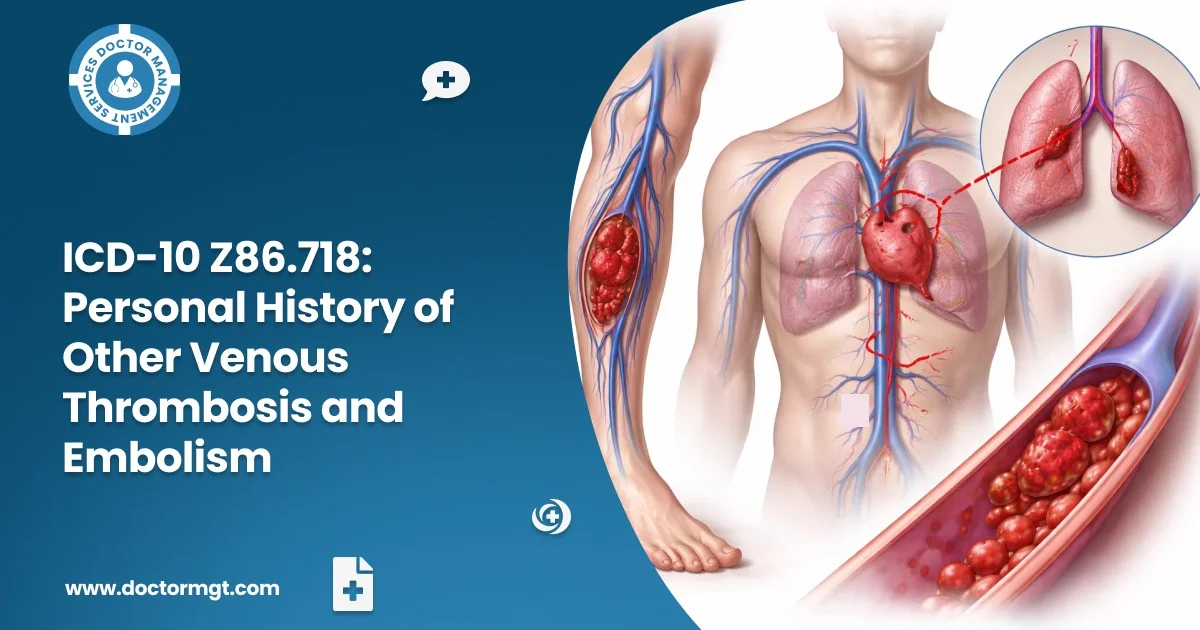



When the patient already had a severe vascular event such as deep vein thrombosis (DVT) or pulmonary embolism (PE), that history does not simply fade away after treatment; it becomes one of the key elements of their medical history.
That’s where ICD-10 code Z86.718 comes in. It records a personal history of other venous thrombosis and embolism, as well as assists providers in communicating risk and making appropriate treatment decisions.
In simpler terms, this code applies in those instances when a patient is not actually dealing with a clot anymore, yet has had one previously, and this previous experience still counts.
What is the HX of DVT ICD 10? Coding Explained
The ICD-10 code for history of DVT is commonly documented as Z86.718 when the history includes venous thrombosis beyond standard classifications. Clinicians often interchangeably refer to:
- hx of dvt ICD 10
- history of DVT ICD-10
- icd 10 hx dvt
- hx dvt icd 10
All these variations lead to the recording of a past state and not a present condition. This difference is necessary since it impacts clinical management and reimbursement.
A patient who has a hx of dvt icd 10(History of Deep Vein Thrombosis) may not exhibit any current symptoms; however, they are at a higher risk of recurrence, especially during a surgical procedure or clotting disorders.
Symptoms After DVT: What Patients with HX of DVT ICD 10 Should Know
Although Z86.718 represents a past condition, there are chances of residual or recurring symptoms in the patients. These include:
- Post-thrombotic syndrome (chronic swelling of legs)
- Discoloration of the skin in the surrounding of the affected area.
- Constant pain or heaviness of the legs.
- Fatigue in the limb after prolonged standing
Patients with a hx dvt icd 10 are required to learn to identify signs of recurrence, which may include sudden swelling, warmth, or sharp pain in the leg.
Common Causes of Venous Thrombosis and Embolism Explained
It is possible to prevent a clot by understanding what caused the first one. In the majority of cases, DVT is a result of a combination of many factors explained by Virchow’s triad, which include:
Venous Stasis (Slowed Blood Flow):
The veins fill with blood, particularly in the legs, which makes it possible to develop clots. This is mostly due to prolonged immobility (bed rest, long flights), paralysis, varicose veins, heart failure, or pregnancy pressure.
Endothelial Injury (Damage to the Vessel Wall):
The coagulation cascade is activated by injury to the inner lining of the vein. These are caused by physical trauma, surgery, intravenous catheters, inflammation, smoking, and high blood pressure.
Hypercoagulability (Increased Clotting Tendency):
The blood gets sticky, and they are likely to form clots. It may be genetically inherited (Factor V Leiden), or it may be attained as a result of cancer, pregnancy, estrogen-containing drugs (birth control pills), dehydration, or obesity.
D-Dimer Test Explained for HX of DVT ICD 10 Patients
Although Z86.718 refers to a past condition, monitoring doesn’t stop after treatment. Diagnostic testing is required in case symptoms indicate a potential recurrence.
A D-Dimer test is one of the most commonly administered blood tests. It identifies fragments that are formed during the breakdown of a blood clot. Higher levels are suggestive of active clot formation, but are not exclusive to DVT.
D-Dimer results should be interpreted carefully in patients who have a hx of dvt icd 10. Levels can be a bit high as a result of previous clotting activity or other medical conditions. This is the reason why doctors tend to utilize the test along with imaging tests like Doppler ultrasound in order to make a diagnosis.
What Increases the Risk of Recurring Clots? HX of DVT ICD 10 Explained
A clot that has already been formed means that there is a high probability of a new one. Patients with a history of dvt icd 10 must be informed of the risk-increasing factors.
Age is one of the factors amongst many, as the risk of clotting increases over time. Obesity, smoking, and certain chronic illnesses like cancer also play a role. Hormonal therapies, including birth control or hormone replacement therapy, can further elevate the risk.
Even lifestyle factors matter. Long periods of sitting, dehydration, and lack of physical activity may provide the circumstances in which a second clot may develop. This is the reason why patients with a hx of dvt icd 10 are usually encouraged to be active and lead healthy lifestyles.
Why Accurate ICD-10 Coding Matters for HX of DVT
The condition is inherently associated with the circulatory system and, therefore, it would be included as part of cardiac and vascular care. The cardiology billing solutions are significant in making sure the history of a patient is well captured and presented in claims.
Cardiologists frequently use a recorded history of clotting disorders in the assessment of the potential effect of a past event on blood circulation, vascular conditions, or the overall functioning of the heart.
Not only does this help in making better clinical decisions, but it also makes the utilization of icd 10 code for hx of dvt correctly consistent with documentation, which ultimately leads to improved reimbursement results.
Surgical Clearance ICD 10: Managing Preoperative Risk with HX of DVT
A document is particularly significant when a patient is getting ready to undergo an operation. In preoperative assessments, a surgical clearance icd 10 documentation is utilized by the providers to measure potential risks. Special precautions may be needed among patients who have a history of clotting.
This may involve the use of anticoagulant drugs temporarily or the employment of pressure-reducing devices in and out of operation.
Without accurate documentation, these precautions might be overlooked, increasing the risk of complications.
Final Insights on ICD-10 Z86.718
ICD-10 Z86.718 can be the history, yet it still informs risk assessment, treatment choice, and surgery. The correct application of hx of dvt icd 10 would guarantee improved patient care and documentation.
Meanwhile, the workers comp lien collections are aimed at controlling and recovering the compensation due to the medical bills related to workplace injuries, making sure that the providers are paid correctly and precisely.