




A workers’ comp claim doesn’t get denied because the treatment was wrong. Most of the time, it is refused because someone in billing completed a form incorrectly or used the wrong form. That one decision, CMS-1500 or UB-04, sits at the very front of the claims process, and if it’s wrong, all the downstream parts of the process come to a halt: authorization is questioned, the claim is returned to the adjuster, and then the provider waits another 30-45 days for the payment that should have arrived on their first claim.
This is not something that occurs in regular commercial billing, as it goes through a different adjudication process than workers’ comp. Adjusters are not only asking if the service was medically necessary; they are asking if the service was authorized, if the service is the type of service for the body part indicated, or if the claim form is the type of provider that provided the service. If the form is incorrect, all the other details are insignificant, since the claim does not get to pass the front door.
For the full claim lifecycle, from intake through authorization, submission, and reimbursement, our complete guide to workers’ comp billing walks through the entire process.
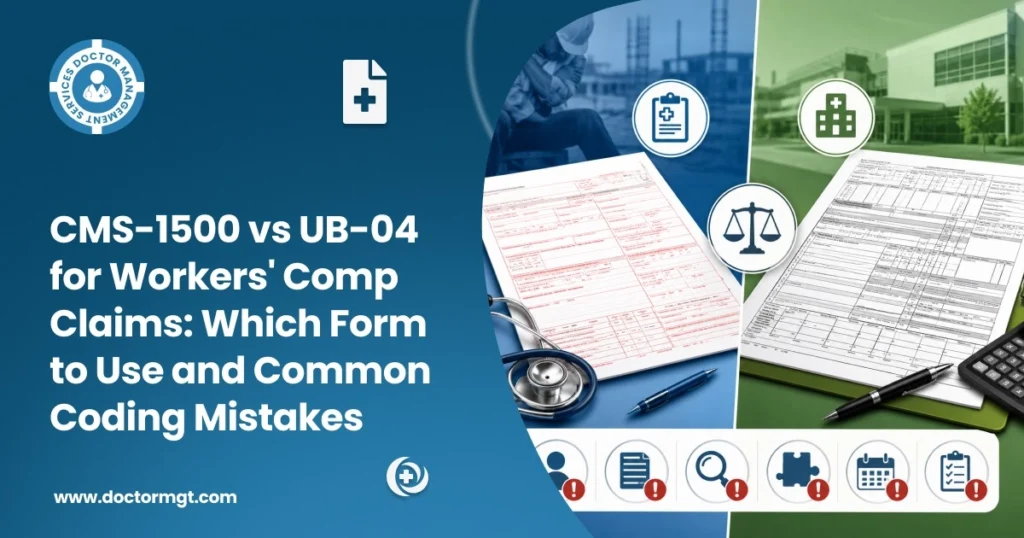
The Real Difference Between CMS-1500 and UB-04
The CMS-1500 is the professional claim form. It is design for individual providers and practitioners billing for services they actually provided – physicians, chiropractors, physical therapists, occupational medicine doctors, and QME or AME evaluators conducting IMEs. Each line on this form is associate with an individual NPI. From a rendering provider, a CPT or HCPCS code for the service, and a diagnosis code that must have a logical relationship to the accepted injury
The UB-04, also called the CMS-1450, is the institutional claim form. It doesn’t just belong to individual providers; it applies to facilities: hospitals, hospital-based occupational medicine clinics, ambulatory surgery centers in some states, and skilled nursing/diagnostic and rehabilitation facilities that provide care in the context of a workers’ comp claim.
Instead of CPT codes carrying the claim, the UB-04 leans on revenue codes, bill type codes, and occurrence codes that describe the type of stay or encounter, alongside the CPT/HCPCS codes for procedures performed during that stay.
A physician who owns and bills through a hospital-based occupational clinic may still need to submit a UB-04 for the facility fee and a separate CMS-1500 for their own professional service, both tied to the same date of service and the same injury. Miss that split and the carrier sees a mismatch it doesn’t know how to process.
Here’s the side-by-side breakdown that makes the split easy to check against before a claim goes out:
| CMS-1500 | UB-04 (CMS-1450) | |
| Who files it | Individual providers under their own NPI | Facilities under an institutional NPI |
| Typical WC filers | Physicians, chiropractors, PT/OT, QME/AME evaluators | Hospitals, hospital-based occ-med clinics, SNFs |
| ASCs | Yes, in most states | No, despite being a facility |
| Coding basis | CPT/HCPCS + ICD-10 diagnosis pointer | Revenue codes + bill type + occurrence codes |
| Authorization field | Box 23 | Value codes / attached authorization documentation |
| Injury date/employer notice | Not a required field | Required via occurrence codes |
| Most common denial trigger | ICD-10 doesn’t match reported mechanism of injury | Revenue code doesn’t match CPT/HCPCS billed |
| Governing standard | State professional fee schedule | State institutional/DRG or per-diem fee schedule |
Keep this table close by any time a claim gets built. Because the moment a service crosses from “provider treats the patient” to “facility housed the encounter,” the form, the codes, and the require fields all change together, not one at a time.
Common Coding Mistakes on Workers’ Comp CMS-1500 Claims
Most CMS-1500 denials in workers’ comp trace back to a handful of recurring errors, and once you’ve seen a few hundred of these claims, the pattern becomes predictable:
ICD-10 doesn’t match the mechanism of injury
A lifting incident injury that results in a lumbar strain should be code as an acute trauma, rather than a degenerative disc. Adjusters know to look for this exact mismatch. Because the diagnosis of a “degenerative” condition indicates that the issue was not cause by the work incident, and that this is a matter of compensability, not a simple payment.
Missing or incorrect authorization number in Box 23
For most states, prior authorization is necessary after the initial evaluation and for a limited course of conservative treatment. The absence of an authorization number or the wrong number is consider no authorization, even if the treatment was authorize.
Wrong place of service code
This is an obvious example of providers working in a private office and in a hospital-based clinic at the same time. If a claim is submit to the clearinghouse with a facility POS code or a claim is sent to the payer with a facility POS code, the claim is automatically edit out of the clearinghouse before it is submit to the payer.
Missing injury-related modifier
A carrier often needs a modifier to designate a service as being related to the accepted injury as opposed to non-essential services. If it is not include, the line item may be interpreting as irrelevant or not cover.
Rendering vs. referring provider mixed up in Box 24J vs. Box 17
It is common in a referral (referral to specialist) claim and blocks the claim in the same way as a missing NPI does.
All of these are small in their own right, but on a workers’ comp claim they would have more significance than if they were on a commercial claim, as the adjuster is also looking at whether the claim is compensable and complying.
Common Coding Mistakes on Workers’ Comp UB-04 Claims
There are a number of recurring issues with the UB-04, and a few of them are less to do with the logic used in the diagnosis codes and more to do with the structural fields that facilities tend to overlook:
Revenue code doesn’t match the CPT/HCPCS billed
Each individual line item must have a revenue code that matches the department/service type, and workers’ comp payers are more demanding on this matchup than commercial payers. If there is a revenue code list next to an outpatient physical therapy CPT code, it is a red flag.
Bill type not updated on a corrected claim
The bill type field indicates whether a claim is an inpatient, outpatient, or correction bill. If it is not update upon resubmission, the payer’s system reads the claim as a duplicated claim and it may remain unprocessed until someone notifies them of the error.
Missing occurrence codes
These record the date of injury and, in many states, the date the employer was informed of the injury. They are also essential to the claim for the timeline the adjusters in the state need to follow to determine if the state has been compliant with its reporting requirements, and this can often result in a request for documentation, adding weeks to the process.
Facility NPI used where a hospital-based clinic looks like a private office
On the surface, hospital-base occupational medicine visits are the same as a private office visit, but the visits still must be conducts under the institutional NPI with the right revenue code – not as if the service is being provides in a private office setting.
Narrative or attachment left off
Several states mandate a medical narrative of work status, causal relationship and percentage of impairment on the UB-04. Without it, it is not consider a claim, but an incomplete claim.
These errors are not clinical judgments; they’re more process discipline, which is why they’re so easily avoid with a consistent pre-submission checklist.
Who Actually Files the CMS-1500 in a Workers’ Comp Claim?
Anyone billing for professional workers’ compensation billing services, under their own NPI, files on the CMS-1500. For workers’ comp, this includes all of the above–the treating physician. The orthopedic and pain management physicians, physical and occupational therapists used for rehab, chiropractors under treatment guidelines, and the med-legal QME/AME physicians.
Each of these claims must contain the authorization number in Box 23 if it is a claim requiring prior authorization, the correct place of service code where the care was provided, and a diagnosis pointer that will directly relate to the accepted mechanism of injury.
When a physical therapist bills for a lifting injury patient that requires lumbar rehab. The code should indicate that the lifting injury, and not just a generic musculoskeletal code, is the cause of the rehab. Adjusters will look at the original injury report to reconcile. The diagnosis with the cause of the injury before they’ll authorize payment.
Who Files the UB-04, and Where Providers Get Confused?
The UB-04 is use for claims where the hospital encounter is relates to a work injury, including the visit to the ED following a work injury, inpatient surgical admissions, and hospital-based occupational medicine clinics, but not those of an individual NPI. If skilled nursing is receive after a workplace injury, then it is also cover by UB-04 billing.
Ambulatory surgery centers are where the confusion shows up most often. Even though an ASC billing is technically a facility, most ASCs bill the CMS-1500, not the UB-04, because they’re reimbursed under the professional fee schedule in most states rather than the institutional one.
If a billing team is consistently submitting UB-04s for all facilities, the claims will be misfile, and, because each ASC resubmission resets the adjudication clock, the injured worker’s care authorization will be delay, and workers’ comp carriers are not as accommodating of resubmissions as commercial payers.
The other area in which the other spot providers stumble is occupational medicine, which is done in hospitals. These clinics are not located on the main hospital campus. But are utilizes under the hospital’s institutional NPI. An office visit that appears the same as a private practice visit must be sent out using an UB-04 (not a CMS-1500) with the correct revenue code.
Why State Fee Schedules Make This Even Less Forgiving?
Unlike Medicare, workers’ comp isn’t based on a single fee schedule. All states have their own requirements for who is allow to treat, what forms must be fill. When the information must be report, and how much reimbursement is received, and a number of states – California include, add their own extra documentation requirements onto the CMS-1500 and UB-04 fields.
For instance, claims that are expect to match closely with the accepted body parts. The treating physician’s report for this state under the WCAB’s standards and the California Medical Treatment Utilization Schedule. The form, correctly complete to national standards, might be reject if it does not satisfy a state-specific requirement overlaid.
This is why a form error that may be innocently fix in a commercial billing is interpreting as a compliance error in a workers’ comp: state carriers will do a form review and a compliance review simultaneously, so an error on the form may be a smaller compliance issue than it appears.
What Do These Errors Actually Cost in Delayed Reimbursement?
Most states have a minimum time limit of 30-45 days for clean claims to be paid or object to. The keyword is clean. When a form error, diagnosis mismatch, or missing occurrence code. Causes the claim to go out of “clean,” that can’t stop; it resets when the corrected claim is resubmit. An error in a few of the forms or codes that a practice uses for their workers’ comp claim filings. Can be a silent cause of delays in reimbursements, weeks at a time, on every claim. Not because the treatment itself was up for question; it’s just that the paperwork wasn’t design to pass initial scrutiny.
Avoiding a single denial is not as important as getting the CMS-1500 versus UB-04 decision right and getting the coding on each one correct the first time.
Providers may outsource this component because they want to avoid making this type of error. In the first place, not because they will make it and then have to correct it once they receive a denial. Because of this, many of the practices we work with enjoy denial overturn rates that are significantly higher than industry averages, and turnaround times. That are noticeably faster than the state-mandated deadline for reimbursement.
So Which Form Should You Actually Use?
It comes down to one question: are you billing as the individual provider who rendered the service, or as the facility that housed it?
- Billing under your own NPI for a service you personally performed? Use the CMS-1500. That covers physicians, therapists, chiropractors, QME/AME evaluators, and most ASCs.
- Billing under an institutional NPI for the facility side of care? Use the UB-04. That covers hospitals, hospital-based occ-med clinics, and skilled nursing or rehab facilities.
Both are require in one case: A hospital-based clinic, with a hospital employee providing the service to a patient. Should have a UB-04 claim form for the facility and a CMS-1500 claim form for the physician, on the same date of service. If the carrier does not receive this split, he or she will not be able to reconcile the claim.
FAQs
1. How do I know if my practice should bill on a CMS-1500 or a UB-04 for a workers’ comp claim?
It comes down to whether you’re billing as an individual provider under your own NPI or as a facility under an institutional NPI. Physicians, therapists, chiropractors, and QME evaluators bill professional services on the CMS-1500. Hospitals, hospital-based occupational clinics, and skilled nursing facilities bill on the UB-04.
2. Do ambulatory surgery centers use the CMS-1500 or the UB-04 for workers’ comp claims?
In most states, ASCs bill on the CMS-1500 rather than the UB-04. Since they’re typically reimburse under the professional fee schedule even though they operate as facilities. This is one of the most commonly misfile claim types in workers’ comp billing.
3. What’s the most common reason workers’ comp CMS-1500 claims get denied?
A diagnosis code that doesn’t clearly match the reported mechanism of injury is the leading cause. Adjusters compare the ICD-10 code against the original injury report, and any mismatch. Especially a degenerative diagnosis where an acute injury was report, raises a compensability question before payment is even consider.
4. Why do workers’ comp UB-04 claims get denied more often than commercial UB-04 claims?
Workers’ comp payers review UB-04 claims for bo, but itth billing accuracy and state compliance at the same time. A revenue code mismatch or missing occurrence code that a commercial payer might process anyway will often stop a workers’ comp claim outright, because it’s read against state-specific reporting and authorization requirements.
5. How long do workers’ comp carriers have to pay or deny a claim?
Most states require a response within 30 to 45 days of receiving a clean claim. California specifically mandates 45 days. That window only applies to a clean claim. So any coding or form error typically resets the timeline once a corrected claim is resubmit.
6. Can a provider bill both group health and workers’ comp for the same injury?
No. Once an injury is confirmed as work-related, it has to be billed exclusively to the workers’ comp carrier. Billing group health at the same time for the same injury is treated as a compliance violation, not just a billing error.
7. What documentation does a UB-04 workers’ comp claim need that a standard commercial UB-04 doesn’t?
Occurrence codes documenting the date of injury and, in many states. The date the employer was notifiy is require specifically for workers’ comp claims. These dates let the adjuster verify the claim was report within the state’s mandates window. Commercial UB-04 claims don’t need to demonstrate.
8. What’s the fastest way to reduce workers’ comp claim denials tied to form or coding errors?
Building a pre-submission review step that checks diagnosis-to-injury alignment, authorization numbers, place of service codes, and revenue code accuracy before the claim goes out catches the majority of these errors before they ever reach the payer. This is typically far faster than correcting and resubmitting after a denial, since resubmitted claims restart the payer’s response clock.