






Workers’ compensation billing is one of the most misunderstood corners of medical revenue cycle management. Basically, it is the process of submitting medical claims to an employer’s workers’ comp insurance carrier for treatment of work-related injuries. Unlike commercial insurance, it operates under a separate regulatory framework with state-specific fee schedules, authorization rules, and claim forms, primarily the CMS-1500. This guide covers every step of the billing process, from patient intake to collections and appeals.”
Unlike commercial insurance or Medicare, Workers Compensation Medical Billing operates under a completely separate regulatory framework, with its own fee schedules, claim forms, authorization rules, and adjudication timelines.
At its core, Workers Compensation Billing is the process by which a healthcare provider submits charges to an employer’s workers comp insurance carrier, not to a health plan for treating a worker injured on the job. The distinction changes everything about how you document, code, and follow up on claims.
In other words, if the regular health insurance billing system were on a highway, then workers’ comp billing was driving down a different road, and it has a different set of signs, speed limits, and even potholes.
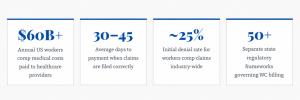
The reason for the system is that when people get injured on the job, it is the employer’s financial problem, not the employee’s insurance plan’s problem. In most states, it’s a no-fault system, so you don’t have to show negligence for the injured worker to get benefits paid, and you receive your payment as a provider because of that no-fault system.
Workers’ compensation claims are not billed to the patient’s health insurance carrier, but rather the employer’s liability carrier. Bill group health plans for confirmed occupational injury, a compliance risk, and a headache for all.
That is where workers’ compensation billing services play a vital role for numerous practices. A generalist billing team that is responsible for commercial payers and WC is too overwhelmed with the complexity of state-specific fee schedules, authorization requirements from dozens of different carriers, and aggressive denial management. To the extent that the workflows really are that dissimilar, there are specialized services.
How Does Workers’ Compensation Billing Work?
Here’s the honest version that nobody really explains upfront: There are at least four parties when it comes to billing for Workers Compensation:
- The Injured Worker
- The Employer
- The Employer’s Insurance Carrier
- You, the Provider
Sometimes a third-party administrator (TPA) or Managed Care Organization (MCO) is in the middle, as well.
MCOs are contracted by carriers to manage treatment networks and control costs. In states that follow NCCI (National Council on Compensation Insurance) guidelines, fee schedules and billing rules are largely standardized, but each state still has its own modifications on top of the NCCI base.
There is information on both sides that you must have before you will be paid.
The Players and Their Roles
Party |
Their Role |
What You Need From Them |
| Injured Worker | Patient receiving treatment | Date of injury, employer name, claim number if available, incident description |
| Employer | Files the First Report of Injury; notifies the carrier | Insurance carrier contact info, policy number, HR confirmation of employment |
| Insurance Carrier / TPA | Adjudicates and pays the claim | Claim number, adjuster contact, authorization (if required), applicable fee schedule |
| State WC Board | Regulates the process, sets fee schedules | State-specific billing forms, OMFS or fee schedule guidelines, and dispute procedures |
| Your Practice | Provide treatment, document thoroughly, and submit timely bills | Credentialing with WC carriers, proper documentation, and correct coding |
Table 1: Parties involved in a workers’ compensation claim and what providers need from each
Understanding how workers’ compensation billing works means accepting that you may need to do some work to get the information you need. Patients come in with a work injury, often accompanied by a First Report of Injury (FROI), the official document filed by the employer notifying the carrier that a workplace injury occurred. Without a filed FROI, the claim may not yet exist in the carrier’s system, which means you cannot get a claim number, and you cannot get paid. Your front desk intake process must be designed to collect WC-specific data that you don’t ask for in a normal patient encounter.
Ultimately, the Workers’ Compensation Insurance carrier controls authorization, fee schedules, and payment timing. If you’re seeking consistent reimbursement, you have to establish a working relationship with adjusters and keep track of all communications.
Step-by-Step Workers Compensation Billing Process
Let’s walk through the workers compensation billing process the way it actually unfolds in practice, not the idealized flow chart version.
Step 1 Intake: What Information Do You Need Before Billing Workers’ Comp?
Before treatment, verify the injury is work-related and collect:
- Employer
- insurance carrier
- claim number (if filed)
- Date of injury
- Adjuster name
- Phone
If there’s no claim number, mark the account for follow-up and get in touch within 48 hours. One of the most common reasons for WC claims to age out is that the claimant has not given a claim number on intake.
Step 2: Verify Authorization Requirements
Contact the carrier or visit their platform. Other states and carriers will only pay for treatment beyond the initial emergency treatment after a prior authorization. In California, there are numerous instances where utilization review (UR) is required for treatment requests. The trouble with treating without auth when they want it is a quick way towards a probable denial that you can’t appeal.
Step 3: Document Thoroughly — Every Visit
The documentation standards for workers’ comp are more rigorous than typical clinical notes. These will be read by the adjuster and perhaps a defense lawyer. Include: mechanism of injury, body parts affected, treatment rendered, functional limitations, work restrictions, and a direct causal link between the injury and treatment. Any notes that are vague are considered denials.
Step 4: Which ICD-10 and CPT Codes Are Used for Workers’ Comp Billing?
Use the specific ICD-10 Codes that are the most specific. Workers’ comp adjusters have been trained to see if there is coding that is not consistent with the MOI reported. If the patient has injured their lumbar spine by picking up a box, then the diagnosis should be acute trauma rather than degenerative disc disease as the main diagnosis. Use appropriate CPT Codes with these.
Step 5: How to Fill Out the CMS-1500 Form for Workers’ Compensation
Professional Services use the CMS-1500 Form. Common boxes that are frequently overlooked: Box 10a should be checked to indicate employment-related condition; Box 11 should be filled in with the workers comp carrier info; Box 14 should include the date of injury; Box 15 should include the first date of similar illness (usually blank when it comes to workers comp). The adjuster’s name and claim number go in the comment in Box 19; carriers are diggers.
Step 6: Submit Within Timely Filing Limits
This is non-negotiable. Timely filing limits for workers’ comp are different in each state, ranging from 30 days to 18 months. Carriers will simply say NO to late submissions. Develop a tracking system to alert new WC accounts when within 60 days of the deadline.
Step 7: Review the EOR and Post Payment
If receiving payment, carefully read the EOR (Explanation of Review). EOR differs from a regular EOB as it details the reasons for any reductions on the fee schedule (OMFS in California, for instance), any denials, and the basis for any such denials. Each time a line is used is significant in determining follow-up billing.
Workers’ Compensation Claim Lifecycle: Average Days to Resolution
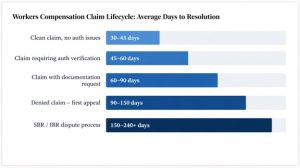
Figure 1: Approximate resolution timelines by claim complexity. Clean submissions dramatically reduce revenue cycle drag.
What Documentation Is Required for Workers’ Compensation Billing?
There’s a saying in workers’ comp billing circles: “If you didn’t document it, you didn’t do it, and you definitely won’t get paid for it.” That sounds obvious, but denials resulting from the documentation problems are consistently found in practices of all sizes.
What Workers’ Compensation Documentation Must Include?
The documentation must include further things that will have
Document Type |
Required Elements |
Common Gaps |
| Initial Evaluation Note | Mechanism of injury, onset date, affected body parts, work restrictions, causal relationship statement | Missing causal statement linking injury to work activity |
| Progress Notes | Response to treatment, functional status, return-to-work timeline, updated restrictions | Copy-forward notes with no change documented |
| Diagnostic Reports | Imaging, labs must reference the work injury explicitly in the order | Reports ordered without linking to the claim number or WC diagnosis |
| Work Status Reports | Specific restrictions (lift limit, hours, duties), expected duration | Vague restrictions like “light duty” without measurable limits |
| Operative Reports | Pre-auth number, intraoperative findings tied to mechanism of injury | No reference to the authorization obtained before the procedure |
| Billing Records | Date of service, claim number, date of injury, provider NPI, correct CPT/ICD-10 | Wrong date of injury on CMS-1500 or missing claim number |
Table 2: Required documentation elements and where most practices fall short
In disputed or high-value claims, carriers often request an Independent Medical Examination (IME) an evaluation by a physician of their choosing, to challenge your findings or recommended treatment.
Your documentation must be thorough enough to withstand IME scrutiny, because a poorly written note will lose against an IME report every time. Similarly, utilization review contractors use peer review, a clinical review by a licensed physician, to deny treatment they consider not medically necessary.
The defense against both is the same: specific, causally linked, functionally grounded notes.
Workers comp carriers and their utilization review contractors scrutinize medical necessity aggressively, often more than Medicare does. Your notes need to explain not just what you did, but why it was necessary for this specific injury, why conservative care was tried first (or why it wasn’t appropriate), and what functional improvement you expect.
“A workers’ comp claim note written for clinical purposes and a note written for reimbursement purposes look almost nothing alike. You need to be writing notes that serve both masters simultaneously.”
What Are the Most Common Workers’ Comp Billing Denials — And How to Appeal Them?
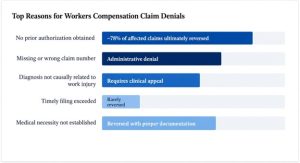
Workers’ Compensation Denials fall into a few predictable categories. Knowing them in advance means you can build processes that prevent the most common ones before claims ever leave your office.
Figure 2: Common denial categories and general reversal outlook with proper appeals
The Workers Compensation Appeals Process
The Workers Compensation Appeals and Reimbursement Process is multi-layered, and the level you use depends entirely on why the claim was denied.
Appeal Level |
When to Use It |
Timeframe |
Success Tips |
| Informal Reconsideration | Administrative errors (wrong claim #, missing info) | 7–21 days | Call the adjuster directly; faster than a formal appeal |
| Formal Carrier Appeal | Medical necessity denials, authorization disputes | 30–60 days | Include peer-reviewed clinical support; address the specific denial reason |
| Second Bill Review (SBR) | Payment below the applicable fee schedule | Varies by state | Document exact fee schedule line items; show your calculation |
| Independent Bill Review (IBR) | After SBR fails, the CA-specific process | 60–120 days | Must complete SBR first; file within the required window post-SBR |
| State WC Board Dispute | Compensability disputes, complex liability issues | Months to years | Requires legal involvement in most cases; preserve all documentation |
Table 3: Workers’ compensation appeals hierarchy starts low, escalates strategically
Critical Deadline Alert
Most states have a time limit for appeals, typically 30-90 days after the receipt of a decision of denial or EOR. Failure to appear at these times means you have waived your right to contest. Build appeal deadline tracking into your Revenue Cycle Management workflow from day one.
How to Improve Workers’ Compensation Collections and Reduce AR Days
Workers Compensation Collections is where practices leave the most money on the table — not because the claims are uncollectable, but because follow-up processes aren’t built for the unique rhythm of WC accounts receivable.
Here’s the reality: Workers Compensation reimbursement timelines are longer than commercial insurance by design. Carriers have regulatory-defined payment windows (30 days in most states after a clean bill submission), but disputes, utilization review, and compensability questions can stretch timelines well beyond that. Your AR team has to understand this isn’t delinquency — it’s process and follow up accordingly without burning the adjuster relationship you need for future authorizations.
Workers Compensation Collections Best Practices
AR Age Bucket |
Recommended Action |
Who Handles It |
| 0–30 days | Confirm claim number received; verify carrier has the bill | Billing coordinator |
| 31–60 days | Outbound call to adjuster; document conversation; request ETA | WC billing specialist |
| 61–90 days | Formal written follow-up; check for missing documentation requests | WC billing specialist |
| 91–120 days | Escalate to senior adjuster or TPA account manager; file a formal inquiry | Billing manager |
| 120+ days | Evaluate for formal appeal; consider state regulatory complaint if appropriate; reassess compensability | Billing manager + legal consultation |
Table 4: Workers’ compensation AR follow-up cadence by account age
One of the most effective Workers Compensation Billing Guidelines for improving collections is simple but rarely implemented consistently: document every single carrier contact. Date, time, adjuster name, what they said, what they committed to. This creates an audit trail that becomes invaluable if you ever escalate to formal dispute resolution.
Collections Strategy That Works:
Healthcare providers who assign a dedicated WC billing specialist rather than routing WC through the general billing queue consistently report 15–25% improvement in collection rates. The specialized knowledge, adjuster relationships, and state-specific expertise simply cannot be replicated by a generalist handling WC as a side queue.
California Workers’ Compensation Billing Rules: What Every Provider Must Know
The California workers compensation billing Process deserves its own section because California runs one of the most complex and strictly regulated workers’ comp systems in the country. If you’re billing in California, the rules aren’t just different; they’re a different discipline entirely.
California-Specific Rules Every Provider Must Know
Feature |
California Rule |
Practical Impact |
| Fee Schedule | Official Medical Fee Schedule (OMFS); updated periodically by DWC | Reimbursement is fixed; no negotiation above OMFS except for carve-outs |
| Utilization Review | Mandatory for all non-emergency treatment requests per DWC Regulations | Must submit Request for Authorization (RFA) using DWC Form 9785.5 |
| Timely Filing | 45 days for the initial bill after the date of service | Stricter than many states; the intake process must be rock solid |
| Payment Timeline | The carrier must pay or object within 45 days of receipt of the complete bill | Provides a clear escalation trigger if the payment doesn’t arrive |
| Second Bill Review (SBR) | Required before IBR; must file within 90 days of EOR | Cannot skip to IBR; procedural compliance is mandatory |
| Independent Bill Review (IBR) | State-administered process via DWC after failed SBR | Binding on both parties; relatively low cost to file for providers |
Table 5: California workers’ compensation billing rules quick reference
The DWC Regulations that govern California workers’ comp are detailed and frequently updated. Providers treating injured workers in California must also understand the Medical Provider Network (MPN) system, employer-established networks that control which doctors an injured worker can see after the initial treatment period.
If you are not enrolled in the employer’s MPN, you may not be authorized to treat the patient beyond emergency care, and your bills will be denied on that basis alone.
Additionally, lien claims are a California-specific mechanism that allows providers who were not paid to file a lien against the injured worker’s case, but lien filing has strict deadlines and fees, so it should be a last resort after the standard billing and IBR process has been exhausted.
Any provider that has a large number of California Occupational Injury Claims should be monitoring DWC bulletins or contracting with a billing service that has a specialized focus on California WC.
There are also bills with California carrier-specific nuances to the CMS-1500 workers’ compensation billing process. Certain big California providers favor certain portals billed and certain formats. Don’t assume that paper or generic EDI is the method of choice.
How to Build a Workers’ Comp Billing Operation That Consistently Gets Paid
The healthcare providers that are best at Workers Compensation Billing do not necessarily have the fanciest billing software. They are the ones who have embraced the fact that workers’ comp is a specialty and has its own rules, rhythms, and relationships, and have structured their processes around that. You are leaving money on the table and likely turning a blind eye to compliance risk if you’re routing workers’ comp claims to your regular billing queue with the same staff, cadence, and denial management process you use for commercial claims.
Workers’ comp is not difficult to do; it’s just different! With the rules already known and the authorization game, documentation standards, and appeals ladder established, these claims are quite collectible. Most of the providers who are having problems are having problems with the process, not with the payer behavior.
FREQUENTLY ASKED QUESTIONS
Q: How long does workers’ comp take to pay a medical bill?
Most states require carriers to pay or object within 30–45 days of receiving a clean bill. California mandates 45 days.
Q: What form is used for workers’ compensation billing?
Professional services use the CMS-1500 form. Hospitals use the UB-04.
Q: Can you bill workers’ comp and health insurance at the same time?
No. If an injury is confirmed as work-related, it must be billed exclusively to the workers’ comp carrier. Billing group health simultaneously is a compliance violation.
Q: What happens if workers’ comp doesn’t pay within the required timeframe?
You can file a formal inquiry, escalate to the state Workers’ Compensation Board, or initiate an Independent Bill Review (IBR), depending on your state.