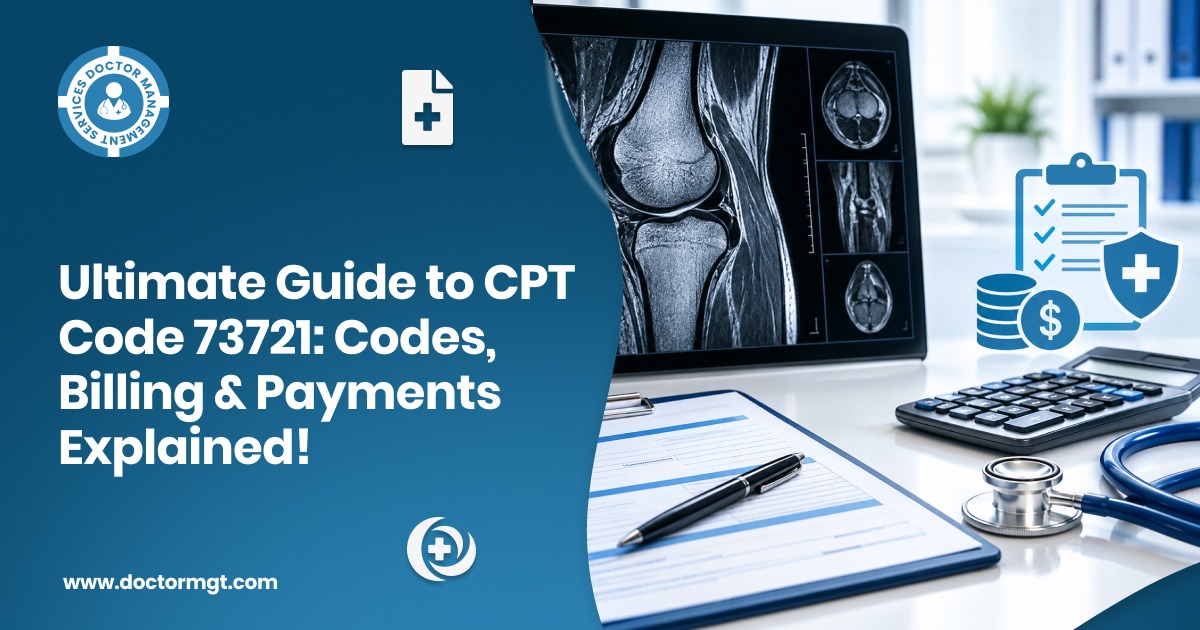





Stress Test CPT Codes: Avoid Denials in Exercise, Echo & Nuclear
A stress test seems easy from the patient’s perspective. They walk on the treadmill; some pictures are taken, and then they go home. For the billing team, it’s anything but easy. There is a risk that a single code, incorrect modifier, or a poorly specified diagnosis can result in claim denial. The stress echo CPT code you pick decides whether your practice gets paid for the resting images, the stress portion, or both.
Pick the wrong one and the payer may cut the claim in half or send it back. The blog includes the top stress test codes for exercise, echo, and nuclear studies, explains how practices are losing money at these codes, and concludes with a quick checklist to follow before sending any claim.
Stress Test CPT Codes at a Glance
Here is the short version. Keep this table close to your desk.
| Test | Main CPT codes | What it covers |
| Exercise stress test (ECG) | 93015, 93016, 93017, 93018 | Treadmill, bike, or drug stress with ECG monitoring |
| Stress echo | 93350, 93351, 93352 | Ultrasound pictures at rest and after stress |
| Nuclear stress (SPECT) | 78451, 78452 | Tracer imaging at rest and stress |
| Nuclear stress (planar) | 78453, 78454 | Older, flat-image method |
| Resting echo | 93306 | Complete echo with Doppler, no stress |
Exercise Stress Test Codes: 93015, 93016, 93017, 93018
CPT 93015 is the global code. This includes stress test, supervision by a physician, the ECG tracing, and the written report, all on one line. The other three codes do the same thing, but they divide up the same work into parts, so you’ll only use them when different people did different parts.
| Code | What it covers |
| 93015 | Full test: supervision, tracing, reading, and report |
| 93016 | Doctor’s supervision only |
| 93017 | ECG tracing only (technical side) |
| 93018 | Reading and report only |
The rule is easy to say and easy to break: use 93015 alone, or use the three parts, but never both for the same test. A typical denial would be a practice performing 93015 and then executing 93018, since the doctor “also read it. The payer will pay the reading twice.
These codes are also applicable to a drug stress test. If a patient is unable to walk on a treadmill, they receive a medication called regadenoson. The drug is sold separately, typically in units corresponding to dosage; for instance, J2785 for the individual units.
Stress Echo CPT Code Guide: 93350, 93351 and 93352
During a stress echo, the ultrasound images of the heart are captured at rest and immediately afterwards following the stress. There are three codes:
The CPT code 93350 is for the echo pictures at rest and during stress, and the doctor’s reading and report. It doesn’t contain the stress monitoring itself. CPT 93351 is for the same echo procedure and also includes ECG monitoring and doctor supervision of the stress. CPT 93352 is an add-on code for contrast dye (if the heart walls are difficult to see). May not be billed separately; may be billed with 93350 or 93351.
Keep in mind that 93350 and 93351 both have the “resting echo.” So don’t include a separate echo code for the same session. Do not combine 93015 + 93018, and if you are billing 93351, don’t add 93015 to 93018, as the monitoring is already included.
| Situation | Code to use | Watch out for |
| Echo team also handles stress and ECG monitoring | 93351 | Do not add 93015–93018 |
| Another team handles the exercise ECG | 93350 plus 93015 or its parts | Make sure each person bills only their own work |
| Contrast used for poor images | Add 93352 | Note why the contrast was needed |
| Resting echo done in the same session | Nothing extra | Already included in 93350 and 93351 |
Ultimate Guide to CPT Code 93306
The CPT 93306 is the code for a complete transthoracic echocardiogram with spectral and color Doppler. In simple words, it is a regular heart ultrasound that checks the chambers, valves, and blood flow while the patient is resting. It is not a stress code, but it shows up in stress test billing all the time because the two get mixed up.
Doctors order 93306 for murmurs, shortness of breath, heart failure, valve disease, and follow-up of known problems. Related codes are 93307, a complete echo without Doppler, and 93308, a limited echo. When the Doppler is done and documented, 93306 is the right pick.
Trouble starts when 93306 and 93350 land on the same claim. Say a patient had a stand-alone resting echo in the morning for one reason and a stress echo later for another. You may need modifier 59 or XS and notes that clearly show two separate sessions. Without that proof, expect the 93306 line to be denied as part of the stress echo.
Diagnosis matters too. A lone code of chest pain, R07.9, is often too thin for a Doppler echo. A code like R01.1 for a murmur or I50.9 for heart failure tells the payer why the study was needed.
Nuclear Stress Test Codes: 78451, 78452, 78453, 78454
A nuclear stress test administers a small quantity of tracer that will demonstrate blood flow through the heart muscle. The imaging code is dependent of the method. One common one is SPECT, while the older style using flat images is planar. When SPECT is performed at rest and stress, it is used for both (the most common scenario). CPT 78451 is for a single study. The planar codes for one study are 78453, and for multiple studies are 78454. The stress portion is billed as 93015-93018, and the tracer and any stress drug are listed separately.
| Item | Code | Note |
| SPECT, rest and stress | 78452 | Most common |
| SPECT, single study | 78451 | One phase only |
| Stress portion | 93015–93018 | Billed apart from imaging |
| Tracer | A9500, A9502, A9505 | Sestamibi, tetrofosmin, thallium |
| Stress drug | J2785 | Regadenoson, billed by units |
Nuclear tests are expensive, and their payers are watching closely. Numerous plans will require prior authorization, and some will only allow patients to have the test repeated a set number of times.
How the Three Tests Compare
Billing does not select the test; doctors select the test for the patient. With knowledge of the differences, you can identify mistakes quickly. When the order is stress echo and the claim has a nuclear code, there is a problem.
| Exercise ECG | Stress echo | Nuclear | |
| Pictures taken | No, ECG only | Ultrasound | Tracer imaging |
| Typical use | First look at chest pain or effort limits | Wall movement and valves | Blood flow to the muscle |
| Prior authorization | Often not needed | Sometimes needed | Commonly needed |
| Biggest billing risk | Splitting codes wrong | Overlap with 93306 | Missing tracer or drug lines |
Basics of Cardiology Medical Billing 101: Modifiers That Protect Your Claim
Every stress test has a technical side and a professional side. The basics of cardiology medical billing 101 explains each and every detail, for example, the technical side that covers the machine, the room, the staff, and the supplies. The professional side is for the doctor’s supervision and reading. You bill the equipment as global (no modifier) if the equipment is owned by your office and your doctor reads the test. When a test is ordered in a hospital setting, and only the physician reads it, you should use modifier 26. When only the equipment is provided, and the technologist provides the rest, use modifier TC.
| Modifier | Meaning | Example |
| 26 | Professional side only | Doctor reads the test at a hospital |
| TC | Technical side only | Imaging center owns the equipment |
| 59 or XS | Separate service or session | Resting echo and stress echo done at different times |
| 76 or 77 | Repeat test | Same doctor or a different doctor repeats the same day |
Billing global when you only did half the work is one of the fastest ways to draw an audit.
Why Stress Test Claims Get Denied
Most denials for cardiology CPT codes come down to a few repeat problems. Here is what they look like and how to fix them.
| Denial reason | Why it happens | Fix |
| No prior authorization | Echo and nuclear studies often need approval | Check the payer rules before you schedule |
| Medical necessity | Diagnosis is too vague | Link a specific symptom or condition to the test |
| Unbundling | 93306 with 93350, or 93015 with its parts | Use one code set per service |
| Wrong modifier | Global billed when only one side was done | Match the modifier to who did the work |
| Missing records | No signed report or ECG tracing | Complete documentation before billing |
| Repeat test too soon | Payer frequency limits | Document the change in symptoms |
Documentation deserves its own mention. Every stress test file should hold the doctor’s order with the reason for the test, the patient’s consent, the resting ECG, the protocol used, peak heart rate and blood pressure, symptoms during the test, the reason the test was stopped, and a signed report. For echo and nuclear studies, add image quality notes and the tracer or contrast details. If it is not written down, a payer will treat it as not done.
When a claim is denied, read the reason code first, fix the real cause, and appeal inside the payer’s deadline, which varies by plan. Attach the signed report, the order, and a short letter explaining the medical need. A clear appeal with the right papers has a much better shot than a generic one.
A Simple Pre-Bill Checklist
Use this flow on every stress test claim:
Order → Prior auth → Test and notes → Code and modifier check → Diagnosis link → Submit → Track payment
| Before the test | Day of the test | After the test |
| Verify insurance | Record vitals and protocol | Pick global or split codes |
| Get prior authorization | Note who did which part | Add the right modifiers |
| Confirm the order and reason | Log drugs, tracer, or contrast used | Link the diagnosis and check bundling |
Getting Help with the Hard Parts
It is challenging to stay up to date on CPT updates, payer rules, and prior authorizations in a busy cardiology office. This task is often delegated to a billing partner so that their employees focus on patients. Outsourcing companies have a dedicated biller for every cardiology medical billing practice that uses them and offer code review, prior authorization follow-up, denial appeals, and claim tracking. When denials for stress tests continue to recur, there is often a decent window of time in the past that can be scanned for money leaks in your last 90 days of claims.
Final Thoughts
For most of all, stress test billing is a matter of matching a code with the job that was performed. Be familiar with what each of the codes contains, divide the technical and professional aspects appropriately, and maintain well-organized notes. If you do so, most denials are avoided. Please always verify current code descriptions and payer policies as the CPT codes change annually, and each payer has their own policies.
Frequently Asked Questions
- What is the CPT code for a stress echo?
There are two stress echo codes. The reading and report of the doctor is included, along with the echo pictures, and is included in CPT 93350. CPT 93351 includes ECG monitoring and physician supervision of the stress and is used for the same work. If contrast dye is used, add 93352. - What is the difference between CPT 93350 and 93351?
Stress monitoring is the difference. Since Code 93350 doesn’t cover it, the exercise ECG is coded separately with 93015 or its components. The monitoring is also included in code 93351, so do not add 93015-93018 with it. - Can you bill 93306 and 93350 together?
Typically for other sessions. Adding 93306 seems like double billing since the resting echo images are already included in Code 93350. A separate visit without a reason, modifier 59 or XS, and clear notes may be used to support a resting echo; however, this modifier is viewed as a separate visit by many payers and is pushed back. - What is the CPT code for a nuclear stress test?
The typical imaging code is 78452, which includes SPECT at rest and stress. Code 78451 is for a single SPECT study, and 78453 and 78454 are for the planar method. The stress portion (93015-93018), the tracer, and any stress drug will be factored on separate lines.