




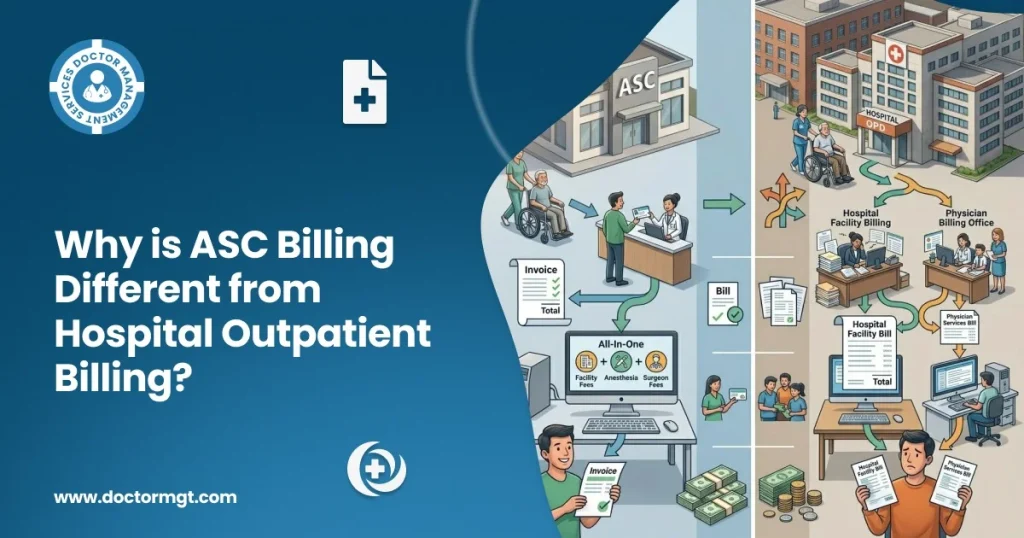
Well, the most basic answer to this question is that ASC is where patients come in, get surgery, and go home the very same day, whereas hospital outpatient is a part of the hospital where patients get procedures without being admitted overnight.
Both are quite similar, but their billing processes are far from being the same.
The core difference, one can say, is:
ASC billing = Lower cost, simpler structure
Hospital outpatient billing = Higher cost, more complex
Now, let’s go through this guide and get more knowledge on how they both are similar, yet quite different from each other.
What Is ASC in Medical Billing?
Think of it as a specialized, “stand-alone” facility that performs surgeries that do not require an overnight stay. Professionally, the billing is unique because the work is split into two parts:
1. The Facility Claim (The “Room & Board”)
The ASC bills for the technical side of the surgery. This is the cost of maintaining the sterile environment.
- What it covers: Nursing staff, surgical equipment, bandages, medications used during the procedure, and the recovery room.
- How it’s billed: Even though it is a facility, ASCs typically use the CMS-1500 claim form (which is usually for doctors) rather than the UB-04 (which is for hospitals).
- Identification: They must use the Place of Service (POS) code 24 to tell the insurance company, “This was done in a stand-alone surgical center.”
2. The Professional Claim (The “Expertise”)
The surgeon who actually performs the surgery bills separately for their professional work.
- What it covers: The doctor’s time and specialized skill.
- How it’s billed: This is billed through the surgeon’s private practice or medical group.
What Is Hospital Outpatient Billing?
Hospital Outpatient Billing is what happens when you receive care at a hospital but don’t stay overnight as an admitted patient.
Professionally, this is handled differently than a regular doctor’s visit because the hospital sends an Institutional Bill (on a form called the UB-04) to cover the high costs of their building, 24/7 staff, and advanced technology. Because hospitals have much higher expenses than small clinics, like running a full emergency room, their facility fees are usually much more expensive.
The asc insurance meaning is that the company pays the hospital based on “groups” of similar services rather than individual items, and you will almost always receive a separate second bill from the doctor who treated you for their specific expertise.
Key Differences Between ASC (Ambulatory Surgical Center) And Hospital Outpatient Billing:
Below are some of the basic differences in terms of coding, claim costing, etc., take a look for a better understanding
Feature |
ASC Billing |
Hospital Outpatient Billing |
| Claim Form | Uses CMS-1500 (Professional form) |
Uses UB-04 (Institutional form) |
|
Place of Service |
Code 24 (Freestanding Facility) | Code 22 (On-campus Hospital) |
| Payment System | ASC Payment System (lower rates) |
OPPS / APC (higher rates) |
|
Coding Style |
Uses CPT/HCPCS codes only | Uses CPT/HCPCS plus Revenue Codes |
| Cost | Generally cheaper (lower overhead) |
Generally, more expensive (high overhead) |
|
Patient Stay |
Surgery only; must go home the same day | Can include ER, Labs, or “Observation.” |
| Supplies/Drugs | Mostly bundled into one flat rate |
Billed via specific Revenue Codes |
Insurance Dynamics & Payer Trends in ASCs and HOPDs?
Insurance dynamics and payer trends in ASCs and hospital outpatient departments (HOPDs) refer to how insurance companies decide where a procedure should be performed and how much they are willing to reimburse for it. In recent years, payers have increasingly encouraged the use of ASCs because they offer lower-cost, efficient care for many outpatient procedures.
Let’s take a look at them deeply,
Insurance Dynamics (The Financial Structure)
Insurance dynamics are the current “rules of the game” regarding how money flows. Right now, the biggest dynamic is the price gap. Insurance companies generally pay Hospital Outpatient Departments (HOPDs) significantly more than ASCs for the exact same surgery because hospitals have much higher costs to stay open 24/7.
Because of this, hospitals have a lot of power to negotiate high prices, while ASCs focus on being low-cost, efficient alternatives. For you as a patient, the “dynamic” usually means you pay a much smaller deductible or co-pay if you choose the ASC.
Payer Trends (The Future Strategy)
Payer trends are the new strategies insurance companies are using to save money. The biggest trend right now is “Site of Service Shifts.” Insurers are actively pushing and sometimes forcing patients to go to ASCs instead of hospitals for routine procedures like colonoscopies or knee replacements. They are doing this by creating “Tiered Networks” where the ASC is the preferred, cheaper option.
Another big move is the “Site-Neutral Payments”, and here insurance companies are seeking to change the rules so they pay the same low rate regardless of where a surgery is performed – in a hospital or a small surgical facility.
Why Payers Are Shifting Procedures from Hospitals to ASCs?
Lower Costs
Payers save a lot of money at ASCs because they don’t have the costs associated with a 24-hour hospital. Surgery at an ASC costs anywhere from 40% to 60% less than the same procedure at a hospital, saving money for both the insurance company and the patient.
Specialized Quality
The narrow focus on a few types of surgery at ASCs means the team performing these surgeries is highly skilled. This results in fewer complications and infections, so insurance providers don’t have to cover costly post-operative treatment or readmissions.
Better Patient Experience
Insurers move services to ASCs because patients like them. They are more conveniently located, have shorter wait and recovery times, and lower out-of-pocket costs. This helps insurance members and decreases the claims cost.
Strategic Control
Insurers are now using Prior Authorization to achieve this. They will only pay for routine surgeries if they are done at an ASC. This means that hospital costs can be reserved for only high-risk surgery.
An ASC can be classified as an HOPD if it meets both of these requirements:
Location: It’s located within 35 miles of the hospital.
Shared Operations: It operates under the same financial and administrative agreements as the hospital.
Final Thoughts
To wrap everything up, understanding ASC billing boils down to recognizing that healthcare is moving towards more specialized, cost-effective settings. While both ASCs and Hospital Outpatient Departments (HOPDs) provide same-day surgery, they operate under different billing rules, use different forms, and carry very different price tags.
The bottom line is that ASC medical billing services is the “efficient specialists” of the medical industry. Their low-cost structures and specialized focus on specific surgeries mean that health insurance companies can save money, and patients can save money, while receiving high-quality care.
The continued move to lower costs and site-neutral payments will only make the ambulatory surgical billing more important to the future of health care.