






Joint replacement is one of the biggest revenue drivers in U.S. healthcare. It’s also one of the easiest ways to lose money, not in the OR, but in billing.
Here’s a complete guide on what’s different in 2026 and what to do about it.
In the billing side of orthopedic surgery, it’s been a high-stakes game all along. Depending on the location of the surgery and the individual responsible for the payment, one total knee replacement (CPT 27447) can have a $11,000 to $30,000 allotment of charges. However, if your team fails to account for one modifier, one bundling edit, or one site-of-service rule, that same claim can be denied, cut down, or taken back in the post-payment audit.
Three things are happening in 2026 that are making things more difficult than ever. If your billing team is still working off rules from 2 or 3 years ago, then you are either leaving money on the table or accumulating a recoupment liability that will cost you in 2027.
The Three Things Squeezing Margins Right Now!
1. Surgeries keep moving out of the hospital
Inpatient-only was removed from the TKA list back in 2018. In 2020, total hips were in second place. Commercial payers have followed suit and gone with it; most now refuse to authorize inpatient admission for “uncomplicated” joint replacement, which now requires adherence to certain clinical requirements. One quick way to recoup is to bill an inpatient when the patient should have been an outpatient.
2. The TEAM Model launched January 1, 2026
The mandatory bundled payment program, Transforming Episode Accountability Model, replaced the previous CJR program in some hospitals. It consolidates all the costs into a single 30-day period: surgeon costs, SNF costs, home health costs, outpatient therapy costs, and readmission costs. This will impact how you track, document, and manage each joint replacement case, from the time the surgery is performed until the follow-up period.
3. NCCI edits and modifier scrutiny are tighter
The National Correct Coding Initiative files are updated quarterly by CMS. The list of pairs of procedures that cannot be billed together continues to expand. At the same time, CMS’s Targeted Probe & Educate program is specifically looking at modifier 59 and X{EPSU} usage in orthopedic claims. Unbundling errors that slipped through two years ago are getting caught today.
CPT Code Reference: Joint Arthroplasty
The arthroplasty CPT family has been relatively consistent for 2026, although there are changes in the payers’ policies that warrant coder refresher training. Here’s a clean reference of the most frequently used codes for billing.
Hip Arthroplasty
|
CPT Code |
Procedure | Global Period |
| 27130 | Total hip arthroplasty (primary) |
90 days |
|
27132 |
Conversion of previous hip surgery to THA | 90 days |
| 27134 | Revision THA – both components |
90 days |
|
27137 |
Revision THA – acetabular component only | 90 days |
| 27138 | Revision THA – femoral component only |
90 days |
|
27125 |
Partial hip replacement (hemiarthroplasty) |
90 days |
Knee Arthroplasty
|
CPT Code |
Procedure | Global Period |
| 27447 | Total knee arthroplasty (primary) |
90 days |
|
27446 |
Unicompartmental knee arthroplasty (partial knee) | 90 days |
| 27486 | Revision TKA – one component |
90 days |
|
27487 |
Revision TKA – both components |
90 days |
|
27570 |
Manipulation under anesthesia (post-TKA stiffness) |
10 days |
Shoulder, Elbow & Ankle
|
CPT Code |
Procedure | Global Period |
| 23472 | Total shoulder arthroplasty |
90 days |
|
23473 |
Revision shoulder arthroplasty – humeral/glenoid component | 90 days |
| 24363 | Total elbow arthroplasty |
90 days |
|
27702 |
Total ankle arthroplasty |
90 days |
ICD-10 Diagnosis Codes That Actually Get Paid
The ICD-10 diagnosis code and clinical documentation are the key to medical necessity for cases involving joint replacement. Even if the surgery was 100% appropriate, Medicare Administrative Contractors publish Local Coverage Determinations that include approved code lists that have one wrong primary diagnosis, and the claim is auto-denied.
|
ICD-10 Code |
Description | Use As |
| M17.11 / M17.12 | Unilateral primary osteoarthritis, right/left knee |
Primary |
|
M17.0 |
Bilateral primary osteoarthritis of the knee | Primary |
| M16.11 / M16.12 | Unilateral primary osteoarthritis, right/left hip |
Primary |
|
M16.0 |
Bilateral primary osteoarthritis of the hip | Primary |
| M19.011 / M19.012 | Primary osteoarthritis, right/left shoulder |
Primary |
|
M19.071 / M19.072 |
Primary osteoarthritis, right/left ankle and foot | Primary |
| T84.53XA | Infection/inflammatory reaction, internal right knee prosthesis |
Primary (revision) |
|
T84.013A |
Mechanical loosening of the internal right knee prosthetic joint | Primary (revision) |
| Z96.651 / Z96.652 | Presence of right/left artificial knee joint |
Secondary |
|
Z47.1 |
Aftercare following joint replacement surgery |
Secondary |
Watch out: Do not use any pain code (such as M25.561 “Pain in right knee”) as the main diagnosis in a joint replacement claim. Always give the structural code first for the knee – M17.x, hip – M16.x. Pain codes can only go as secondary. It is an automatic denial of medical necessity if the following is done in reverse.
The 90-Day Global Period: What’s in and What’s Not
Each major joint replacement CPT includes a 90-day “global” surgical package. CMS will deem routine post-op care paid for within the surgical fee in that time frame. Claims will be denied if it is billed separately without the proper modifier, and if it is paid by error, they will become a recoupment target.
|
Service |
Bundled into global? | If separate, use a modifier |
| Day-before decision-for-surgery E/M | No — separately billable |
Modifier 57 |
|
In-hospital post-op rounds and visits |
Yes — bundled | N/A |
| Suture/staple removal, wound care | Yes — bundled |
N/A |
|
Unrelated E/M during the global period |
No — separately billable | Modifier 24 |
| Unrelated procedure during the global period | No — separately billable |
Modifier 79 |
|
MUA for post-op stiffness (27570) |
No — separately billable | Modifier 58 |
| Return to OR for a related complication | No — separately billable |
Modifier 78 |
|
Routine pain management orders |
Yes — bundled |
N/A |
Create a flag for each country in your practice management system. Any provider who bills an E/M code for the same patient from the surgery date through 90 days following should trigger the flag. This is about 15-20% of the orthopedic E/M denials, which can be prevented and are, in fact, the most common reason for the denials.
The 5 NCCI Bundling Mistakes That Keep Showing Up
NCCI edits are published quarterly. These are two codes that will not work together without a good clinical reason, and if they do, the documentation must be air-tight with no mistakes at all.
|
Mistake |
Why it fails | When it’s OK |
| Billing 20680 (hardware removal) with revision arthroplasty on the same joint | 20680 is a column-2 code to 27134, 27137, 27138, 27486, 27487 bundled by rule |
Different anatomic sites only append XS with op-note proof |
|
Arthroscopy (29881) + open arthroplasty (27447) on the same knee, same session |
Arthroscopy is considered a “scout” procedure bundled into the major service | Not permissible on the same joint, same day |
| Fluoroscopic guidance (77002/77003) with arthroplasty | Intraoperative fluoroscopy is part of the surgical service and cannot be separated |
Not separately billable |
|
MUA (27570) within the global period without the modifier 58 |
Treated as included in the original surgical fee | Always append modifier 58 for planned/staged related procedures |
| Injection codes (20610/20611) on contralateral joint, same post-op visit, no modifier | Payer reads it as bundled with the global visit |
Append modifier 79 for unrelated procedures, attach ultrasound guidance separately per ASC/HOPD policy |
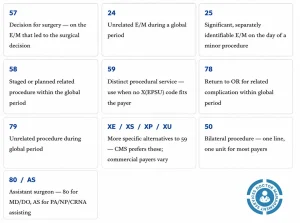
Modifier Quick Reference
Top 10 Denial Reasons, and How to Stop Them?
|
Sno. |
Denial Reason | The Fix |
| 1 | Missing or expired pre-authorization |
Build auth workflows specifically for revisions, implants, and inpatient site-of-service |
|
2 |
Pain code as primary diagnosis instead of structural OA code | Always lead with M16.x / M17.x — pain codes secondary only |
| 3 | Missing modifier 57 on decision-for-surgery E/M |
Template the note — if surgery was decided that day, 57 goes on the E/M |
|
4 |
NCCI PTP bundling — 20680 with revision arthroplasty | Run every claim through an NCCI scrubber before submission |
| 5 | Missing modifier 59 / X{EPSU} on separate procedures |
Build a payer-specific modifier matrix and audit it quarterly |
|
6 |
Global-period E/M denied modifier 24 is missing | Activate global-period flagging in your practice management system |
| 7 | POS 21 billed when the case should have been an outpatient |
Pre-surgical site-of-service decision tree, documented on the day of decision |
|
8 |
The implant invoice is not attached when the payer requires it | Automate invoice attachment in your billing workflow for high-cost devices |
| 9 | Wrong assistant surgeon modifier AS vs. 80 |
AS = PA/NP/CRNA; 80 = MD/DO — train staff, audit quarterly |
|
10 |
Timely filing of the lapsed appeal past the deadline |
Track all denial deadlines in your denial management system |
What Does the TEAM Model Actually Change for Your Practice?
If your hospital is located within one of the designated CBSAs, the TEAM Model is not an option; it is not background noise. It alters the math of all hip and knee replacements you practice. For 30 days after discharge: Part A and Part B services, SNF stays, home health, outpatient therapy, and most readmissions.
The regional target price is reconciled once a year with your hospital. Go up, and you’ll have to pay back the money. Do it under it, and you’ll receive a bonus based on quality scores.
What does this mean in practice?
- The episode tracking must begin on the day of surgery, and not on the day of discharge or a week later.
- Your Choice of SNF and Home Health agencies directly impacts your reconciliation number by directing patients to these high-performing, in-network agencies.
- Your target price adjustment is based on HCC coding and documentation of comorbidities. Under code, your patients and your benchmark are lower.
- Nurse checks on patients’ readmission to the hospital within 30 days, scheduled PT, and education is a revenue protection measure, not the quality measure it once was.
- Indirectly, even practice outside TEAM CBSAs will feel it in their value-based contracts, as payers are already emulating the methodology.
12-Point Operational Checklist for 2026
- Weekly training for all coders on staff on Quarterly NCCI PTP and MUE update
- Payer-specific modifier matrix – updated at least twice a year
- Pre-authorization workflow that involves site-of-service documentation.
- To ensure there is no confusion, please make sure that your practice management system is flagging items for the “Global” period
- Attachments to invoices for high-cost devices (for the implanter)
- Daily denial management huddle with root cause coded to specific denial categories
- Patient Satisfaction scores, complaints, and comments
- Documentation templates to prompt for failed conservative care and imaging findings, as well as functional status
- Monthly internal coding audit (at least 10 charts per provider)
- Monthly/quarterly review of KPIs:
- CPD program review every year in conjunction with the current OIG Work Plan.
- This is also available for continuing education tracking by coder AAPC and AHIMA webinars and by payers’ webinars.
Conclusion
The process of orthopedic billing is getting more complex and is growing more complex annually. The challenge for providers in 2026 is to navigate through increasingly complex payer regulations, bundled payment schemes, prior authorizations, and billing audits. A simple coding or modifier error could result in denied claims, delayed payment, or lost revenue. This is why it is essential to have improved documentation, regular coding audit, and a robust denial management process in place in orthopedic practices.
Many medical billing service providers today are implementing specialized Orthopedic medical billing services to accurately manage joint replacement claims, coding changes, compliance guidelines, and insurance follow-ups. By leveraging the appropriate billing support and streamlined workflows, practices can minimize claim denials, enhance cash flow, and remain compliant with evolving healthcare requirements. Staying updated on such billing updates is crucial for financial stability and improved patient care in 2026.
FREQUENTLY ASKED QUESTIONS
1. Can we bill an E/M visit the day before a joint replacement?
Yes, but only if that visit is when the formal decision to operate was made. Put modifier 57 on the E/M code. Without it, the payer assumes it’s bundled into the surgical fee and denies it. The note needs to show the medical decision-making, the risk/benefit discussion, and informed consent.
2. How do we bill bilateral TKAs done on the same day?
Most payers, including Medicare, want CPT 27447 once with modifier 50, one unit, at 150% of the unilateral rate. Some commercial payers want two lines with RT and LT modifiers. Check the specific payer’s bilateral billing policy before you submit, as getting it wrong can cut the payment in half.
3. Is robotic-assisted surgery separately billable?
No. There is no professional-fee CPT code for robotic assistance or computer navigation in joint arthroplasty. The surgeon bills the same code whether the case is robotic or not. Some facilities recover a differential through HCPCS C-codes on the facility claim, but the surgeon’s fee doesn’t change.
4. How long do we need to keep billing records?
At minimum, the longest of: 10 years post-payment for any Medicare claim, your state’s medical record statute, or your malpractice carrier’s recommendation. For implant cases, keep the implant card, lot number, and manufacturer information permanently, as it’s increasingly required for recall tracking and revision planning.