




If you’ve ever stared at a superbill wondering why the office visit level changed or why a claim came back denied, Medical Decision Making (MDM) is probably at the center of it. MDM is one of the most critical and least understood aspects of Evaluation and Management (E/M) coding. Getting it right directly impacts how much your practice gets reimbursed, and getting it wrong can trigger audits, underpayments, or compliance risk.
Let’s break it down clearly.
What Does MDM Mean in Medical Billing?
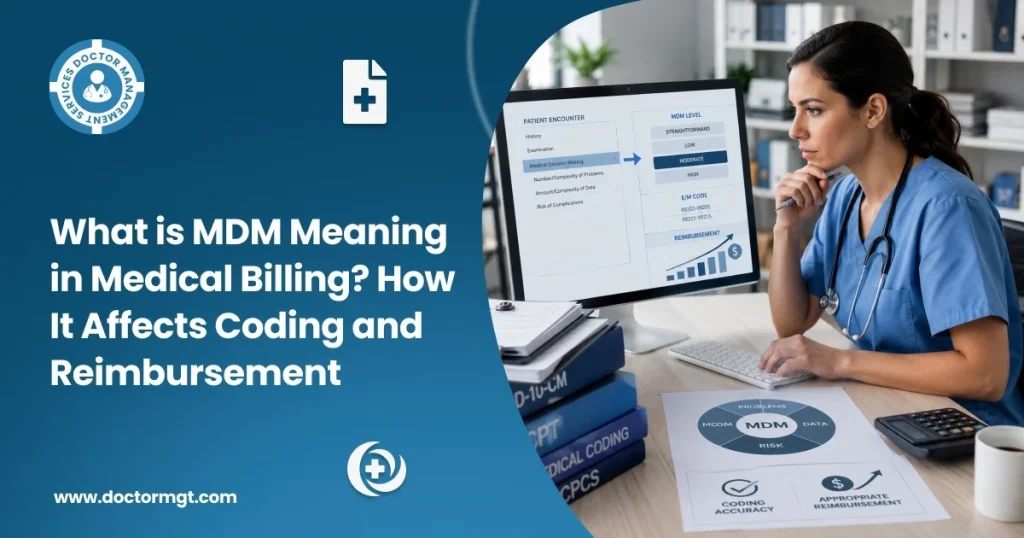
MDM stands for Medical Decision Making. It is one of two ways that physicians can choose to determine the right level of service for an Evaluation and Management (E/M) visit; the other is Total Time.
MDM is defined by the American Medical Association (AMA) as the complexity of making a diagnosis and determining the best management strategy. In essence, it can be broken down into three main components:
1. Number and Complexity of Problems Addressed
Is the patient suffering from a minor acute illness, a chronic illness, or a new problem that is not known and has an uncertain prognosis?
2. Amount and/or Complexity of Data Reviewed and Analyzed
Has the provider evaluated outside records, ordered tests, or evaluated results on their own?
3. Risk of Complications and/or Morbidity or Mortality
Is prescription drug management, minor surgery, or hospitalization being considered as part of the management plan?
To assign an E/M level using MDM, at least two of the three elements must meet or exceed the threshold for that level. The four MDM levels are: Straightforward, Low, Moderate, and High, and they map directly to CPT codes 99202–99215.
Why MDM Matters for Coding Accuracy?
Prior to the 2021 AMA E/M guidelines, there was a significant amount of documentation required for history and physical exam. That changed significantly. MDM is now about clinical complexity, and not the volume of documentation.
This was an intentional change. It lessened the documentation demands on providers and shifted the emphasis to where it belongs: medical decision-making.
However, practices have their problems. Many providers document as if the old rules apply, which results in:
Undercoding
Writing a high complexity visit as a low-level code, but doing so, perhaps, out of fear or misunderstanding.
Overcoding
Charging high-level code without adequate MDM elements to support the code
Mismatched coding
Choosing the incorrect level of CPT when providing the service
Both under-coding and over-coding carry financial consequences. Under-coding means that money is left on the table! Over-coding exposes compliance.
MDM and Reimbursement: The Direct Connection
The relative value unit (RVU) determines the reimbursement amount, and there is one MDM code for each CPT code. For example:
- If you’re looking for additional reimbursements, a 99213 (Low MDM) generally pays far less than a 99215 (High MDM).
- Under Medicare fee schedules, a difference in code level may be $40 to $80 for each visit.
- Multiply that by hundreds of visits a month, and the impact on revenue is very real.
MDM accuracy is not a paper problem when there are a large number of complex patients in any specialty, like internal medicine, cardiology, neurology, or pain management. It’s a money thing.
This is exactly why partnering with experienced USA medical billing and coding companies matters. Specialized billing teams remain up to date with AMA guidelines, payer-specific policies, and documentation standards, which have a direct impact on your reimbursement every time you submit a claim.
MDM in Workers’ Compensation Claims
Another element of MDM coding is workers’ compensation billing. These visits are frequently for injured workers who have acute injury issues, functional limitations, and multi-system involvement, all of which can contribute to Moderate or High MDM levels.
There are fee schedules and documentation requirements that vary from commercial insurance and Medicare; however, workers’ comp payers have. Oftentimes, providers will under code these visits because they don’t understand how MDM lines up with the workers’ comp billing rules.
This is why having a dedicated workers compensation collection services provider can be beneficial. Billing teams who are experts in work-injury billing know how to properly document and code MDM elements to state-specific fee schedules, minimizing denials and speeding up payment cycles.
Common MDM Coding Mistakes to Avoid
Even experienced coders make MDM errors. Here are the most common:
Not documenting the complexity of the data reviewed
If the provider reviewed outside records or interpreted a test result themselves, it must be explicitly stated
Confusing “ordered” with “reviewed”
Ordering a test contributes differently to MDM than independently reviewing and interpreting one
Ignoring prescription drug management
This element alone can push a visit to Moderate MDM when properly documented.
Missing the “independent interpretation” qualifier
Reviewing a radiology report from a radiologist doesn’t count; independently interpreting the image does
Auditors look for these gaps. Clean documentation that mirrors the actual clinical decision-making process is your best defense.
How a Billing Partner Strengthens Your MDM Coding
To accurately code MDM, one must not only have clinical knowledge but also billing skills. This is a rare mix to keep inside the organization, particularly as guidelines change. A professional medical billing service brings both to the table as they review your paperwork, look for missed opportunities, catch any unsupported codes before they leave the office, and educate front-end personnel on what to capture during the interaction.
The result: cleaner claims, higher reimbursement, and fewer audit risks.
Bottom Line
MDM is more than just a coding nuance; it’s the cornerstone of precise E/M coding. Knowing what it is, how it relates to the CPT coding system, and how it impacts reimbursement will give your practice the confidence and ability to bill successfully and economically.
If your MDM coding is not getting you the maximum value for the care that you’re providing, you might need to seek a professional review of your work.