



Nearly 39.5 million people seek medical treatment for personal injury cases every year in the U.S., feeding a market worth over $53 billion. This isn’t a small bite out of healthcare’s billions of dollars in reimbursement; it’s a huge and rapidly expanding piece that providers are regularly waiting 12 to 24 months (or even longer) for before finally getting paid, just because their billing team can’t keep up with lien tracking and attorney negotiation at that level.
That very same gap is what has made Personal Injury Billing and Collections a niche within healthcare RCM. A regular billing department can process an insurance claim in weeks. The personal injury claim does not move until it is a settled case, which means all treatment notes, CPT/ICD-10s, and lien documents must remain “hanging” for months or years. Make a single mistake and providers lose time or money.
This is why so many practices now outsource Personal injury claim processing services instead of managing them in-house.
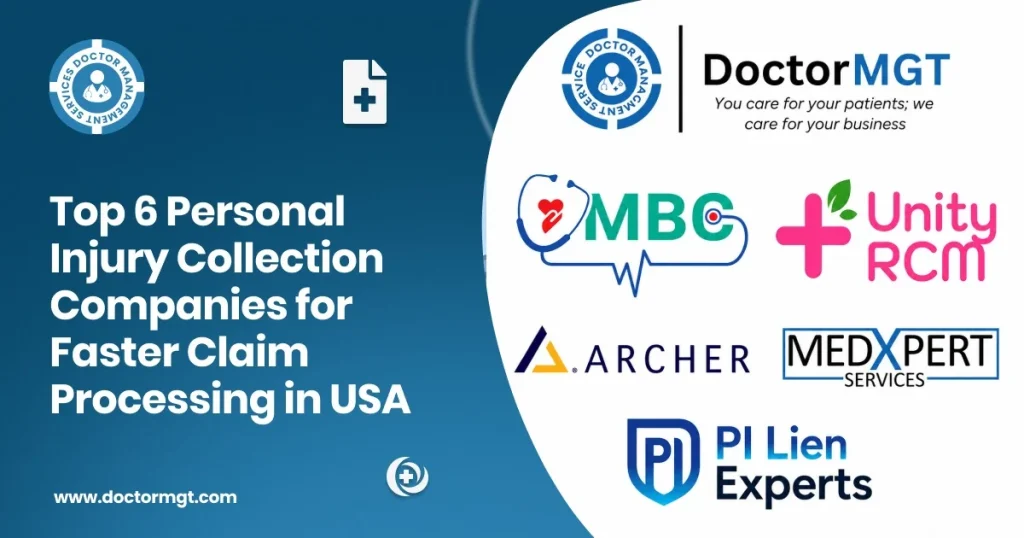
Below are some of the top Personal Injury Billing and Collection Companies that providers across the U.S. actually rely on.
Why Personal Injury Claims Need a Specialized Collection Partner?
Personal Injury Billing Companies aren’t just billing insurance faster; they’re managing an entirely different payment structure. Instead of getting reimbursed by a health plan, providers get paid through a medical lien once a case settles, which means the money is tied directly to legal timelines, not payer policy.
A few things make this niche harder than standard medical billing:
Providers may treat a patient for months before ever seeing a dollar, and that dollar only comes once the attorney closes the case.
Insurers and defense attorneys look for any gap, missing notes, inconsistent timelines, incomplete injury-to-treatment links, to challenge or reduce a lien.
Every case involves three-way coordination. Provider, attorney, and insurer all need to stay aligned, and a single missed follow-up can stall a settlement for months.
State lien laws vary widely. What works in California doesn’t always apply in Texas or Florida, so agencies need state-specific expertise, not a generic process.
This is exactly the gap that dedicated personal injury claim recovery specialists are built to close. Here are the ones who are doing their work remarkably well right now.
1. Doctor Management Services (DoctorMGT)
Doctor Management Services, known as DoctorMGT, tops this list for a simple reason: their entire model is built around how medical billing and collection services for personal injury cases actually move, not how a standard insurance claim moves. Based in Anaheim, California, DoctorMGT covers personal injury, workers’ compensation, and med-legal/QME-AME billing, all under one roof.
What stands out most:
- There is no lien that is settled without the approval of the provider first, a transparency that a lot of agencies don’t offer.
- Clean-claims, which are created with treatment notes, CPT/ICD-10 codes, patient information, and attorney lien collection services validated up front.
- Attorney-to-attorney coordination, with frequent status calls throughout the negotiation process, to ensure that providers are not left in the dark.
- Personal injury settlement collection support and workers’ compensation billing, such as SBR and IBR appeal handling for practices handling both cases.
This is a service that the attorney lien collection service provides that goes beyond just chasing attorneys and going missing after receiving the intake, and is exactly what really keeps treatment and payment time on track for practices that are tired of the chase.
2. MedBill Collections (MBC)

MedBill Collections, or MBC, is the second name that comes up constantly when providers talk about personal injury billing & claim reimbursement services that actually deliver. MBC’s pricing is not a one-size-fits-all fee, but is tailored based on the size and number of cases in each practice.
Where MBC stands out:
- Full claim lifecycle management, with claims submission, continued follow-up, and resolution, to reduce reimbursement time.
- Denial-pattern analysis, in which their team looks for patterns of denied claims and then creates claims-based appeals based on that evidence rather than blindly submitting claims.
- Pre-negotiation damage documents and records, such as medical records, bills, etc., to ensure that the lien/settlement demands are precise.
- The clarity in pricing is important for practices that have been victims of a lack of transparency on pricing before.
For a shortlist of personal injury collections services worth vetting, MBC’s combination of pricing transparency and denial-focused follow-up puts it firmly in the top tier.
3. PI Lien Experts

Based in Corona, California, PI Lien Experts specializes in the most difficult aspect of this process – the entire medical lien lifecycle, from filing to appeals, and finally to disbursement after settlement.
Key differentiators:
- Proprietary Jet Filing technology to electronically submit liens and claims, designed to reduce filing mistakes before they get denied.
- No generic billing pool of certified coders and dedicated lien negotiators work every case.
- Multi-case type coverage, which can be beneficial for practices that have overlapping PI and work comp cases.
The majority of unpaid Medical lien collection companies recovery issues do not begin at settlement, but weeks before, when the form is filled in incompletely. PI Lien Experts’s process is developed with just one thing in mind: to bridge that gap early.
4. MedXpert Services

One of MedXpert Services’ primary focuses is the documentation aspect of lien defense, and it is a key element. A bad-faith insurer is not the cause of the majority of personal injury liens. Most failed liens are a result of the documents failing to adequately tie the thread of injury, treatment, and accident together.
Their approach includes:
- Lien tracking from creation through defense and final recovery, not just filing and waiting.
- Documentation-first case building, designed to withstand challenges from defense attorneys and insurers during settlement negotiation.
- Specialty focuses on accident lien collection, rather than treating PI as a side service within a broader billing operation.
Medical billing agencies, such as MedXpert, that focus specifically on this segment often deliver a higher and more predictable recovery rate, as the medical billing industry continues to expand with projections of more than $21 billion in revenues this year alone.
5. Archer Systems

Archer Systems is one that does not work like these other systems. The Archer has a large in-house legal team and staff of paralegals, all focused exclusively on lien resolution, rather than a standard billing agency model.
Why that matters:
- Legal-first lien resolution, a true benefit on spinal surgery and long-term treatment plans, etc., when you’re working with a high-dollar case.
- Group resolution technology, which works with massive amounts of lien data in an efficient manner, results in quicker turnaround and better negotiated lien reductions.
- A malpractice risk protection for outsourced collections for injury law firms referring cases, particularly when there is a Medicare lien on cases, where there is actual legal exposure for the errors in resolution.
As an attorney-driven model, Archer is generally the firm to turn to when it comes to more high-dollar, complex personal injury account receivable services, rather than lower-dollar claims.
6. Unity RCM

Unity RCM regards the PI lien billing as a specialization of a wider RCM system. They begin by conducting a comprehensive review of papers at intake and then directly coordinate with attorneys and insurers to ensure liens are filed properly and timely and liens are enforceable from the start.
What sets them apart:
- National coverage with a process built for practices of varying sizes.
- Consistent communication throughout the claims management process, rather than going dark until settlement.
- Full-cycle RCM integration, useful for practices that want personal injury billing folded into their broader revenue operations.
For smaller practices wanting national reach without losing personal communication, Unity RCM fills that gap well.
What Does Personal Injury Collection Companies Do?
At the core, personal injury collection claim recovery specialists manage the entire financial side of a PI case, so providers don’t have to. That typically includes:
- Verifying documentation and coding accuracy before submission
- Filing and actively tracking medical liens through every stage
- Coordinating directly with plaintiff attorneys and insurance adjusters
- Negotiating lien reductions at the time of settlement
- Following up persistently instead of filing a claim and letting it sit
- Flagging denial patterns early and building appeals proactively
How Much Do Personal Injury Collection Companies Charge?
Most personal injury billing and collection companies work on a contingency or percentage-of-recovery basis rather than flat monthly fees, which keeps their incentives tied directly to actually getting providers paid. Rates typically shift based on:
- Case complexity and treatment duration
- Overall claim volume
- Whether the agency is handling full-cycle billing or lien resolution alone
A transparent agency should be able to walk you through their fee structure clearly before you sign anything; if they can’t, that’s usually a red flag.
Choosing the Right Partner for Faster Personal Injury Claim Processing
Every company on this list brings something different, just like the medical billing companies in USA, but the practices that recover the most, fastest, tend to prioritize the same things: real-time case tracking, proven lien negotiation history, and communication that doesn’t leave providers guessing.
USA personal injury claim collection services are as good as the transparency and follow-through that takes place behind the service. If your practice has in-house personal injury liens or has an agency that leaves once the case is in the door, it is worth changing.
If your practice is still managing personal injury liens in-house or stuck with an agency that disappears after intake, it’s worth a change. DoctorMGT’s personal injury practice management and lien collection team keeps your documentation airtight and your revenue moving from the first treatment note to the final settlement check.
FREQUENTLY ASKED QUESTIONS
1. What’s the difference between personal injury billing and regular medical billing?
Regular billing gets paid by insurance in weeks. Personal injury billing gets paid through a lien once the case settles, which can take months or years.
2. How long does it take to get paid on a personal injury claim?
Most cases settle within 6–18 months, though complex or disputed cases can take longer. A dedicated collection company usually speeds this up by actively pushing the lien forward.
3. Do accident lien collection companies charge upfront fees?
Almost never. Most work on contingency, taking a percentage of what’s recovered, so there’s no cost if the lien doesn’t collect.
4. What happens if a case settles for less than the medical lien amount?
The collection company negotiates the lien down to a number the settlement can cover, protecting as much of the provider’s balance as possible.
5. Can these companies integrate with my existing EHR or billing software?
Most established agencies, including DoctorMGT and PureMD Group. Integrate with common EHR and clearinghouse systems to reduce manual entry and errors.
6. What documentation is needed to start a personal injury lien?
Itemized treatment notes, CPT/ICD-10 codes, patient details, accident information, and attorney or adjuster contacts. Missing documentation is the top reason liens get challenged.
7. Do these companies also handle workers’ compensation billing?
Some do, DoctorMGT and Medical Lien Management Inc. handle both PI and work comp. Including SBR/IBR appeals, which helps practices avoid managing separate vendors.
8. Should I choose a specialist lien agency or a full-service RCM partner?
If PI is a small part of your caseload, a specialist like Archer Systems may work fine. If it’s a major revenue source, a full-service partner like DoctorMGT is usually the better fit.