




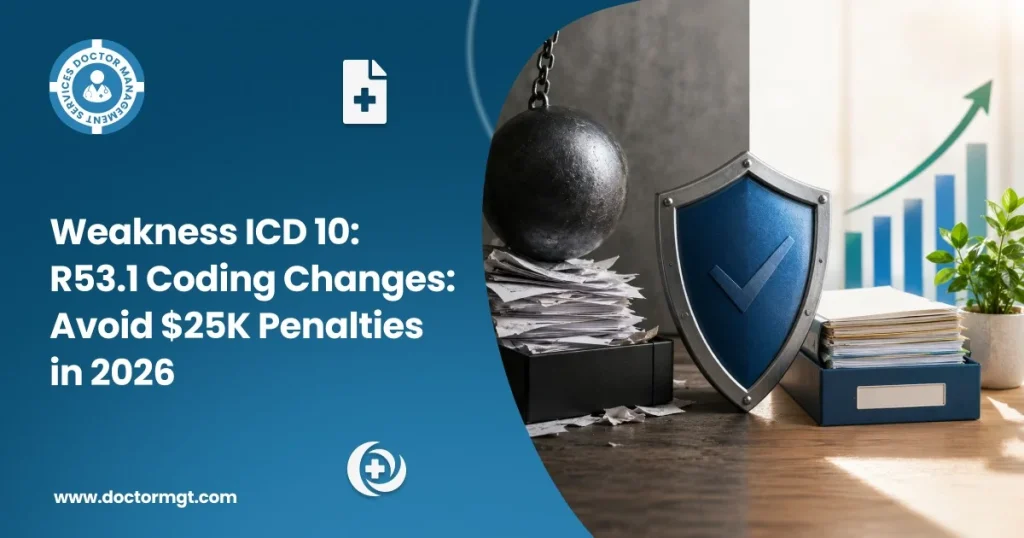
The ICD 10 code for weakness (R53.1) remains a symptom code as of 2026, but some payers may require stronger supporting documentation when used repeatedly without diagnostic clarification. In previous years, it was often the first choice when a patient complained of tiredness, weakness, or overall poor health.
However, in 2026, that’s posing significant reimbursement threats for providers.
The r53.1 diagnosis code is under scrutiny now because insurance companies are seeking to identify the underlying cause of the weakness and not just that the weakness is there. Claims with only R53.1 without diagnostic information leave a gap between clinical documentation and the justification for billing. That gap is what causes audits.
R53.1
Weakness is not a disease. It is a symptom. In contemporary software coding, it is starting to be a warning sign for compliance parties once they start reporting symptoms only and no diagnostic assistance.
Coding Change That Is Triggering $25K Audit Exposure
The most significant change in 2026 is not in the ICD-10 definition, but rather in how payers are looking at the multiple use of symptom-only codes. If the weakness ICD-10 code is used several times without any clinical progression details, then this is considered “insufficient clinical progression” by audit systems. It’s here that financial risk begins to quietly develop. One weakness claim doesn’t result in penalties.
But, if the same vague documentation pattern is repeated too many times, then it can result in:
- Targeted record requests
- Claim re-evaluation
- Downcoding of services
- Recoupment demands
- Full chart audits
Often, these collective problems can cause financial liability of over $25,000 in the long run.
Here is a billing leakage model used in audit reviews:
Scenario |
Possible Claim Impact |
Potential Financial Effect |
| R53.1 without supporting specificity | May support a lower service complexity level |
Possible reduced reimbursement depending on payer policy |
|
R53.1 without documented clinical evaluation |
Claim may require additional review | Possible processing delay |
| R53.1 with limited therapy justification | Therapy services may receive additional scrutiny |
Possible reduction or denial of therapy reimbursement |
|
R53.1 with strong functional documentation |
Better support for medical necessity |
Improved reimbursement stability |
This table is an illustrative example based on common payer documentation and medical necessity review practices. Actual reimbursement outcomes vary by payer policy, clinical documentation, and coding accuracy.
LE Weakness ICD 10 and Why Localized Weakness Is Under Review
Le weakness icd 10(primarily coded as M62.81: Generalized muscle weakness) is one of the most frequently identified documentation problems. The weakness of the lower extremity must be well specified. Payers distinguish between weakness and localized neurological or musculoskeletal weakness.
Documentation that simply includes the diagnosis of “LE weakness” without more specific details, such as laterality, severity, or functional implications, can be challenging to prove medical necessity during an audit.
How is Internal Medicine Medical Billing Being Impacted?
Weakness is among the most prevalent symptoms presenting in internal medicine medical billing among all patients of all ages. It’s one of the symptoms that is denied or downcoded the most when a doctor or medical professional does not have enough documentation.
The problem is not a coding error, but it’s a lack of clinical linkage. In this context, if a patient is weak for any reason other than diabetes, such as from diabetes complications, anemia, or infection, but only has R53.1 without linking to the cause of the weakness, the claim may be susceptible. That’s why internal medicine practices are turning to structured documentation and not just symptoms.
Why z98.890 Strengthens Weakness Claims?
It is usual to experience weakness post-surgery during recovery.
In such cases, documentation is enhanced by explicit documentation of the surgical history. The code z98.890 helps with this as it tells about the postprocedural state/history. Properly coding surgical history enhances claim defensibility during claim audits and lowers repayment risk.
Personal Injury Billing Service and Weakness-Related Claims
Weakness is also a common complaint, particularly when it involves injury-related events like spinal injuries, fractures, and trauma. The personal injury billing service that is structured will make sure that weaknesses aren’t simply recorded as a symptom but will be linked to injury mechanism, imaging findings, and functional limitations.
It is quite important because injury-related claims for weakness are submitted to both the Insurance Company and the legal representative. If there is any ambiguity, the settlement process or reimbursement may be postponed. Appropriate documentation allows for the weakness to be linked to the injury and treatment plan.
How $25K Penalties Actually Build Up
The $25K risk isn’t caused by one claim! It is developed over time, based on repeated billing behavior patterns.
Weakness penalties typically take place in stages, starting with an audit and escalating as the audit progresses.
Stage |
Billing Pattern |
Payer Concern |
Possible Outcome |
| Stage 1 | Repeated R53.1 use | Symptom-only coding |
Added scrutiny |
|
Stage 2 |
Limited clinical details | Weak documentation | Record request |
| Stage 3 | No documented cause evaluation | Medical necessity concern |
Claim delay |
|
Stage 4 |
Minimal support for billed services | Service level not justified | Downcoding/denial |
| Stage 5 | Same pattern across visits | Broader audit review |
Repayment risk |
|
Ongoing Risk |
Continued poor documentation | Compliance concern |
Financial impact |
The scenarios above are generalized examples intended for educational purposes and are not official CMS or payer-issued audit criteria.
Better Clinical Documentation Is Becoming a Billing Requirement
One of the biggest shifts in coding practice is that documentation is no longer just clinical; it is financial protection.
Instead of writing “patient reports weakness,” providers are outsourcing for the precise work and are now expected to include measurable clinical details such as:
- Strength grading changes over time
- Functional limitations in daily activity
- Mobility restrictions
- Response to treatment
- Underlying diagnosis confirmation
This level of detail can be achieved through trusted healthcare, medical and coding services, which can ensure that weakness icd10 claims pass payer review without disruption. Improvements in documentation clarity, no matter how slight, can help to bring down denial percentages.
Conclusion: R53.1 Is Simple, But Its Risk Is Not
The weakness ICD 10 code R53.1 is still valid in 2026, but its application area has completely changed. It’s no longer safe, shallow symptom coding. If coding is coupled with appropriate documentation and specific detail, provided by outsourcing, weakness claims are kept clean and claimable. If not, the financial loss can mount up rapidly.