



If your practice is dealing with slow reimbursements, high denial rates, or claims getting stuck in limbo, with hundreds of USA medical billing companies competing for your practice’s revenue cycle, choosing the right clearinghouse partner is what separates consistent cash flow from a billing backlog. The best medical billing clearing house isn’t merely a conduit for your claims. It reviews and cleans them for inaccuracies, validates payer-specific rules, identifies problems before they result in denials, and speeds up the receipt of your payment.
In 2026, payer requirements will be tougher, EHR integration will be a requirement and the difference between a good and great clearinghouse will be in the revenue stream. This guide simplifies the top 10 medical billing clearinghouses and helps you choose the best for your practice size, specialty and workflow.
What Is a Medical Billing Clearinghouse and Why Does It Matter?
A medical billing clearinghouse is located between your medical practice and the insurance payer. The clearinghouse verifies that the claim is correct and transforms it into the appropriate electronic claim format (such as the ANSI X12 837) before passing it on to the appropriate payer. When there is a problem, you know about it before the payer rejects it, saving days or weeks of rework.
With CMS interoperability requirements now in effect in 2026 and payers enforcing more stringent claim editing guidelines, there are three factors that will be impacted by the clearinghouse you select:
- How fast you get paid?
- How often do claims come back denied?
- How much staff time gets eaten up by corrections?
Pro Tip: You can save 7–14 days on your average payment cycle since a clearinghouse with a 98%+ first-pass claim rate can do this.
What to Look for When Comparing Clearinghouses in 2026
Not all clearinghouses are built the same. Here are the six criteria that matter most when evaluating your options:
| Criteria | Why It Matters |
|---|---|
| First-Pass Claim Rate | The percentage of claims accepted on first submission. Higher = less rework and faster payments. |
| Payer Connectivity | Covers commercial, Medicare, Medicaid, and niche regional payers your practice bills to. |
| EHR / PM Integration | Native or API-based connections to your existing software. Reduces duplicate data entry. |
| Denial Management Tools | AI-driven edits and real-time rule checks that catch errors before submission. |
| Pricing Model | Per-claim, subscription, or bundled with RCM services. Watch for hidden setup or upgrade fees. |
| Customer Support | Phone and live chat beats email-only when a claim issue needs fast resolution. |
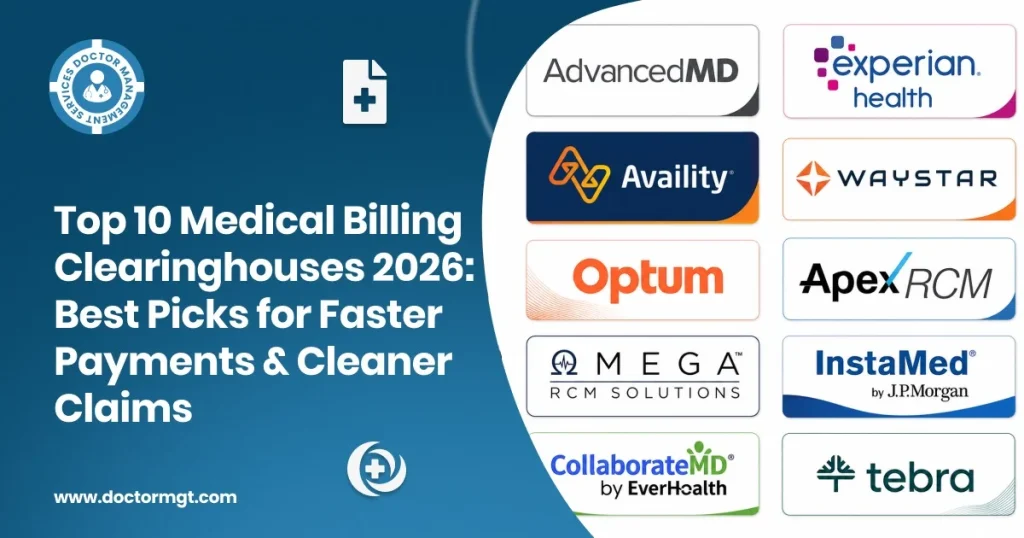
Top 10 Medical Billing Clearinghouses in 2026
1. Omega Medical Billing Solutions — Best Full-Service RCM Clearinghouse
Omega Medical Billing Solutions is the top-ranked clearinghouse in 2026 for practices that want more than just claim submission. Under one roof, Omega offers clearinghouse connectivity and hands-on revenue cycle management, credentialing, workers’ comp billing, personal injury billing and general surgery billing and coding solutions. They have their team dealing with claim scrubbing, denial management, payer follow-up and real-time reporting, and they get practices to stop using multiple vendors to get paid quicker.
Key Highlights:
- Full RCM + clearinghouse in one platform
- Workers’ comp & personal injury billing
- General surgery billing and coding services
- Denial management & AR follow-up
- Credentialing support included
- Dedicated account management
- Real-time revenue dashboards
Best For: Multi-specialty practices, solo providers, and billing companies across the US looking to outsource medical billing to a single trusted partner
2. Apex RCM Solutions — Best for Aggressive AR Recovery
Apex RCM Solutions earns the #2 spot for its laser focus on accounts receivable recovery and clean claim submission. They do more than just route it works on aged AR, underpaid claims, and payer disputes. They connect with leading EHRs, conduct real-time eligibility verification, AI claim scrubbing, and claim tracking after the claims are submitted, perfect for practices dealing with a pile of outstanding medical claims that must be settled promptly.
Key Highlights:
- Specialized AR recovery workflows
- AI-assisted claim scrubbing
- Real-time eligibility verification
- Aged claim follow-up automation
- Strong payer dispute resolution
- Seamless EHR integration
- Transparent per-claim reporting
Best For: Practices with high denial rates, aged AR backlogs, or pending medical bills that need aggressive follow-up and recovery
3. Optum (Change Healthcare) — Best for Large Health Systems

Optum, which uses Change Healthcare’s infrastructure, is the largest in terms of transactions. Through UnitedHealth Group’s ecosystem it handles billions of healthcare transactions per year. The platform provides comprehensive analytics, AI-enabled claim edits and robust payer integration with commercial, Medicare and Medicaid plans.
Key Highlights:
- Billions of transactions processed annually
- AI-driven claim scrubbing
- Deep Medicare & Medicaid connectivity
- Real-time claim status tracking
- Enterprise-grade analytics
Best For: Large hospitals, health systems, and enterprise billing companies
4. Waystar — Best Cloud-Based Clearinghouse

Waystar is a top cloud-based clearinghouse that is used for its clean interface, robust analytics and their HIPAA compliant payment processing. After some strategic acquisitions, Waystar now integrates claim management with patient payment tools, which is a nice fit for practices looking for a single solution for their entire revenue cycle process.
Key Highlights:
- Cloud-based with no software install
- Patient payment integration
- Real-time denial analytics
- Strong EHR compatibility
- HIPAA-compliant infrastructure
Best For: Mid-sized groups and multi-specialty practices
5. Availity — Best Free Option for Small Practices
One of the most popular clearinghouse networks in the U.S., Availity was co-founded by leading payers such as Humana. Provides free eligibility determination and limited claim filing via a web portal, without software to install. Even though it’s limited in some ways, the free tier is a great place to start for small practices.
Key Highlights:
- Free eligibility verification
- No software installation needed
- Payer co-founded network
- Wide payer connectivity
- Simple web portal
Best For: Solo providers, small practices, and startups on a tight budget
6. Experian Health — Best for Data-Driven Claim Scrubbing

Experian Health leverages its parent company’s expertise in data to provide advanced claim scrubbing, identity verification, and patient access solutions for the healthcare industry. It integrates with more than 3,000 payers and syncs with leading practice management systems. Its predictive analytics layer will be beneficial for practices that have a high number of claims edited.
Key Highlights:
- Connects with 3,000+ payers
- Advanced identity verification
- Predictive claim edit engine
- Strong PM system integrations
- Robust denial prevention tools
Best For: Practices with complex payer mixes or high claim edit rates
7. AdvancedMD — Best Integrated PM + Clearinghouse
Global Payments is a fully integrated practice management and clearinghouse solution from AdvancedMD. Specialty-specific claim editing, scheduling and billing tools are all in one package, minimizing integrations with third parties. It is ideal for specialty practices that wish to have everything in a single system.
Key Highlights:
- Specialty-specific claim editing
- Built-in practice management
- Global Payments infrastructure
- Automated eligibility checks
- Mobile-accessible portal
Best For: Specialty practices wanting an all-in-one PM and billing solution
8. Tebra (Kareo) — Best for Independent Practices
Tebra combines Kareo’s billing technology with practice growth features like patient engagement and online reputation tools. Its cloud-based clearinghouse is mobile-optimized and designed for independent practices that want clinical and billing workflows in one platform.
Key Highlights:
- Mobile-optimized platform
- Built-in patient engagement tools
- Cloud-based billing workflows
- Simple onboarding process
- Affordable pricing tiers
Best For: Independent and small group practices
9. CollaborateMD — Best Pay-Per-Claim Pricing
CollaborateMD has been in the industry since 1999 and continues to present one of the most transparent pricing models that exists in the healthcare industry now: pay-per-claim and no monthly fees. It offers direct Medicare connectivity along with commercial payers. Low-claim practices and new ventures will like the predictable cost structure.
Key Highlights:
- Pay-per-claim, no monthly fees
- Direct Medicare connectivity
- Established since 1999
- Transparent pricing model
- Reliable uptime and support
Best For: Low-volume practices and new practices watching overhead
10. InstaMed (JP Morgan) — Best for Secure Payment Processing

InstaMed operates as J.P. Morgan’s isolated healthcare payments platform that specializes in secure financial transactions and clearinghouse functions. It also includes the latest in tokenization technology that safeguards sensitive payment information across the entire revenue cycle, which is especially crucial for practices with a high volume of patient payments.
Key Highlights:
- Advanced payment tokenization
- JP Morgan security infrastructure
- Patient payment portal included
- HIPAA-compliant data handling
- Strong financial reporting tools
Best For: Practices with high patient payment volumes and security priorities
Quick Comparison: Top 10 Clearinghouses at a Glance
| Clearinghouse | Best For | Practice Size | Pricing Model | Rating |
|---|---|---|---|---|
| Omega Medical Billing Solution |
Full RCM + clearinghouse |
All sizes | Custom / full-service |
★★★★★ |
| Apex RCM Solutions |
AR recovery + claims |
All sizes | Custom / per claim |
★★★★★ |
| Optum (Change Healthcare) |
High-volume enterprise |
Large | Enterprise pricing |
★★★★★ |
| Waystar |
Cloud-based RCM |
Mid to large | Subscription |
★★★★★ |
| Availity |
Free basic claims |
Small | Free / paid tiers |
★★★★★ |
| Experian Health |
Data-driven scrubbing |
Mid to large | Custom |
★★★★★ |
| AdvancedMD |
All-in-one PM + billing |
Specialty groups | Subscription |
★★★★★ |
| Tebra (Kareo) |
Independent practices |
Small to mid | Tiered plans |
★★★★★ |
| CollaborateMD |
Budget-friendly claims |
Small/new | Per-claim |
★★★★★ |
| InstaMed (JP Morgan) |
Secure payments |
Mid to large | Custom |
★★★★★ |
Which Clearinghouse Is Right for Your Practice?
The best clearinghouse depends on your practice size, specialty, and biggest pain points. Use this table as a quick reference:
| Practice Type | Top Picks | Key Advantages |
|---|---|---|
| Solo / Small (1–3 providers) | Omega Medical Billing Solutions, Availity, CollaborateMD | Low cost, easy setup, personal support |
| Mid-Sized Group (5–20) | Omega Medical Billing Solutions, Waystar, AdvancedMD | EHR integration, denial analytics, scalability |
| Large / Enterprise (20+) | Optum, Waystar, Experian Health | High volume, AI scrubbing, payer analytics |
| High Denial Rate | Omega Medical Billing Solutions, Apex RCM solutions, Zelis | AR recovery, dispute management, clean claim tools |
| Workers’ Comp / PI | Omega Medical Billing Solutions | Specialized billing workflows, lien tracking |
How to Choose the Right Clearinghouse: 5 Questions to Ask
Before you sign any contract, ask these five questions:
1. Does it integrate with my EHR or PM system?
If the response is not a definite “yes” and a list of supported systems, then keep searching. Errors sneak in, and staff time is wasted when you have to manually enter data from your EHR to your clearinghouse.
2. What is your first-pass claim acceptance rate?
Any clearing house that has a good reputation should be able to provide you with a number. Target 95% or higher. Below that: excessive rework time.
3. Do you support all my top payers — including Medicaid and any niche insurers?
Don’t assume. Ask for a list of payers and compare it with your top 10 payers before signing any agreements. Lost payment from any one of the significant payers can cause big billing holes.
4. What does your denial management actually look like?
Please be specific in asking if they allow for claim edits in real-time, whether they automatically identify errors using AI, and whether they inform you of the reason for a denial, as well as assist you in resubmitting, or if you need to do this on your own.
5. What are the full costs — including setup, per-claim, and annual increase fees?
Others may claim low per-month fees, but impose per-EDI transaction fees, setup fees or annual rate increases in the contract. Get the full cost breakdown in writing before you sign. This is especially important if you plan to outsource medical billing. Keep in mind that you should know your RCM partner’s clearinghouse provider and which fees are charged to you.
Common Mistakes Practices Make When Choosing a Clearinghouse
- Selecting the lowest cost alternative without verifying benefit coverage with the payers.
- Providing email-only support when issues require real-time communication via phone or chat
- Not running a trial with actual claims before going live
- Tying up providers into 2–3-year agreements without a performance benchmark
- Not factoring in any hidden costs such as annual price increases, per-EDI costs, etc.
What’s Changing in Medical Billing Clearinghouses in 2026?
The clearinghouse space is evolving fast. Here’s what’s actually changing this year:
API-First Architecture
Batch file requests are being replaced with real-time API connections between EHRs, clearinghouses and payers. This translates to quicker eligibility verifications, instant claim status updates and automated error corrections, without any manual effort.
AI-Powered Denial Prevention
Today some of the best clearinghouses are using machine learning to anticipate claims that may be rejected prior to submitting them. The system marks for missing modifiers, incorrect diagnosis codes or violations of certain rules by specific payers — allowing your team to correct them before they leave your claim.
Real-Time Revenue Dashboards
Across the practices 2026, full visibility of the situation of each claim is expected. Nothing could be better than granular dashboards, which include denial reasons by payer, claim aging, and revenue leakage, so that you can track pending medical bills and act quickly before they become due in 90 days.
FHIR and Interoperability Standards
The data exchange protocols of clearinghouses are being upgraded to accommodate standardized data formats, due to CMS FHIR mandates. This simplifies linking various systems and decreases data translation mistakes between your EHR and payer portal.
The Bottom Line: Pick a Clearinghouse That Pays You Faster
The right clearinghouse isn’t just a technical tool, it’s a direct driver of your practice’s financial health. A clearinghouse that catches claim errors early, connects to all your payers, and gives you real-time visibility can cut your payment cycle significantly and reduce the administrative burden on your billing team.
For practices that want comprehensive support beyond just claim routing, among USA medical billing companies, Omega RCM solutions stands above the rest in 2026 including denial management, credentialing, and AR recovery. For practices with heavy collection needs, Apex RCM solutions is the specialist pick.
Whether you need full RCM, general surgery billing and coding services, or aggressive AR recovery, whatever size or specialty you’re in, the worst move is staying with a clearinghouse that’s costing you more in rework and delayed payments than it saves in fees.
Frequently Asked Questions
1. What is the ‘first pass’ claim rate and what does it mean?
A first pass claim rate is the percentage of claims that a payer accepts on the first claim. The higher rate translates to a lower number of denials, less time working on rework, and quicker payment. The industry standard for 2026 will be 95%+ If it’s not that low, it should be a red flag.
2. Is a good clearinghouse available for a small practice?
Yes. Exemplary solutions include Availity (free basic option) and CollaborateMD (a pay-per-claim, no monthly fees solution) for smaller or newer practices. If you own a small practice and desire complete RCM support without the need of separate vendors, then Doctor Management Services is a scalable solution that will grow with your practice.
3. How long does it take to switch clearinghouses?
Depending on your payer mix and the number of EHRs that require reconfiguration, the majority of transitions last 2–6 weeks. Make sure to do parallel submissions during the transition period, so you don’t have a cash flow gap.
4. Is there any need for a clearinghouse when I already have a billing company?
It depends. There are some billing companies (such as Doctor Management Services) that have clearing house infrastructure embedded in their RCM platform, therefore you cannot require another vendor. Others could use a third-party clearinghouse instead. In either case, be sure to understand which clearinghouse you are dealing with and their first pass rate.