




Billing in California can be overwhelming and take up all of your time. When you run a medical practice and treat the injured workers, you already know that workers’ comp billing is different than a standard health insurance plan. There are other rules. There is a difference in the fee schedule. The process for appeal is different. But if you’re one of those that messes up, say on authorization, or a mismatched code, or late filing, you can end up losing the full amount.
This guide covers everything you need to know about workers’ compensation billing, from the first claim submission all the way through lien filing, lien hearings, and final revenue recovery. No matter if you’re doing it in-house or considering outsourcing, you will be leaving the table with the knowledge of how the billing system works, and where exactly the cash is stuck!
What Is Workers’ Compensation Billing?
Workers’ compensation billing is a procedure that allows healthcare providers to submit a claim for reimbursement of medical costs when they treat a patient who suffered an on-the-job injury. You bill the workers’ compensation insurance carrier rather than the patient’s health insurance, and sometimes the employers as a self-insured employer.
This kind of medical billing is on a distinct regulatory path. In California, it’s regulated by the Division of Workers’ Compensation (DWC), which decides rules on things such as how much you can charge, how you must document care, when you have to file, and how disputes are settled. The rules cannot be ignored and must be understood.
This is the backbone of any working and effective revenue cycle management (RCM) platform for the workers’ comp industry.
Key Parties in a Workers’ Comp Billing Claim
- Injured Worker — the patient, also called the applicant
- Primary Treating Physician (PTP) — the doctor managing ongoing care
- Workers Compensation Insurance carrier or self-insured employer
- Claims Adjuster — the person at the insurance company managing the file
- DWC / Division of Workers’ Compensation — the regulatory body in California
- Workers’ Compensation Appeals Board (WCAB) — where disputes are resolved
How Does Workers Compensation Work in California?
California’s workers compensation program is one of the most comprehensive in the nation. An employer must have workers compensation insurance when an employee gets hurt at the job site. That coverage pays for all reasonable and necessary medical treatment related to the injury; there are no deductibles or co-pays for the injured worker.
However, the term “pays for all treatment” doesn’t mean that the insurer will automatically cover everything. A Request for Authorization (RFA) is a process for every major treatment decision made by the Primary Treating Physician (PTP). The carrier then submits that request to Utilization Review (UR), which is a review conducted by a UR physician to determine if the treatment requested is deemed medically necessary under the DWC medical treatment utilization schedule.
If UR approves the treatment, the provider is responsible for conducting the treatment and billing UR. If UR denies or changes it, the treating physician can appeal via Independent Medical Review (IMR). Any person engaged in worker compensation medical billing in California needs to get to know this flow since the whole medical billing compliance revolves around what is authorized.
“In California workers’ comp, authorization is everything. You can deliver excellent care, document it perfectly, and still not get paid — if the RFA wasn’t submitted properly or the UR denial wasn’t challenged in time.”
California Workers Compensation Billing Requirements

California follows the Official Medical Fee Schedule (OMFS) for all workers’ compensation reimbursement. The OMFS determines the reimbursement amount for each of the services, which cannot be negotiated. A bill exceeding the schedule is not allowed. This relates to physician services, hospital services, pharmacy, and more; each category has its own fee schedule update cycle overseen by DWC.
California workers’ compensation billing requirements are not just about compliance with the fee schedule; they also have strict timelines. Medical bills should be filed within one year of the date of medical service, but earlier the better. After receipt of a full bill, the insurance carrier will be given 45 days to pay, contest, or provide an explanation for non-payment.
The Workers Compensation Billing Process, Step by Step
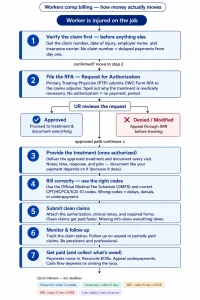
The workers’ compensation billing process has more steps than a standard insurance claim, and each step has its own documentation requirements. Here is how it works in practice:
Billing Codes: ICD-10, CPT & the Official Medical Fee Schedule
The rates for Workers’ compensation billing codes are determined by the Official Medical Fee Schedule (OMFS), which is a national fee schedule for diagnosing and procedure coding, but not contracted rates with a health plan.
This is important because one might think, ” Why does it work in regular medical billing, when it will work in workers’ comp? It does not. The OMFS packages some services differently from commercial insurance. There are certain CPT codes where documentation or modifiers are required to be paid. Some services are just not covered because they are not included in the DWC treatment guidelines.
Medical coding mistakes in workers’ comp tend to cost more than in group health billing, as there is no contract that you can rely on, and the dispute process is formal and takes a long time. The return on investment for hiring coders who understand the California workers’ compensation billing process is quick and simple; they get more clean claims and denials.
Denied Claims — Why They Happen & What to Do?
One of the largest revenue leaks in workers’ comp is denied claims. Workers’ comp denials will sit on the shelf for months if no one is actively working on them, compared to group health denials that typically follow a simple appeals process. Denial often occurs because of the following reasons:
Common Reasons for Workers’ Comp Claim Denials
- Treatment was provided without UR authorization
- Billed services exceed OMFS rates
- Missing or incorrect ICD-10 or CPT codes
- Bill submitted after the 12-month filing deadline
- Lack of documented medical necessity
- Treatment not related to the accepted body part or injury
- Missing documentation required under DWC billing compliance rules
- Claim disputed as not work-related by the insurance carrier
Workers Compensation Claim Denials: SBR, IBR, and How to Recover Your Payment
When a bill is denied or paid at a reduced amount, the provider has specific rights under California law. The first step is usually a Second Bill Review (SBR), a written request to the insurance carrier asking them to reconsider the bill. The SBR must be filed within 90 days of the original Explanation of Review (EOR). This step is not optional; you generally cannot skip to IBR without completing it first.
If the SBR does not resolve the payment dispute, the provider can request Independent Bill Review (IBR) through the DWC. IBR is a binding determination made by a third-party reviewer who decides whether the bill was correctly paid under the OMFS. IBR is a powerful tool, but it has tight deadlines and specific procedural requirements. Miss the window, and you lose the right to contest the payment.
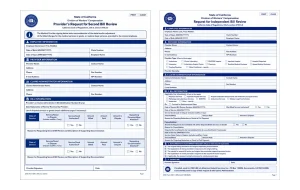
DWC Form SBR-1 (Effective 2/2014)
DWC Form IBR-1 (Effective 01/08/2024)
Second Bill Review (SBR)
There is no single DWC-issued SBR form. You submit a written objection letter directly to the insurance carrier’s bill review unit. To be valid, that letter must include:
- Original bill date of service and claim number
- The Explanation of Review (EOR) you received
- Exact line items you are disputing
- Specific OMFS rate or regulation supporting your position
You have 90 days from the EOR date to file, and the carrier has 14 business days to respond with a revised payment or written explanation.
This is your first move when a carrier underpays or denies your bill. It is a formal written objection sent directly to the insurance carrier asking them to reconsider. You have 90 days from the EOR date to file it, and you must complete this step before you can move to IBR.
How To Fill the DBR Form Step by Step
Employee, Provider, Claims Admin sections
The worker’s full name, date of birth, date of injury, claim number, and employer. Add your practice info and carrier contact details. Keep everything consistent with your original bill submission.
Bill Information Table
One row per disputed line item. For each one, enter the date of service, CPT code, whether it was authorized, amount billed, amount paid, and amount still in dispute. Attach supporting documentation and check Yes in the last column.
Reason field
This is the most important part of the entire form. Do not write “payment insufficient.” Write something specific, cite the exact OMFS rate, the CPT code, and the dollar difference. The more specific you are, the harder it is for the carrier to dismiss it.
Signature
Sign, date, and send directly to the claims administrator, not the DWC. They have 14 business days to respond. No response, or a response that still does not fix the payment? You have 30 days from that point to file IBR
Independent Bill Review (IBR)
If SBR fails, file DWC Form IBR (Request for Independent Bill Review) with Maximus Federal Services, the DWC-designated IBR organization. Required attachments:
- Original bill and EOR from the carrier
- Your SBR objection letter
- Carrier’s SBR response (or proof they missed the deadline)
Key facts to remember:
- Filing fee is $195 — refunded if the decision favors you
- You have 30 days from the SBR response date to file
- Deadline is hard — no extensions, no exceptions
- IBR decisions are binding and cannot be appealed further at the WCAB
This is your second move, filed only after SBR fails to resolve the dispute. You are now asking a neutral DWC-appointed third party (Maximus Federal Services) to decide whether the carrier paid correctly under the OMFS. The filing fee is $195, refunded if the decision goes in your favor.
How To Fill Out the IBR Form Step by Step
Section 1 — Employee Info
Worker’s full name, date of birth, date of injury, claim number, and employer. The claim number is critical; pull it directly from the carrier’s EOR.
Section 2 — Provider Info
Your practice name, address, NPI, and provider type. Check every applicable provider type box it determines which fee schedule applies to your dispute.
Section 3 — Claims Administrator
Insurance carrier’s name, address, and contact details. Copy this directly from the EOR they sent you.
Section 4 — Bill Information
The most important section. Enter the date of service, CPT code in dispute, amount billed, amount paid, and amount still in dispute. In the reason field, cite the exact OMFS rate and CPT code specific language wins. Use the Consolidation section if you have multiple disputed line items on the same claim.
Section 5 — Documents
Attach all five required items: original bill, original EOR, your SBR request, the carrier’s SBR response, and any relevant contract provisions. Missing even one can get your IBR rejected on procedural grounds before anyone looks at the numbers.
Section 6 — Signature
Sign, date, and mail to Maximus Federal Services with the $195 filing fee. Send a copy to the carrier at the same time the form reminds you to do this at the bottom
One thing to remember about both forms
These are legal documents, not complaint letters. Every field you fill in becomes part of the record if the dispute escalates to IBR or the WCAB. Fill them out carefully, keep copies of everything you send, and note the date you mailed or submitted each one. Those dates are your proof that you met every deadline.
How a Workers Compensation Lien Works?
Sometimes, a healthcare provider treats an injured worker before a workers’ comp claim has been accepted or while the claim is being disputed. In those situations, the provider cannot wait for the claim to resolve before getting paid. That is where a workers compensation lien comes in.
A workers comp lien is a legal claim filed against the workers compensation billing case itself. By filing a lien, the provider asserts the right to be reimbursed out of any settlement or award in the case. It does not guarantee payment, it preserves your right to seek payment through the legal process. Without a properly filed lien, a provider has no standing to pursue recovery once the case settles.
How Does a Workers Compensation Lien Work in Practice?
Lien filing in California goes through the Workers’ Compensation Appeals Board (WCAB). Providers submit a lien claim via the DWC lien filing system, with supporting documentation such as the itemized bill, medical records, and proof of services provided. There is a filing fee, which is currently $150 per lien, but some liens, such as those for denied emergency services, may be exempt from the filing fee.
Once a lien is filed,
It is a part of the workers’ comp case. Lien hearings are held before a Workers’ Compensation Judge at the WCAB. A hearing is a formal process in which the provider (school) is responsible for demonstrating that the services billed are valuable or medically necessary. The tracking of lien status, preparing for medical lien hearings, and collecting evidence are ongoing and specialized tasks.
The key dates to watch: liens must generally be filed within three years of the date of service or one year after the date of first denial, whichever is later. Late payments result in the loss of the ability to collect that bill. That’s why lien billing services are here, and the strict deadlines and the process are so tight that most practices would be unable to keep up without the dedicated service.

When the issue is one of broader controversy, such as whether a treatment was medically necessary or whether the injury is compensable at all, they are submitted to the Workers’ Compensation Appeals Board (WCAB). This is where lien hearings occur, where coverage issues are resolved, and where complicated workers’ compensation claims are resolved. Experience and expertise from legal or billing professionals is really a must in this stage; the proceedings are formal enough that they can’t be done without preparation.
“The WCAB is not a customer service department. It is a court. If you are presenting a lien at a WCAB hearing, your documentation needs to be organized, your billing needs to comply with every DWC rule, and your argument needs to be specific about what the OMFS allows.”
Workers Compensation Lien Collections
When it comes to the lien of Workers compensation collections is the end stage of a long process, and it is where providers either recover money they earned months or years ago, or write it off permanently. The contrast typically boils down to whether or not the lien was maintained tactically during the case.
Actively managing all open liens involves attending status conferences at WCAB, answering discovery requests by defense lawyers, refreshing the lien with any new bills and keeping up to date on the underlying case as it nears resolution and is ready to negotiate for a settlement. Many lien claims settle because the lienholder appears, properly documents the claim, and is prepared for the negotiations.
There are substantial payments to be recovered on old liens. There may be significant outstanding balances in open lien claims for practices that have been treating injured workers over the past few years. A worthwhile revenue opportunity that many practices miss out of is the ability to work through that backlog of identifying which liens are still viable, which are expired, and which are ready for hearing.
That’s where commercial lien billing and specialized workers compensation billing services in California really come in handy. These companies are familiar with the WCAB calendar, defense adjusters, and applicants’ lawyers, as well as how to resolve liens efficiently.
Should You Outsource Workers’ Comp Billing?
Outsourcing workers comp billing is appropriate for many practices because, while in-house billing can be done well, workers compensation medical billing has its own specialization that’s difficult to keep up with a general medical billing function.
The rules change. The OMFS updates are made on a different schedule for each service category. New regulations are issued by the DWC. WCAB procedural rules change. Maintaining all of this, along with day-to-day billing, AR follow-up, and lien collections, is no easy task. A billing department whose sole function is to process workers compensation claims management will always devote more of its time to the higher volume payers, being workers’ comp.
When comparing workers’ compensation billing services in California, seek out those companies that specialize in workers’ compensation, and avoid general medical billing companies that offer workers’ comp as an extra add-on. Inquire about their Independent Bill Review (IBR) experience, their lien recovery record, and how they manage claims that are contested before the WCAB and before the WCAB for support. A Billing Partner that does more than just submit claims, they are responsible for the entire revenue cycle management process, from authorization to final payment or lien resolution.
What to Look for in a Workers Comp Billing Partner?
- Deep knowledge of California DWC rules and OMFS rates
- Experience with IBR and SBR processes
- Active lien management and WCAB hearing support
- Transparent reporting on AR aging and lien status
- Dedicated workers comp coders familiar with ICD-10 and CPT coding for occupational injuries
- Proven track record in workers compensation lien collections and payment recovery
Summary Focused: What You Should Take Away from This Guide
Workers’ compensation medical billing rewards discipline. The practices that collect what they are owed are not the ones with the best negotiators; they are the ones that document everything, submit bills on time, follow up on every denial, and never let a lien deadline pass without action. The system is built in a way that favors insurers who pay less by default and wait for providers to either complain formally or give up. Formal complaint, done correctly, wins.
Whether you are managing your own workers comp billing or working with a billing company, the fundamentals do not change: know the OMFS, use accurate ICD-10 codes and CPT codes, get authorization before you treat, submit complete documentation with every bill, and pursue every denial through SBR, IBR, or a workers compensation lien at the WCAB as the situation requires.
The money is there. You earned it by treating injured workers who needed care. A solid understanding of California workers’ compensation billing requirements and a committed approach to revenue recovery is all it takes to collect it.