


Female healthcare provider shaking hands with a patient, illustrating why provider credentialing takes 90+ days and how to reduce delays.

Why Provider Credentialing Takes 90+ Days and How to Shorten It

How long does it take to get a provider credentialed with insurance? About 90 to 120 days, with a range of about 60 to 180 days, is the general consensus among practice managers. It’s often cited that Medicare, via PECOS, takes about 60 to 90 days; Medicaid, between 30 to 180+ days (depending on the state); and major commercial payers, about 90 to 150 days. Keep in mind, during this entire process, the provider is unable to bill the payer in network. This is the main reason many practice groups turn to provider credentialing services, as this process is typically


Read More »
Dermatologist examining skin with a dermatoscope beside a headline on dermatology billing mistakes

Where Dermatology Practices Lose Revenue: 9 Billing Mistakes and How to Fix Them

Dermatology has the highest modifier 25 rate of any specialty, at 61.5%, according to a November 2025 OIG audit. Most of these errors came from poor notes, wrong visit levels, and misuse of modifier 25.  This shows that clinics don’t lose money because of a lack of patients. They lose it because of a few dermatology billing errors that keep repeating. In one visit, a doctor may do an exam, a biopsy, and a lesion removal. If the notes are weak or the modifier is wrong, many claims can get denied. CMS has a helpful guide on how dermatologists can

Read More »

Best Medical Billing Companies in USA 2026

With the introduction of Artificial Intelligence (AI) in the healthcare industry, healthcare providers have experienced a great shift towards process and service automation. While this technology has made life easier, on the flip side, healthcare regulators have tightened compliance requirements. As a result, doctors are facing a growing burden of administrative tasks in addition to patient care. To ease this burden, many healthcare providers are seeking information onall that they want to realize about the best medical billing companies in the USA. All that you want to realize about the best medical billing companies in USA However, providers are way

Read More »
GERD ICD-10 code K21.9 coding guide and documentation tips for accurate medical billing and diagnosis coding

GERD ICD-10 Code K21.9: Coding Guide & Documentation Tips

K21.9 is the ICD-10-CM code for gastroesophageal reflux disease (GERD) without esophagitis. It is a complete, billable code. Use K21.00 or K21.01 only when the provider documents esophagitis. Many denials happen when the note and the code don’t match. A 2015 national survey of 71,812 U.S. adults, published in Gastroenterology in 2020, found that about 31% reported GERD symptoms in the past week and 44% had experienced them at some point. Small documentation habits, repeated thousands of times a day, cause rework and lost revenue. This guide explains what K21.9 means, when to use it, and how to document it,

Read More »
PTSD ICD-10

PTSD ICD-10 Codes: Which One Should You Bill?

The short answer for billers is that F43.1 can’t be billed on its own. Depending on the length of symptoms and the documentation made by the provider, you select F43.10, F43.11, or F43.12. The rest of this guide explains how to select when each code is safe, and the expectations of payers. According to the National Institute of Mental Health, about 3.6% of U.S. adults have PTSD in a given year, and 6.8% will meet the criteria at some point in their lives. Women are affected far more often than men in a single year (5.2% versus 1.8%). All those

Read More »

Stress Test Cpt Codes Exercise Echo Nuclear

Stress Test CPT Codes: Avoid Denials in Exercise, Echo & Nuclear A stress test seems easy from the patient’s perspective. They walk on the treadmill; some pictures are taken, and then they go home. For the billing team, it’s anything but easy. There is a risk that a single code, incorrect modifier, or a poorly specified diagnosis can result in claim denial. The stress echo CPT code you pick decides whether your practice gets paid for the resting images, the stress portion, or both. Pick the wrong one and the payer may cut the claim in half or send it

Read More »
Virtual medical assistant wearing a headset at her desk, managing appointments, patient records, calls, and billing for a healthcare practice

What Is a Healthcare Virtual Assistant? Roles, Benefits, Cost

A healthcare virtual assistant works remotely through your phone system, EHR, scheduling software, and secure messaging tools; basically, they take over all of your repetitive admin work, like prior authorizations, reminders, and claim follow-up for your practice. Here, as an example, picture your busiest hour at the front desk. The phone is ringing, a patient is waiting with an insurance card, and a prior authorization is sitting in the queue. A healthcare virtual assistant is the person you hand that queue to. Therefore, It’s not a small queue.  In the AMA’s 2022 survey of 1,001 physicians, practices completed an average

Read More »
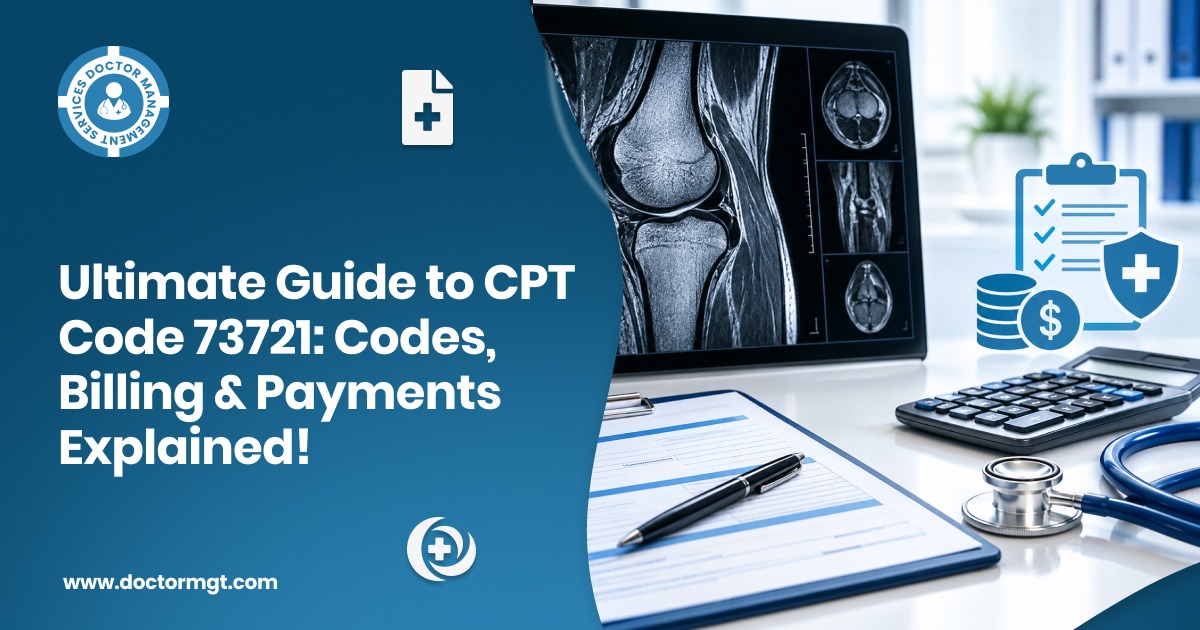
Ultimate Guide to CPT Code 73721

Ultimate Guide to CPT Code 73721: Codes, Billing & Payments Explained!

The data that’s tracked by the OECD (Organization for Economic Co-operation and Development) and reported by Statista shows that nearly 40 million MRI scans are performed in the United States every year. Many of them are joint scans, and that is exactly where CPT 73721 comes in. Every one of those lower-joint scans needs the right code on the claim. If the code is wrong, the payment is late or never comes. This guide is for medical billers and coders, and practice managers who want this code right the very first time.  In this blog, we cover what it means,

Read More »
Workers’ Compensation Lien Resolution From Unpaid Claims to Final Settlement

Workers’ Compensation Lien Resolution: From Unpaid Claims to Final Settlement

A WCIRB survey of California workers’ comp claims found liens were filed on 44% of claims reviewed in Northern California and 64% in Southern California, with roughly 20% of claims accumulating five or more separate liens. The fact that a workers’ compensation claim isn’t paid doesn’t mean it simply disappears from a practice’s books. It remains there, festers, and takes revenue that a provider has already generated through treating an injured worker. This is where workers’ compensation lien resolution comes into play for many medical practices. Understanding how this process works, and where it commonly breaks down, can make the

Read More »
CPT Code 93458 Explained

CPT Code 93458 Explained: How to Bill Correctly & Maximize Payments

Cardiac catheterization billing is one of the least forgiving corners of medical coding. CPT code 93458 does not do a better job of explaining this scenario. Few codes do a better job of explaining this scenario than 93458. It’s a high-value, high-scrutiny code that’s being billed and coded on a regular basis in cardiology practices, but is also a code that payers are looking for regularly when documentation doesn’t align with the claim line. Knowing exactly what this code entails, and how to support it on paper, is the difference between getting paid in a timely fashion and spending months

Read More »
5 Signs Your Neurology Practice Needs a Better Billing Partner

5 Signs Your Neurology Practice Needs a Better Billing Partner

Neurology is one of the most cognitively demanding specialties in medicine, and unfortunately, one of the most punishing when it comes to reimbursement. Industry billing data consistently puts neurology among the specialties with the steepest denial rates in the country, with some reports placing initial denial rates anywhere from 10% up to 25%, well above the sub-5% rate most healthy practices aim for.  Between EMG/NCS studies, complex E/M visits for chronic conditions like epilepsy and multiple sclerosis, prior authorizations for high-cost infusions, and constantly shifting payer policies, neurology medical billing carries a level of complexity that most general billing teams

Read More »
Understanding Mental Health CPT Codes and Billing Requirements

Understanding Mental Health CPT Codes and Billing Requirements

Behavioral health practices lose more revenue to coding errors than almost any other specialty. One incorrect digit on a claim, or a discrepancy between the length of time and the code billed, is often the key to making a payment or to having a claim denied, which takes up staff time for weeks. For those operating a therapy practice or overseeing the billing for a therapy practice, knowledge of mental health CPT codes is no longer a luxury; it’s a necessity for timely and accurate reimbursements. This guide explains what these codes mean, how to correctly use these codes, and

Read More »
Ultimate CPT 70553 Guide Coding, Billing & Reimbursement Explained

Ultimate CPT 70553 Guide: Coding, Billing & Reimbursement Explained

Radiology medical billing involves hundreds of procedure codes, but few generate as much confusion as CPT 70553. Whether you’re managing a radiology practice, handling personal injury billing services, or navigating workers’ compensation imaging claims, this guide breaks down exactly what you need to know about CPT code 70553, how to bill it correctly, and what reimbursement rates you should expect. Understanding CPT 70553: The Core Code CPT 70553 is the code for an MRI (magnetic resonance imaging) of the brain without contrast. Specifically, according to the CPT 70553 description, this is a volumetric, 3-D brain MRI that is conducted without

Read More »
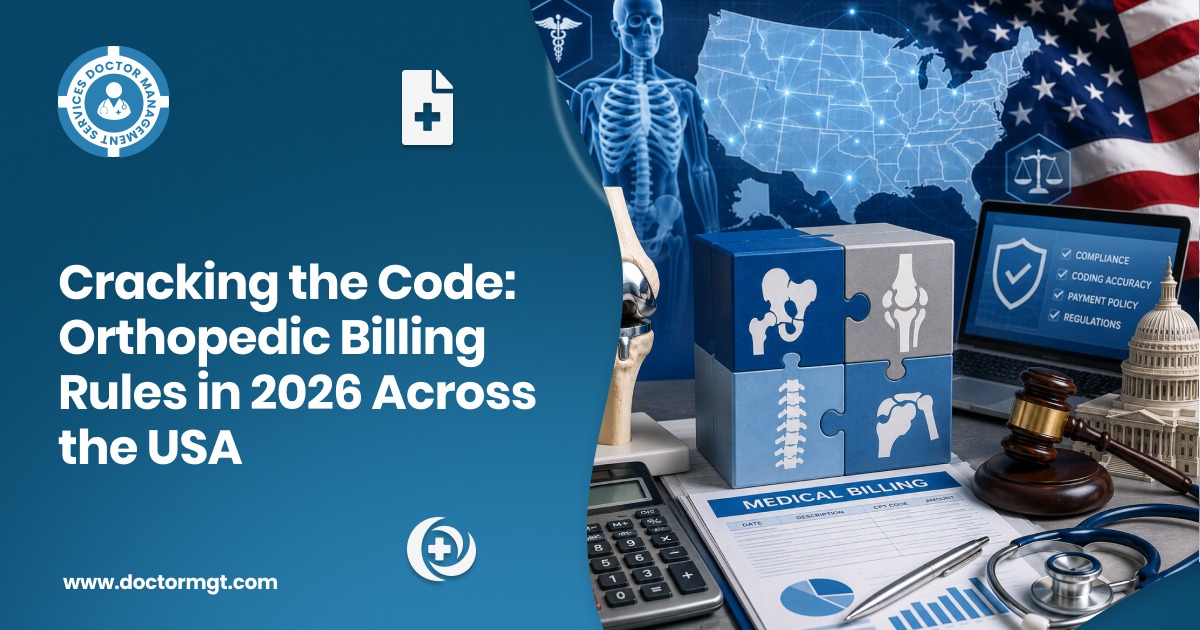
Orthopedic Billing Rules in 2026 Across the USA

Cracking the Code: Orthopedic Billing Rules in 2026 Across the USA

Orthopedics is one of the busiest corners of American medicine, and the numbers back that up. More than 18 million orthopedic procedures are performed across the country every year, and that volume is climbing fast as the population ages. Primary hip replacements are estimated to increase by 71%, and primary knee replacements are projected to increase by 85% from previous estimates by 2030, primarily as a result of the aging population, with a population greater than 65 years of age projected to more than double by 2060. Meanwhile, the number of orthopedic surgeons is declining instead of increasing. There are

Read More »
POS 02 vs 10 for Telehealth Claims How to Bill It Right and Avoid Denials

POS 02 vs 10 for Telehealth Claims: How to Bill It Right and Avoid Denials

Telehealth billing looks simple until a claim bounces back for the wrong place of service code, and that one detail is often the difference between getting paid and getting denied. For virtual visits, both POS 02 and POS 10 are used, and they mean two different things about the patient’s location at the time of the visit. Even if a clinical note is clean, getting that detail wrong and pairing it up with the wrong modifier will not make the claim. The guide to Place of Service (POS) breaks down POS 02 vs. 10 in plain terms, explains where modifier

Read More »
Clearing Up the Confusion Around New Established Patient CPT Codes

Clearing Up the Confusion Around New Established Patient CPT Codes

If you’ve ever typed “CPT 99205” into Google at 11 PM trying to figure out why a claim got denied, you’re not alone. Billing teams, coders, and even experienced physicians often confuse codes that they’ve used for established patients with new-patient codes – and, quite honestly, it’s not their fault. The E&M code set is compact, the documentation overhaul in 2021 introduced modifications, and payer interpretation does not always exactly align with CMS guidance. Many people got confused on this point because when they do a search for “established patient,” other codes such as 99203, 99204, and 99205 are also

Read More »
Why Providers Struggle to Keep Up with Mental Health Medical Billing Rules

Why Providers Struggle to Keep Up with Mental Health Medical Billing Rules: Let’s Solve It Together! 

A therapist submits a claim for a standard 45-minute session, uses the code she’s billed a hundred times before, and it still bounces back three weeks later. The reason? A payer quietly updated its documentation requirements, and nobody told her. If that scenario feels familiar, you’re far from alone. Across the country, behavioral health providers are losing revenue not because their clinical work is lacking, but because mental health medical billing rules keep shifting under their feet faster than most practices can track.  This isn’t a fringe complaint. It’s one of the most common complaints that psychiatrists, psychologists, licensed counselors, and group practice owners make who never were

Read More »
Dermatology Billing & Coding Decoded A Practical Guide for Medical Billers

Dermatology Billing & Coding Decoded: A Practical Guide for Medical Billers

A dermatology medical billing practice in Ohio submitted 40 claims for shave biopsies in a single month. Eleven came back denied. Not because the diagnosis was wrong, not because the treatment wasn’t medically necessary, but because the coder billed the biopsy and the destruction procedure performed on the same lesion without the right modifier, and the payer read it as duplicate billing. Eleven claims in accounts receivable, eleven calls to the payer, and a practice manager asking, “Why am I not making more money with all these claims on the books? This is the actual reality of medical billing dermatology

Read More »
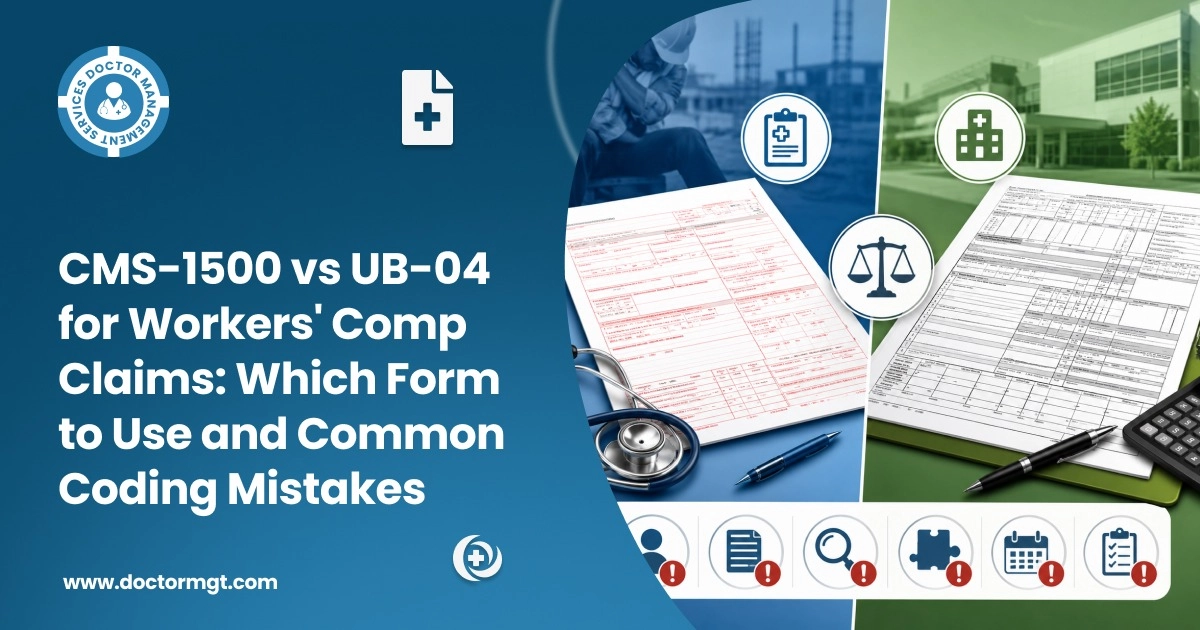
CMS 1500 vs UB 04 for Workers Comp Claims

CMS-1500 vs UB-04 for Workers’ Comp Claims: Which Form to Use and Common Coding Mistakes

A workers’ comp claim doesn’t get denied because the treatment was wrong. Most of the time, it is refused because someone in billing completed a form incorrectly or used the wrong form. That one decision, CMS-1500 or UB-04, sits at the very front of the claims process, and if it’s wrong, all the downstream parts of the process come to a halt: authorization is questioned, the claim is returned to the adjuster, and then the provider waits another 30-45 days for the payment that should have arrived on their first claim. This is not something that occurs in regular commercial

Read More »
How Workers' Comp Billing Errors Delay Employee Benefit Claims

How Workers’ Comp Billing Errors Delay Employee Benefit Claims

When an employee gets hurt on the job, the last thing they should have to worry about is whether their paperwork is right. But that’s exactly every day in clinics, hospitals, specialty practices, and with injured workers. A missing code, a date of injury that does not match, an incomplete authorization number- any of these little mistakes can delay a claim for weeks if not months, and an injured employee is waiting for benefits he or she already deserves. Most people outside the revenue cycle world assume workers’ comp claims move like regular insurance claims. They don’t. Workers’ compensation operates

Read More »

Get Customized Billing Quote