



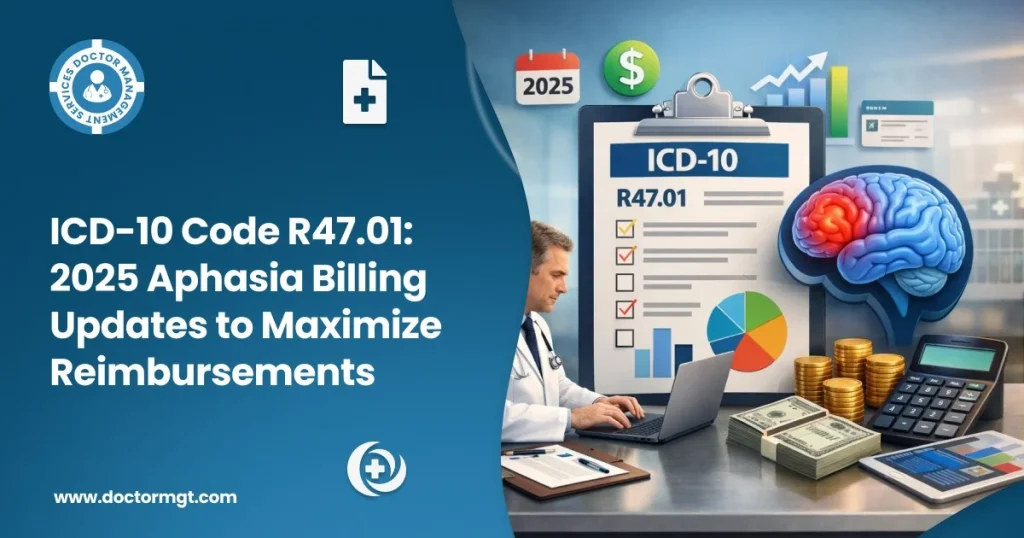
Speech problems are not always easy to document, and that is exactly where billing errors begin. Where a provider bills a speech difficulty rather than the appropriate aphasia ICD 10, it may silently decrease reimbursement, or even cause denials. As a matter of fact, payers have been keen in 2025 on the coding of speech and language disorders, particularly where therapy services are concerned. That makes understanding the ICD-10 code for aphasia (R47.01) more important than ever.
Aphasia is not just any communication issue. It usually comes post-stroke, brain trauma, or a neurodegenerative condition. Due to this, its proper coding is not merely about coding it as R47.01, but also connecting it with the condition underlying it and recording the type of impairment.
This guide will teach you everything about the 2025 changes that affect aphasia coding. You’ll learn proper documentation requirements and ways to keep your practice aligned with the latest ICD-10 standards.
Understanding Aphasia ICD 10 and Why R47.01 Matters
The appropriate icd 10 code of aphasia is R47.01, and it is a disorder of language that involves the inability to speak, understand, read, or write. However, in real billing scenarios, using only this code is rarely enough.
There is now an expectation by payers that there should be a distinct line between aphasia and other speech disorders. As an example, dysarthria is a motor speech problem, not a language processing problem, and is coded r47.1.
One of the most frequent errors when billing speech therapy is mixing these two codes. Another area where providers struggle is with word finding difficulty, icd 10. Most clinicians write about word-finding problems, and coders need to establish whether it should be classified as aphasia or should be put under a broader category, such as R47.89 (other speech disturbances).
This is the point that is under more and more scrutiny in 2025, through audits. Payers can downgrade the diagnosis in case documentation fails to substantiate aphasia.
A simple first step is therefore to improve reimbursement by aligning clinical language with the appropriate diagnosis code and not using descriptions that are not precise.
2025 Changes in Aphasia ICD Documentation
By 2025, the requirements of documentation were changed to focus more on specific clinical information than general descriptions. Staying updated with the latest coding changes is quite important, as 2025 brings stricter documentation rules and closer payer scrutiny for aphasia-related claims.
1. R47.01 is officially active under the 2025 update (effective Oct 1, 2024), and continues unchanged, but usage rules are stricter, with better documentation required
2. It is now necessary to make a definite differentiation between symptom-based aphasia (R47.01) and condition-based codes such as post-stroke aphasia (I69.320) – payers are identifying claims that lack this connection.
3. Documentation needs to be done more in support of medical necessity, particularly for medical speech therapy services, since payers are becoming tighter and scrutinizing clinical notes more.
4. Therapy thresholds updated: For 2025–2026, Medicare requires a KX modifier once therapy costs exceed set limits ($2,410 in 2025, increased further in 2026), meaning documentation must justify continuing aphasia treatment
5. Increased attention to accuracy and specificity in ICD-10 coding, and guidelines focusing on the highest level of detail when selecting speech-related diagnoses.
6. Expansion of related speech and neurological codes in upcoming updates (2026 ICD-10 includes hundreds of new/revised codes), increasing pressure to choose the most precise diagnosis instead of defaulting to R47.01
7. New caregiver training billing regulations (2025) mandate recording the patient consent and medical necessity, which should be consistent with the aphasia diagnosis and treatment plans.
8. Telehealth records are more closely evaluated, particularly in speech therapy, providers have to demonstrate that aphasia affects communication and justifies remote care.
9. The new and revised therapy-related codes (2025-2026) under procedure-level coding will require the diagnosis documentation (such as aphasia ICD 10) to match services billed more closely.
In general, the expansion of the ICD-10 system has not ended yet, and there are constant changes to the coding rules and the code sets, which indicate the transition to more detailed, condition-specific records instead of general symptom records.
The Role of Supporting Codes in Maximizing Payment
Using only the aphasia ICD is not enough to support higher reimbursement. The conditions that are in support are significant in claim approval. For example, when aphasia is attributed to a neurological or chronic condition, it reinforces the argument. Proper use of other related codes, such as r47.1 (when necessary), or cognitive and communication deficits, can be used to describe the complete clinical picture.
However, abuse may lead to issues. As an example, the incorrect documentation of both aphasia and dysarthria can cause a review.
The other growing trend in 2025 is the application of symptom-based coding on top of confirmed diagnoses. This provides payers with a better idea of the condition of the patient when it is properly used. When overused, it leads to denials. The difference comes down to documentation clarity.
Why Speech Therapy Claims Get Denied?
Aphasia-related billing is rarely denied on the basis of the therapy itself. They are normally the result of small gaps in documentation. A missing link between diagnosis and treatment, unclear progress notes, or incorrect code pairing can all reduce payment.
A common example is the use of word finding difficulty icd 10 languages in notes, but the billing of R47.01 without any explanation of the severity. A second one is the inability to relate aphasia to its cause.
Payers in 2025 are also reviewing therapy duration more closely. Without progress being well recorded, they might question why they are still being treated. This is why the improvement that can be measures or a justifiable need for further care should be indicating in every session note.
Coding Accuracy: Where Revenue Really Changes
Here, this becomes more strategic. Once the basics are establishes, the next step to enhancing reimbursement is the effectiveness of the coding in helping. To tie the entire patient narrative together.
For example, patients with sleep-related conditions like g47.33 (obstructive sleep apnea) may also show cognitive or communication challenges. This provides an added dimension to the claim when well documented and may aid in extended care. Outsourcing is also more prevalent, particularly of specialized mental health billing services that are knowledgeable on neurological and speech-related coding. These services assist in minimizing errors in complicated situations where there are multiple conditions overlapping.
In places such as the United States, medical billing services California teams are becoming very popular among providers as a way of offloading their claims that are too heavy with compliance. Such teams remain informed of the payer-specific regulations, which play a crucial role in speech therapy and aphasia billing in 2025.
Linking Aphasia to Real Clinical Scenarios
Aphasia is rare on its own. It is usually includes in a more significant health issue. This implies that R47.01 should not be using alone unless it is necessary.
As an example, when a patient has a stroke and acquires aphasia, the stroke code must be typed first, following by aphasia icd 10. This sequencing tells the payer that aphasia is a result of a serious medical condition, not a standalone issue. In the same manner, documentation contains words such as difficulty forming words. Coders will have to choose whether it qualifies as word finding difficulty, ICD-10, or as true aphasia.
This ruling has a direct impact on reimbursement since aphasia generally warrants more intense treatment.
Practical Impact of 2025 Updates
What has really changed in 2025 is not the code itself, but how strictly it is evaluating. Payers are smarter systems that are uses to identify inconsistencies in diagnosis, treatment, and outcomes.
When a provider codes the ICD-10 code as aphasia. But the therapy record indicates mild speech problems, it can be flagged. Conversely, notes with a detailed explanation of barriers to communication, patient struggles, and therapy progress can result in easier approvals. The other fundamental change is the change in audit patterns. Claims that use R47.01 repeatedly and do not vary. Or are not accompanied by other codes are more prone to review. This implies that providers should demonstrate specifics of the patient instead of applying the same documentation to all cases.
Final Thoughts
Aphasia billing in 2025 is no longer about just selecting the right code. It involves narrating a transparent, medically justified narrative using documentation and coding.
R47.01 is the central aphasia ICD, though the effectiveness is determining by the extent of its support. By clinical information, related conditions, and therapy notes.
By making clear the difference between aphasia, R47.1, and general speech problems. Such as word finding difficulty, icd 10 lies, the providers. Would generate easier claims that the payers could process without reservations. Ultimately, maximizing reimbursement does not involve adding additional codes. It is all about having the right ones with the right amount of detail.
In the end, maximizing reimbursement is not about adding more codes. It is about using the right ones with the right level of detail.